Prescriptivism
Spain is still multilingual
 Play video
This video talks about the linguistic diversity in Spain and how the Spanish state maintains it, contrasting with other states which suppress minority languages. The video describes how Spain's state acts against standard language ideology by mandating that regional languages also be taught in their schools, such that students are raised bilingual, and the minority languages become preserved systemically. The video also touches on the concept of standard language ideology and how it isn't as innate to state power as is sometimes thought.
Indian English isn't always a foreign accent
 Play video
This video describes how despite Indian-accented English is often understood by people in the Global North as an imperfect acquisition of English, it is essentially as much a legitimate variant of English as Australian English is to British English, and goes into the history of how English came into India and what phonetic rules apply.
When Good Grammar Gets Snobbish
Short opinion piece addressing the tendency for prescriptivism to override legibility. In this case, the host of This American Life had violated the dangling modifier rule by saying: "As a middle schooler, there was always one channel I wanted to watch --- TCM." The "correct" phrasing would be, "As a middle schooler, I always wanted to watch one channel." As columnist John McWhorter puts it: "We don't need to be training people to look down upon perfectly comprehensible speech." McWhorter argues that with the encroachment of improving AI technology, "we need to sweep away linguistic cobwebs, like grammar rules that serve no purpose. It requires people to know a password to gain entrance into respectability, one of the last permissible outlets for classism." [Published on 04-16-2026]
Chai Tea: FIGHT ME ABOUT IT
 Play video
In this video Hank Green discusses (and defends the use of) terms like 'chai tea' and 'La Brea Tar Pits' where meaning is repeated within the term.
Belizean National Kriol Council Website
The National Kriol Council of Belize promotes the usage of Belizean Kriol, an the English-based Creole language of Belize; they hope to standardize a grammar and and phonemic latin-script orthography for the language and promote its education, use, and legitimacy.
Protactile Linguistics: Discussing recent research findings
 Play video
Discussion of recent linguistic research on Protactile, a touch-based language used by deafblind people, by researchers Jelica Nuccio and John Lee Clark. The most sociolinguistically relevant section begins at 31:28.
ER, Don't Keep Tagging Along
 Play video
Video from Singapore's Speak Good English Campaign telling Singaporeans that they are overusing "er" at the ends of words.
Council for German Orthography Enshrines "Idiot's Apostrophe", Move Decried as Another "Normalization of Anglicisms"
This article details some of the immediate reactions to the Council for German Orthography announcing that using an apostrophe to indicate possession will now be considered 'correct' German grammar. Some German grammar purists consider the move to be a result of excessive encroachment of English conventions into the German language, but others point out that this may not actually be the case. [Published on 10-08-2024]
Americans Weigh In on Their Favorite Global Accents
Results of a survey of 1,000 Americans on their opinions about different accents (of English). Participants rated accents on scales such as attractive, beautiful, annoying, boring, and funny, among many others. Participants also rated celebrities on the enjoyability and intelligibility of their accents. [Published on 08-08-2023]
Journalist claims that using singular "they" is not "correct grammar"
A person being interviewed by a news anchor introduces themself with they/them pronouns. Journalist responds that "you don't get to require me to use incorrect grammar."
How is "Appalachian" pronounced?
Youtubers disagree on the pronunciation of the word "Appalachian" and refer to the authority of first their mothers and then the internet in order to determine the "correct" pronunciation. Example of language ideology at work. [Published on 04-02-2024]
Conlang Critic: Lingwa de Planeta
 Play video
A video talking about how languages ought to be constructed, using a specific example of a constructed language as an example.
It Is Will Reopen
Photo of paper posted around Reed Campus saying "It Is Will Reopen," mocking the recent SOLAR outage and the text displayed on the error page. Expressive of general unhappiness with Reed admin recently. A bit prescriptivist. Michel de Certeau says that skyscrapers are the letters of a language/rhetoric -- graffiti is a reappropriation.
Another example: https://www.instagram.com/p/C51qsw1SlYWZgpLj1SP56kpT61fF3ZmvaQel3s0/
Arnold Schwarzenegger State Farm Commercial
 Play video
Really absurd commercial with sociolinguistic implications. Arnold Schwarzenegger’s r’s are really non-rhotic and everyone tries to correct him.
fredoontv and french prescriptivism
fredoontv's response to an french person's prescriptivism.
Prescriptivism in the Wild
In another Kent Rollins video about whether beans belong on chili, some commenters get into it over subject-verb agreement and differing dialects! [Published on 11-15-2023]
we're ✨english majors✨
we're ✨english majors✨ #fyp #foryou #trending [Published on 02-13-2024]
Trixie and Katya on 'Crispy R's
 Play video
Drag queens Trixie and Katya discuss a pronunciation of the /ɹ/ phoneme that they have a pretty strongly negative reaction to! From their production of it, it sounds like a plainly alveolar [ɹ], which they seem to be contrasting against the 'normal' retroflex labialized one [ɻʷ]. It's interesting that a small articulatory difference causes such a reaction, and how strong the negative emotion around it is!
Anglish Home
This wiki contains a brief overview of the Anglish movement. Some of the major works, like the YouTube video by Rob Words, and also the history of the movement all the way back to Paul Jennings coining the term "Anglish". In addition to the history, there are also links to major Anglish related resources, such as a wordbook (dictionary), the Anglish subreddit, and chat groups. [Published on 05-18-2023]
Kids These Days Are Ruining Language With Their Superlatives!! SMH
This lithub article discusses the "Maxim of Extravaganza", arguing that speakers (implicitly, young speakers, digital natives, internet users, and speakers without formal/literary/standardized education) are "draining language of its power" by applying superlatives to an "inappropriate breadth" of situations. Particularly interesting is the comment section, where (generally older) commenters name explicitly some of the assumptions and prejudices left explicit in the article. The article itself also makes two interesting claims: that overuse of superlatives is a sign of the deterioration of critical thought, and that it disagrees with academics and researchers' claims that there is not more communication going on now than in the past, it's just more visible. I wonder what her credentials are... . This seems to me like a textbook "Kids these days..." claims, although we might also think critically/productively about the effects of capitalism, social media, and the prolific influences of advertising & algorithm on our communication. [Published on 09-27-2022]
Queen's English Society
The Queen's English Society, referenced in Harrington's study of Queen Victoria's language change over time, still exists. They are self-described prescriptivists who want to protect the "clarity and elegance" of the English language. [Published on 02-24-2022]
Life of Brian - Latin Lesson - Romans Go Home!
 Play video
1979's "Life of Brian" comedically depicts the titular main character, played by Graham Chapman, defacing, in Latin, a Roman monument. A Roman centurion, played by John Cleese, stops him and punishes him for his "bad" grammar. The scene is largely a parody of the relationship between English schoolchildren and their teachers. Linguistically, it's interesting as a demonstration of prescriptive norms as well as the representation of different dialects. Cleese's dialect is meant to sound more elevated while Graham Chapman's, who is from Melton Mowbray, north of London, is meant to sound less elevated, which is supposed to add to the comedy. Funnily enough, I think some of Brian's usages correlate with changes that would end up occurring in Latin before it changed into the various Romance languages.
Hearing Your Own Accent
A video of someone doing a "Baltimore Accent Test," and saying the phrase "Aaron earned an iron urn." After saying it out loud they seem amazed and say, "We really talk like that?" Their friends also say the phrase, while someone in the background comments on its unintelligibility. It speaks to how difficult it is for us to hear our own accents. [Published on 12-04-2019]
An Appeal to Everyone: Please Stop Pronouncing “Pokémon” Wrong
A HowToGeek contributor's plea: Neither Japanese nor Americans "pronounce it po-KEE-mon. The true pronunciation is po-KAY-mon, or po-KAH-mon, both propagated by the cartoon, which is available on Netflix just in case you need a refresher."
Dictionary of American Regional English: Linguistic Profiling
Article about the use of what the author calls linguistic profiling, although it is not quite the same as John Baugh's use of the term, to narrow down suspects for a crime. I had some concerns about the ideas, partly because it seemed like it was over-generalizing or treating certain groups as the default (for instance, it stuck out to me that at one point it was automatically assumed that the writer of a note must have been male because there were no features specifically treated as female, like hedging, but there were also other instances of this), and partly because a lot of the ideas they're relying on go against what we've talked about with the issues in directly linking a linguistic feature to a specific group. I also have some concerns about the ethics of trying to do this at all, given the prevalence of linguistic discrimination, and how unequivocally positively the article talks about it. [Published on 12-31-1969]
The War on Grammar
Found on r/badlinguistics. An "explanation" for why the singular use of 'they' is wrong. Includes the line, "Ideally we’d still use “thou” as the familiar for an individual." [Published on 10-08-2016]
The Anglish Moot
This fandom page is dedicated to the Anglish movement, a form of English linguistic purism. Followers of this movement speak English only using Germanic-based words, purposefully omitting words with Latin or Greek roots. They do this either because they think it's fun and historically interesting, because they think that's how the language was "meant" to be, or because they think it simplifies the language, therefore making it easier to speak. This is a really informative site, but can be kind of difficult to navigate due to the Anglish terms.
For a more concise but thorough explanation, I will also link the following YouTube video. Here he explains more of the linguistic aspects rather than the movement itself: https://www.youtube.com/watch?v=IIo-17SIkws
Additionally, here is a Reddit page devoted to Anglish and opinions about it (but not written in Anglish, so easier to read): https://www.reddit.com/r/anglish/
I found this fascinating because this is an idea that has allegedly been about since the 1100s. [Published on 03-10-2019]
Melissa Lozada-Oliva - "Like Totally Whatever" (NPS 2015)
 Play video
A response to the video where the white man had a stick in his butt about how younger people speak.
Taylor Mali Totally like whatever, you know
 Play video
An older white man thinks he is the only one that sounds like he knows what he's talking about but misses the irony in that he's talking about how younger people speak . . .
Grammar gripes: why do we love to complain about language?
This article discusses the nature of prescriptivism and how modern technologies are contributing to language change [Published on 03-11-2018]
One Part Plant Lifestyle Podcast interview
In the introduction to the second episode of podcast, the host mentions that her dad listened to her pilot episode and criticized her usage of way too many prepositions at the end of sentences. She apologizes and acknowledges that she uses too many prepositions and that "it's bad." [Published on 07-16-2014]
Philosophize This! episode 115
 Play video
this is a podcast about the origins of Structuralist philosophy, it takes a look at the contribution Ferdinand de Saussure made to philosophical thought through his work in linguistics and semiology.
Nigerian Pidgin Speakers Struggle to Translate a Phrase Into "Proper English"
 Play video
This video shows speakers of Nigerian Pidgin English struggling to translate the phrase “This Ogbono soup too draw” into “proper English.” The video itself is a good example of how pidgin languages can have a majority of lexical features from one language, but cannot be directly translated due to the uniqueness of the created pidgin. The use of the phrase “proper English” in the title also shows the prescriptive ideology of language that the creator of the video possesses by labeling one way of speaking English as the “proper” way.
Grammer Nazi
 Play video
CW// Violence, blood. A satirical scene from the show That Mitchell and Webb Look—season 4, episode 1—depicting those who force their language ideology with regard to "correct English grammar" on others in an oppressive way. It comments on hegemony and the difficulty of conforming to the myriad of proposed rules by some, as well as the impossibility to conform perfectly even for those imposing such rules, since English borrows words from languages with different grammatical structures. Furthermore, it is entitled, "Grammer Nazi," indexing a notion of domination and violent imposition of rules by those who hold such views of "correct English."
A letter saying they won
Linguist Geoff Pullum ignites a new firestorm with a blog post about singular they to refer to a non-binary person. [Published on 12-04-2017]
Key & Peele- Substitute Teacher
 Play video
This video shows how language is often construed as wrong to many different kinds of people because there are so many different variations in the English language.
Asterisk*
Play audioAsterisk* is a spoken word poem written and performed by Oliver Renee Schminkey. This piece first appeared as the closing act of The Naked I: Insides Out produced by 20% Theater Company in Minneapolis, MN. The artist, who identifies as gender queer, eloquently and powerfully describes what it is like to live in a world that neither affirms nor denies their gender identity. It exemplifies how prescriptive language that is set in ideology can be limiting and discriminatory.
Romani ite domum - Monty Python's Life of Brian
 Play video
https://www.youtube.com/watch?v=2lru4dJ4J6g In an act of rebellion against the Roman occupation of Judea, Brian writes in Latin "Romans go home". He is caught by a Roman soldier played by John Cleese who, instead of punishing Brian for vandalism, corrects Brian's grammar and forces him to conjugate his "grafitti"
Howard Stern on vocal fry
 Play video
This video is a voice recording of Howard Stern discussing vocal fry used by a contestant on the show the Bachelor. Stern discusses the use of vocal fry and refers to it as "an epidemic" that women are using where they begin to switch back in forth between a croaking voice and their "feminine voice"
Troy and Abed Being Normal Scene from Community
 Play video
In this scene Troy and Abed, who typically behave far from socially acceptable, try to be "normal" so they do not embarrass their friend Shirley at her wedding. They each change their voice to diminish any distinctive characteristics and accents as well choosing words and using grammar that supports what might be considered a "standard" form of English. They do their best not to be sarcastic and to talk to others in a way that follows social norms.
Fry & Laurie comedy sketch
 Play video
Stephen Fry & Hugh Laurie perform a comedy sketch satirizing attitudes about language change.
Linguist Says You Can Use ‘Like’ More. He’s, Like, Wrong.
This article demonstrates the, potentially discriminatory, language ideology contending that the word "like" is overused in society today. [Published on 11-01-2013]
Chelsea's grammar on not to use the word irregardless.
 Play video
In the video, Chelsea explains how using the word "irregardless" and double negatives is improper. As speaker's of English, most would understand what someone means when they say this word. She is viewing the use of "irregardless" through the monoglot ideology by applying the hegemony of the "standard" English.
People obsessed with grammar aren't as nice as everybody else, study says
A report on a study that relates personality to prescriptivism, finding among other things that more "agreeable" readers are less harsh towards grammatical and typographical errors. [Published on 04-22-2016]
Professional Educator: Grades, Showing Up On Time Are A Form Of White Supremacy
This education consultant takes issue with values that are taught in schools as beneficial for success but which she says are selected to favor white people, including language-related expectations of students. She suggests some unusual methods to "move away from all these aspects of white privilege in education." [Published on 04-16-2016]
Tense Present: Democracy, English and the Wars Over Usage
David Foster Wallace reviews 'A Dictionary of Modern American Usage'. In so doing, Wallace explores how language rules are developed and on what authority they are created. Near the end he tells a story about trying to convince students to write in what he calls SWE "Standard Written English" or "Standard White English". [Published on 04-01-2001]
English or Ebonics
 Play video
This is a video that show the code-switching involved between "Standard English" and African American Language.
Should dictionaries do more to confront sexism?
A New Yorker article about the recent criticism of the Oxford English Dictionary for sexist examples entires for words like "rabid" and "bossy," touching on issues of prescriptivism and descriptivism. [Published on 02-24-2016]
Washington Post accepts singular they
The Washington Post's style guide now accepts singular they. [Published on 12-10-2015]
"Like Totally Whatever"
A poem detailing the ideologies related to some features of young women's language, and the effect this sort of policing can have on young women.
99% Invisible Autoreply
The main reason I'm sharing this article is the auto-reply from the podcast 99% Invisible, near the top: it's set up for when people send in complaints about women's voices. I especially love that it mentions that they never get complaints about men's voices on the show. Also that they'll "consider the complaints within, well, never". So good.
Toward the end of the obnoxiously prescriptivist académie française?
The current French minister of culture and the French language holds a very progressist discourse about fluidity of language, its constant change and the ever growing richness of it. [Published on 03-12-2015]
xkcd: Quotative Like
The webcomic xkcd offers a humorous take on language change and the use of "like" as a quotative complementizer.
What makes a word "real"?
 Play video
A TED talk about the change and creation of words in the English language and how they eventually get added into the dictionaries.
Do You See What I See?
From about 1:20-5:00 the film crew focuses on the Himba tribe, who have half as many color terms as we do. This seems like it gets at the idea in the Bourdieu chapter that language without objectification and codification exists to have functionality. It also seems to me that finding out related phenomena like this is another benefit of not being prescriptive in our language use. [Published on 08-11-2011]
Time Magazine's "Which Words Should We Ban?"
The banned word poll consists mainly of slang found in youth culture and in AAE, and while the article suggests the words in question are new and over-exposed, the lexical items in AAE have long been in use. The descriptions for the words and slang mock those who use them, heavily targeting African American youth. [Published on 11-12-2014]
Nefertiti Menoe: Speaking White
 Play video
A video by artist Nefertiti Menoe on the criticism of minority speakers as 'speaking white.' She disagrees with this characterization, saying "having proper diction doesn't belong to the Caucasian race." The video sparked the long-time debate over accusations of speaking 'white' in the U.S.
France protects itself from dreaded English language
A Daily Mail (a British publication) article on the restrictions on English borrowings into French put forth by the Academie Francaise in France. [Published on 03-12-2008]
25 Questions for Teaching with "Word Crimes"
Lauren Squires provides a linguist's perspective on Weird Al's spoof "Word Crimes," with practical suggestions for how teachers might use the video to teach important lessons about prescriptivism. [Published on 07-17-2014]
Word Crimes - Weird Al Yankovic
 Play video
Weird Al Yankovic promotes prescriptivism online in his cover of the pop song Blurred Lines.
Password Plus: Don't Piss Marcia Off
 Play video
On this episode of the game show Password Plus, Marcia Wallace used "furry" to prompt her partner to say "Harry" (or for her, the homonym "hairy.") The judges rejected this, pointing out the "Harry" and "hairy" have different pronunciations. But not for Marcia, who is from the midwest, as she correctly points out.
XKCD: Cautionary Ghost
An XKCD comic on prescriptivism and the use of "literally" to mean "figuratively."
A Short Class in Manglish: 88, 3Q
Mandarin Chinese written internet-slang is becoming more popular; however, there is also growing opposition to the inclusion of English words and phrases into the Chinese language. By Patti Waldmeir.
Prescription and African American English
 Play video
A 2006 Fox News Chicago story about Garrard McClendon and his visits to classrooms with African American students where he highlights their grammatical "mistakes."
R Grammar Gaffes Ruining the Language? Maybe Not
Improper grammar usage is becoming more and more prevalent in the world, yet it may not necessarily be a bad thing.
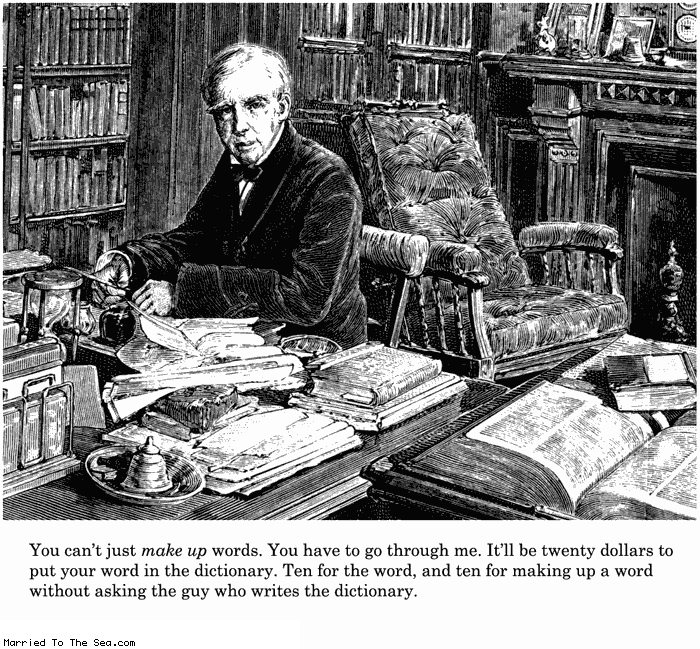
How New Words Are Added to Dictionaries
 (Enlarge image)