Merger
Out of date dictionaries- with native speakers from UK/USA/Australia!
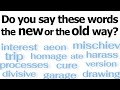 Play video
Dr. Geoff Lindsey interviews young native speakers across the USA, UK, and Australia to find how pronunciations of common words have been changing/are changed from standard dictionary phonetic transcriptions. This is an example of a diachronic approach to linguistics- comparing phonology in the past to the present to look at an evolution of pronunciation.
Alysa Lie' Asian-Californian accent
 Play video
This video analyzes the fact that Asian American communities in California do not partake in the caught-cot merger as most Californian accents do, using examples Alysa Liu speaking with the "caught" vowel in places where most Californians (and sometimes most standard American English speakers) would use the "cot" vowel. The video then gives an example of Liu's L-vocalization.
How accents allow interesting, non-standard rhymes in music
 Play video
This video discusses the ability of accents and vowel mergers to allow for new, non-standard rhyming patterns in music. The video gives several examples of different musicians using this to their advantage.
Potential Tonogenesis in Seoul Korean
This Instagram video talks about a trend found in Seoul Korean, where younger generations are beginning to merge the plain (b, d, g, etc.) and the aspirated (p, t, k, etc.) consonants. To compensate for this merge, words that are the same except for this consonant difference are beginning to see an introduction of a tone into the vowel following the consonant, with plain consonants being followed with a lower pitched vowel.
Kang, Y., & Han, S. (2013). Tonogenesis in early Contemporary Seoul Korean: A longitudinal study. Lingua, 134, 62-74. [Published on 02-13-2026]
Pin/Pen Merger Skit
 Play video
Silly little skit about the PIN/PEN merger by a speaker with a Southern Accent.
Merry, Marry, Mary
 Play video
A linguist talking about the words merry, marry, and Mary, and how some people have a merger between the three, and some people don't.
Sonic girls making new words
 Play video
These girls are taking words that already exist and combining them to make a new word with a new meaning.
Pera Code Mixing
 Play video
A little girl explains why she combines the Turkish and English language in her speech. She explains that she combines the two languages because she uses both languages, but at times it is hard for her to think of the words in English so she reverts to the Turkish term. It gives great examples of specific terms that she tends to revert to the Turkish term and the reason why she does.
Linguistic- Code Switching
 Play video
This video gives the breakdown of code-switching in America. It talks about all the different types of English that exist in US. It also addresses why and individual partitakes in this linguistic practice; a word translation doesn't come to mind so they revert to the word in another language, or they are purposely excluding others from understanding. Code Switching if referred to different terms depending on the language mixture; Spanglish, Chinglish, etc.
How Y’all, Youse and You Guys Talk: Personal Dialect Map Activity
Most of the questions used in this quiz are based on those in the Harvard Dialect Survey, a linguistics project begun in 2002 by Bert Vaux and Scott Golder. The original questions and results for that survey can be found on Dr. Vaux's current website.
The data for the quiz and maps shown here come from over 350,000 survey responses collected from August to October 2013 by Josh Katz, a graphics editor for the New York Times who developed this quiz. The colors on the large heat map correspond to the probability that a randomly selected person in that location would respond to a randomly selected survey question the same way that you did. The three smaller maps show which answer most contributed to those cities being named the most (or least) similar to you." I thought of this when we were talking about conceptions of American dialects.
Password Plus: Don't Piss Marcia Off
 Play video
On this episode of the game show Password Plus, Marcia Wallace used "furry" to prompt her partner to say "Harry" (or for her, the homonym "hairy.") The judges rejected this, pointing out the "Harry" and "hairy" have different pronunciations. But not for Marcia, who is from the midwest, as she correctly points out.
Greg and Donny have an accent
 Play video
Would-Be Robbers Walk Away Empty Handed
Feel/fill merger in Utah causes miscommunication during a robbery.