Change
Leftovers from Older English
 Play video
Simon Roper traces the etymology of common phrases in contemporary Northern English to Old English, using data from 19th century Devonian dialects as a stepping stone. He looks at how changing grammatical constructions affected meaning and use of certain words over time, like willy-nilly.
Out of date dictionaries- with native speakers from UK/USA/Australia!
 Play video
Dr. Geoff Lindsey interviews young native speakers across the USA, UK, and Australia to find how pronunciations of common words have been changing/are changed from standard dictionary phonetic transcriptions. This is an example of a diachronic approach to linguistics- comparing phonology in the past to the present to look at an evolution of pronunciation.
Phonetic Change in Languages Between Generations
A chat with an Oxford linguistics student discussing their dissertation, which covers how language interaction alters accents and creates creoles over time and between generations. [Published on 12-15-2024]
"How to speak with a less monotone voice"
 Play video
This artifact is a video of someone teaching people how to speak in a less monotone and more varied tone. This relates to the idea of standard language ideology and how people promote language that is seen as "more standard" or less marked than language that is less standard.
The Euphemism Treadmill
In this video, the creator explains the euphemism treadmill originally coined by Steven Pinker, where replacement words gradually get more offensive. He uses examples such as "commode", "toilet", and in inverse example like the actual word "treadmill". [Published on 11-18-2023]
"Eye" evolving from the Bronze Age to today
 Play video
A man shows how the word "eye" evolved through time to become the word we are familiar with today. The evolution features many small phonetic changes that allowed the word to take on a completely new pronunciation after 6000 years.
The Influence of Women's Speech on Language Evolution
 Play video
This video is a clip from an interview with sociolinguist Valerie Fridland discussing how the evolution of language is often catalyzed by women. Fridland explains that because women often hold caregiving roles in the home, they pass on their language to children more than men do, leading to intimate diversification. Additionally, once children are in school and begin developing speech patterns that are distinct from those of their families and more closely align with those of their peers, women have been observed to use more novel language than men, which is often later adopted into standard language. She cites the transition from "doth" to "does" in written English, a change observed in texts by women a generation before it appeared in works by men. Interestingly, Fridland also notes that some aspects of language, such as the regular use of "totally", become enregistered as highly feminine, which contradicts this trend and prompts a clear pushback in men's language.
Lexical Shifting Towards AI
 Play video
This video describes and reviews how our language is influenced by the technology we use. It does this specifically with AI, showing how our word choice and language usage are changing as people use AI more.
Trans Thoughts on Gender Neutrality in the Spanish Language
Spanish is a highly gendered language with a rigid gender binary. To combat this binary, some Spanish speakers have been introducing gender-neutral alternatives to nouns, pronouns, adjective forms, etc. This article features interviews with trans Spanish speakers, sharing their perspectives on gender-neutrality in the Spanish language. [Published on 10-01-2021]
Let's Start by not Using "Expat"
This blog post goes over how the two words "expat" and "migrant" are used and the way they signal the power imbalance of people who have moved abroad for different reasons. The post highlights that the word "expat" is oftentimes used for white Westerners who live elsewhere while the rest are considered migrants and looked down upon. Because of this reason, the post argues to stop using the term "expat" in order to reevaluate how we look at migration in general.
Is Korean becoming Tonal?
 Play video
A video explaining Korean might be undergoing a tonal genesis. The video cites a paper that studies the decrease in difference between plain and aspirated consonants and increase in tonal distinction of vowels in Korean amongst young speaker.
TikTok
This TikTok uses the terms “Framogging and Outmogging” to demonstrate retronyms and how they are developed. [Published on 02-14-2026]
Algospeak
This article is about how TikTok users use “algospeak” like “cute winter boots” to bypass censorship and discuss immigration, protests, and political issues. [Published on 02-05-2025]
An infographic showing the Etymology of the different parts of Boston
This infographic describes how each part of Boston came to be called what it is called. I like it mostly because I'm, from Boston, and I am very interested in how these places I have known my whole life came to be named. [Published on 04-23-2019]
HAN "I GOT IT" | [Stray Kids : SKZ-RECORD]
 Play video
Instance of English-Korean wordplay in k-pop/k-rap. The Korean-accented English pronunciation of "I GOT IT" in the chorus is homophonous with the Korean "아가리" which is a curse word/harsh way of saying "shut up". There are other uses of wordplay throughout, especially in the final few lines of the song. This is a commonly used tactic in k-pop to tiptoe around explicit language. When Korean swears are turned into English words (and vice versa), fans typically tend to think that the songs are cooler and the artists are smarter and edgier than normal—in other words, the lyricists index themselves and their work as sophisticated. This does not just apply to explicit language, and it carries different connotations depending on the exact wordplay being used.
Protactile Linguistics: Discussing recent research findings
 Play video
Discussion of recent linguistic research on Protactile, a touch-based language used by deafblind people, by researchers Jelica Nuccio and John Lee Clark. The most sociolinguistically relevant section begins at 31:28.
"Do you speak Swiss?"
 Play video
In my German class, we’ve been exploring Swiss German and the multilingual environment of Switzerland, which has four official languages: German, French, Romansh, and Italian. In the second half of the video, we see a cashier in a multilingual region easily shifting between these languages depending on the customer. Rather than style shifting in the traditional sense, this seems more like an alteration of language based on practicality and politeness. The cashier is fluent in all the languages spoken and navigates them effortlessly, suggesting a stable multilingual competence rather than conscious style-shifting. Still the language that the cashier speaks is dependent on the customer, so the shift is more of a situational language adaptation. I am fascinated by the Swiss and the flexibility that comes with being multilingual in this everyday sense without necessarily having a shift in the social identity.
English over 2000 years
 Play video
language enthusiast reproduces the same sentence over many iterations of the english language to show change over time.
Leftovers from Older English
Play videoVideo mentioning different features in English that are inherited from older dialects of English but are either fossilized or are particular to specific communities.
Were British Accents Invented in the 1700s? A 'Deep Dive'
 Play video
Video about the evolution of "British English" (a term acknowledged within the video to be problematic, but intentionally used to attract a non-linguist audience). Focuses in particular on the evolution of rhotic sounds in English, especially in contexts in which they're dropped.
Council for German Orthography Enshrines "Idiot's Apostrophe", Move Decried as Another "Normalization of Anglicisms"
This article details some of the immediate reactions to the Council for German Orthography announcing that using an apostrophe to indicate possession will now be considered 'correct' German grammar. Some German grammar purists consider the move to be a result of excessive encroachment of English conventions into the German language, but others point out that this may not actually be the case. [Published on 10-08-2024]
How to Say 'Wife' in Korean - Many Ways
Koreans are increasingly using the English loanword 'wife', due to it lacking many of the social and cultural connotations that are encoded in its native Korean counterparts. This blog post by Dom & Hyo provides brief breakdown of several Korean terms for 'wife'. As women's status in Korean society has evolved, the younger generations are moving away from some older and more formal Korean terms, including one that literally translates to "home person" or "person that stays at home".
Usage of new death euphemism "Unalive"
 Play video
This person conducted a survey of parents of Gen Alpha children and asked about their children's usage of the term “unalive”, and found that it was used in a variety of contexts, but predominantly as a euphemism for death or suicide, cool innovation!
Japanese words replaced by English loans
 Play video
A list of japanese words which have been replaced by english loans in common usage; not using these loanwords makes you seem outdated

Might be related to the "Queen's English" study: "An Upper-Class Southern British Accent, 1673 - 2023"
 Play video
This video is one person's attempt to describe the shift over time in the pronunciation of "upper-class" British English using primarily written transcriptions. I'm not sure how credible this guy is, but it was a fun watch when I found it last fall! I thought his attempts to pronounce these older, unrecorded pronunciation systems were both valiant and funny.
Tumblr Post on Responses to Thank You (referenced in course readings)
A viral Tumblr post by a non-linguist hypothesizing about how Millennials say "no problem" as a response to "thank you" and why baby boomers might think that is rude.
Referenced in the course reading "It’s no problem to be polite: Apparent-time change in response to Thanks" by Aaron Dinken (2017) [Published on 07-07-2015]
Australian English: History of vowel shift
Link to an animated vowel plot of Australian English (by a University in Sydney, Australia). On this webpage, there are also audio files of broad, general, and cultivated types of thisveriety.
Why are British place names so hard to pronounce?
 Play video
Jay and Mark explain British place names with context for the historical development of the English language and dialect formation
Linguistic Diversity in China
 Play video
This video centers on how people across Guilin would say a common Chinese greeting: ('Have you eaten yet?). As China's linguistic diversity is changing rapidly, this video shows how people in incredibly close proximity can show so much linguistic variation.
Surfer Bro Makes Plea for House Parties
 Play video
Excellent example of back vowel fronting. Listen to his last name “Kroger”!
Can Filipinos Speak Their Own Language?
 Play video
This video features street interviews with several Filipino people who attempt to speak pure Tagalog (no English or other loanwords). They also share their thoughts on the increasing incorporation of loanwords into everyday speech.
Internet Slang: the -ussy suffix
This paper talks about how words are created on the internet by adding the suffix -ussy. [Published on 01-01-2018]
Wharr I do?
 Play video
The speaker in this video is replacing a string of two alveolar stops /t/ and /d/ divided by an unstressed vowel /ɪ/ with an alveolar trill [r]. This is a very interesting example of how new, ostensibly difficult to pronounce sounds can be introduced to a language.
The case of the disappearing determiners
A survey of a diachronic change in the use of determiners across languages. Data sources include Facebook posts, American presidents' State of the Union addresses, Google books, etc.
(Comparison of two bible translations in a related article: https://languagelog.ldc.upenn.edu/nll/?p=23396)
Life of Brian - Latin Lesson - Romans Go Home!
 Play video
1979's "Life of Brian" comedically depicts the titular main character, played by Graham Chapman, defacing, in Latin, a Roman monument. A Roman centurion, played by John Cleese, stops him and punishes him for his "bad" grammar. The scene is largely a parody of the relationship between English schoolchildren and their teachers. Linguistically, it's interesting as a demonstration of prescriptive norms as well as the representation of different dialects. Cleese's dialect is meant to sound more elevated while Graham Chapman's, who is from Melton Mowbray, north of London, is meant to sound less elevated, which is supposed to add to the comedy. Funnily enough, I think some of Brian's usages correlate with changes that would end up occurring in Latin before it changed into the various Romance languages.
Nigerian Pidgin English accepted as unofficial second language
 Play video
This article shows how Nigerian Pidgin English is up and coming as more people are starting to listen to it and learn it.
New Kanji for the "New Normal"
New kanji was created to indicate a socially-distanced gathering. The original symbol resembles two people sitting near each other, and the new creation sets them further apart. [Published on 12-25-2020]
Modern vs Older words of Black American Sign Language (BASL)
Nakia Smith and her grandfather, Jake Smith Jr., demonstrating some "old fashioned" BASL signs. For the first part of his education, Jake Smith Jr. went to a segregated school for Black deaf children, and here he is demonstrating some of the signs he and his peers used, while Nakia demonstrates their modern equivalents. [Published on 10-10-2020]
Saying Thank You for No Reason!
 Play video
The guy in the video was trying to elicit responses just by saying "thank you" without a specific request...it's funny that most people first responded with a surprised "for what?" but later gave a formal "you're welcome" response, as if they're trying to end/escape the awkward interaction?
Why we say "OK"
 Play video
"How a cheesy joke from the 1830s became the most widely spoken word in the world." A short video about the origin of the word OK and how it rose in popularity.
Why “No Problem” Can Seem Rude: Phatic Expressions
 Play video
A discussion about Phatic Expressions and how language change over time creates differing ideas of the standard of politeness
Fred Astaire and Ginger Rogers - Let's Call The Whole Thing Off
 Play video
Song written for the 1937 film Shall We Dance, highlights some interesting phonological differences in American speech at the time that were obviously salient to speakers. Includes the famous [təˈmeɪtə]~[təˈmɑːtə] variation.

Northern Cities Vowel Shift
 Play video
The Northern Cities Vowel shift was mentioned in our reading as characteristic of "burnout" girls as a marker for being "rough". I didn't know what this was so looked it up., this explains it pretty clearly. ps. I assume "bill" is the same William Labov from the New York department store study?
How Technology Has Changed the Meaning of Words
This infographic made by Decluttr, gives examples of how technology has changed the meaning of some words. Technology has progressed at such a rapid rate, that the semantic change of words has also moved at a very fast rate.
Your Personality Changes When You Change Language
This video talks about those individuals that are multilingual change personalities when they change languages. This video shows in great detail how personalities all around the world are effected by changing languages. The video also talks about how only when a speaker matches their linguistic personality with their new language are they likely to be considered truly multilingual.
Language Death- How do languages die?
 Play video
This in an informational video about language death and language extinction. This video gives several examples of languages that have become extinct, and how languages become dead and/or extinct. He also goes into detail about the different kinds of language death which include, gradual, bottom-to-top, sudden, and radical. To offer a more clear understanding, the video also describes case studies of language death.
Grammar gripes: why do we love to complain about language?
This article discusses the nature of prescriptivism and how modern technologies are contributing to language change [Published on 03-11-2018]
Is New York losing its most famous accent?
A short video on the "disappearing" New York City accent. [Published on 08-18-2017]
'He', 'She', 'They' and 'Us'
This article appeared on The New York Times Insider and discusses transgender issues and the use of a person’s preferred pronoun rather than the conventional or binary pronouns commonly used when reporting a news story. The Washington Post, The Associated Press, and The New York Times policy for use of unconventional pronouns is discussed. [Published on 04-05-2017]
Anne Curzan: What makes a word "real"?
 Play video
In this video Anne Curzan reviews how a word can be introduced to language, how words can begin to move out of the language, and how the usage of words change and alter through time. Curzan also covers how people use dictionaries and resources in order to stay caught up but, editors of dictionaries are struggling to keep up with our vocabulary and have to gabble on which words will actually survive.
Icelanders Seek to Keep Their Language Alive and Out of 'the Latin Bin'
Icelanders are becoming concerned that their language is being overridden by the English language. The current official language in Iceland is Old Norse. It has changed in incredible amount over more than a thousand years and is now a unique dialect. Nowadays English is becoming more prominent due to the tourism industry and devices with automated voices in English. Only about 400,000 people speak it now, and with the vast globalization Icelanders as well as linguistic experts are in fear that Old Norse will have the same fate as Latin. [Published on 04-22-2017]
Language Lessons Told Through Twitter
This article it explains how social media particularly twitter not only can change language, but can provide a proper input on the evolution of language.
[Published on 10-26-2012]
Fry & Laurie comedy sketch
 Play video
Stephen Fry & Hugh Laurie perform a comedy sketch satirizing attitudes about language change.
Hurt BAE
 Play video
This video shows a younger couple discussing the infidelity on part of the male in the relationship, while a variety of older viewers watch the conversation. The video shows the differences in how younger generations communicate versus older generations, and the changes in how we communicate. Throughout the video, you see and hear the various reactions from the group and hear their thoughts and perception of the situation based on the conversation between the couple and the memes that were posted on the internet about the video.
The new Standard Swedish - sound experiment showing how Sweden sounds today
A Swedish linguistics professor has helped design a new kind of Riksvenska, or Standard Swedish, which more closely reflects the way people speak in 2017. [Published on 01-31-2017]
The Ebonics Controversy in my Backyard
This article talks about Ebonics and Code-Switching, It explains what happened when the Ebonics controversy broke out.
How American accents are changing
A detailed map of how American accents are changing.
The Evolution of Dude
 Play video
How the meaning of the word dude has radically changed over 130 years.
Language Could Diagnose Parkinson's, ALS and Schizophrenia before Lab Tests
A recent study shows the use, or lack of, certain words by patients could be diagnostic indicators of a future disease or ailment. [Published on 02-01-2016]
The Linguistic Sex Appeal of the Unicorn
Mark Peters discusses how the word unicorn is beginning to be used to describe unique, desirable and highly unattainable business goals. He also discusses the appeal of other similar terms such as just bump, couch surfing, and cyberbully. [Published on 02-21-2016]
Bernie Sanders' Accent
A description of Bernie Sanders' accent. Includes brief discussions of vowel-raising and vocalization of r in New York City English, as well as of terminal t enunciation, which is linked to Jewish dialects of English. The decline in New York City English usage over time and its usage as linked to socioeconomic status are also discussed (compare with Labov, William. 1972. Language in the Inner City.; and Mathers, Patrick-André. 2012. The social stratification of /r/ in New York City: Labov's department store study revisited). [Published on 02-18-2016]
Teenager Girls: The Real Disruptors of Language
Details historical evidence that young women have always been a driving force behind language change, including some changes previously credited to Shakespeare, for example. [Published on 08-07-2015]
Latinx: The ungendering of the Spanish language
A NPR story on the current practice of using a gender-neutral term for Spanish nouns like Latino/a, amigo/am, etc. Some commons approaches are Latin@ and Latinx. [Published on 01-29-2016]
Way Back When
 Play video
This artifact brings a funny play on words that has shows how much our culture has changed over the years and how even in our society words have taken on several meanings. They aren't pointed out directly but most people in our society today can relate.
Washington Post accepts singular they
The Washington Post's style guide now accepts singular they. [Published on 12-10-2015]
In defense of "textspeak:" A socio-linguist says emojis and LoLs are modernizing English
A description of some forms of internet language and how the contribute to change in American English. [Published on 05-04-2015]
That Way We’re All Writing Now
This article talks about change in syntax on the Internet. More specifically it addresses the rise of subordinate clauses, leading to utterances such as "that x when..." or "when x..." as well as suggestions for their increasing prevalence. [Published on 03-06-2015]
xkcd: Quotative Like
The webcomic xkcd offers a humorous take on language change and the use of "like" as a quotative complementizer.
How using 'they' as a singular pronoun can change the world
This is an article that discusses the importance of using singular 'they' and addresses issues related to its "correctness". [Published on 02-03-2015]
What makes a word "real"?
Play videoA TED talk about the change and creation of words in the English language and how they eventually get added into the dictionaries.
Fuhgeddaboudit: New York Accent On Its Way Out, Linguists Say
This is just a short article that looks at the inevitability of language change. Although it mostly talks about neutralization, I feel as though other processes and possible future developments are left out in a way that makes it more sensational for the average reader, especially New Yorkers. [Published on 02-02-2015]
Speech markers reveal details about your age, sex, and lifestyle, scientists claim
A daily mail article discussing research that finds gender and age-based differences in the use of fillers [Published on 10-06-2014]
Translating Philly-ese
A 2014 article on the changing Philadelphia dialect.
English has a new preposition, because internet
A 2012 post on the "because + noun" construction
XKCD: Period Speech
A XKCD comic highlighting language change.
XKCD: Misusing Slang
A XKCD comic about language change, youth, and slang.
Stephen Fry on language
 Play video
Humorist Stephen Fry rants against language mavens and prods us all to enjoy linguistic innovation.
Beckhams talk more posh, say researchers
A 2013 report on research from the University of Manchester that David and Victoria Beckham have decreased h-dropping and l-vocalization in their speech.
Philly's Accent is Changing
 Play video
A video interviewing William Labov and colleagues about their project on change in Philadelphia English
Fox News: No Maw 'New Yawk'
A 2010 article on the change away from raised THOUGHT in New York City English.
The Queen's Christmas Broadcast 1984
 Play video
I use this with the following reading: Harrington, Jonathan et al. 2000. Monophthongal vowel changes in Received Pronunciation: An acoustic analysis of the Queen's Christmas Broadcast.
The Queen's Christmas Broadcast 1957
 Play video
I use this with the following reading: Harrington, Jonathan et al. 2000. Monophthongal vowel changes in Received Pronunciation: An acoustic analysis of the Queen's Christmas Broadcast.
North American English Dialects
A 2013 piece on Iowa Public Radio on North American English dialects.
The Queen's Christmas Broadcast 1985
 Play video
I use this with the following reading: Harrington, Jonathan et al. 2000. Monophthongal vowel changes in Received Pronunciation: An acoustic analysis of the Queen's Christmas Broadcast.
eNCLLP: Charlotte
 Play video
A clip from the documentary Voices of North Carolina on language in Charlotte, North Carolina.
Yoo talkin' to us? Researching whether New York is losing its distinctive accent
A 2012 New York Post article by Kara Becker on the changing nature of the NYCE accent.
Val Systems: Pretentious /ae/ hole
The blog post provides a clip from the popular NPR show "Car Talk, with two native Bostonians as hosts. In the clip, one hosts relates being teased by his daughter for his trap-bath split, saying it sounds pretentious.
FDR's Inaguaural Speech and /r/ - Fear Itself
 Play video
An example of FDR's /r/less, upper class New York City variety. An interesting spot to look at r vocalization, as the iconic phrase "The only thing we have to fear is fear itself" includes two coda /r/ environments that we don't expect to vocalize, given that they are intervocalic.
(r) in New York City English
 (Enlarge image)
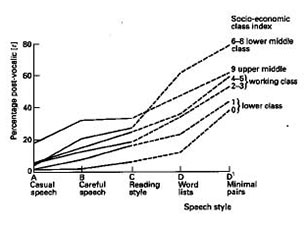
The classic graph from Labov (1966) showing stratification by socioeconomic class and speaker style for coda r vocalization in New York City English
R Grammar Gaffes Ruining the Language? Maybe Not
Improper grammar usage is becoming more and more prevalent in the world, yet it may not necessarily be a bad thing.
Northern Cities Vowel Shift: How Americans in the Great Lakes Are Revolutionizing English
A 2012 Slate article on the Northern Cities Shift and the diversification of American regional dialects.