Phonetics
Indian English isn't always a foreign accent
 Play video
This video describes how despite Indian-accented English is often understood by people in the Global North as an imperfect acquisition of English, it is essentially as much a legitimate variant of English as Australian English is to British English, and goes into the history of how English came into India and what phonetic rules apply.
Phonetic Change in Languages Between Generations
A chat with an Oxford linguistics student discussing their dissertation, which covers how language interaction alters accents and creates creoles over time and between generations. [Published on 12-15-2024]
"Eye" evolving from the Bronze Age to today
 Play video
A man shows how the word "eye" evolved through time to become the word we are familiar with today. The evolution features many small phonetic changes that allowed the word to take on a completely new pronunciation after 6000 years.
How to Neutralize an Accent │American Accent Training
 Play video
His video is an instructional guide on how to “neutralize” a speaker’s accent in order to sound clearer, more professional, and easily understood in General American English. The speaker describes accent neutralization as a process of modifying pronunciation features such as vowel quality, intonation, and rhythm, often framed as achieving a “non-regional” or “standard” form of English used in professional contexts like interviews or presentations.
From a sociolinguistic perspective, this video reflects standard language ideology, in which certain varieties of English are treated as more neutral, correct, or socially desirable than others. Although the speaker briefly acknowledges that all speakers have accents, the overall framing still positions regional variation as something to be reduced or controlled. This illustrates how linguistic features become socially evaluated, where “neutral” speech is associated with professionalism, clarity, and authority.
How to Neutralize an Accent │American Accent Training
Play videoThis video is an instructional guide on how to "neutralize" a speaker's accent in order to sound more professional and easily understood in General American English. The speaker describes accent neutralization as a process of modifying pronunciation features such as vowel quality, intonation, and rhythm, often framed as achieving a "non-regional" or "standard" form of English used in professional contexts like interviews or presentations.
From a sociolinguistic perspective, this video reflects standard language ideology, in which certain varieties of English are treated as more neutral, correct, or socially desirable than others. Although the speaker briefly acknowledges that all speakers have accents, the overall framing still positions regional variation as something to be reduced or controlled. This illustrates how linguistic features become socially evaluated, where "neutral speech is associated with professionalism, clarity and authority.
Evolution of the names of metals from Proto-Indo-European to English
This person goes through the names of "iron", "lead", "copper", and "gold", tracing them from Proto-Indo-European to current American English pronunciation. He even has them in IPA! It's pretty cool :) quite unrelated to contact languages (languages in contact, languages, contacting languages, etc. etc.) but I thought it was cool. [Published on 04-14-2025]
"Anything else you want to say, buffoon?" | Santiago mimics Louis | Interview With The Vampire S2
 Play video
A scene from AMC's Interview With The Vampire where a character with a New Orleans accent is mimicked and the nuances of his pronunciations are identified as being specifically from NOLA (based on borrowed pronunciation from French).
How to Speak Like a Catperson
A DeviantArt user with no formal linguistics knowledge explains a set of phonetic rules they follow when replacing English syllables with /njɑ/ or /nju/, or more generally appending /j/ to nasals in specific environments in order to imitate the sounds of a cat. They refer to this style of speech as their 'nyaccent.' [Published on 09-25-2013]
Arnold Schwarzenegger State Farm Commercial
 Play video
Really absurd commercial with sociolinguistic implications. Arnold Schwarzenegger’s r’s are really non-rhotic and everyone tries to correct him.
we're ✨english majors✨
we're ✨english majors✨ #fyp #foryou #trending [Published on 02-13-2024]
Rain-fAR-est vs. rain-fOR-est
Right at the beginning of the reel a teacher says rainforest [reɪnfɑɹəst] and one of their students says: rain-fOR-est [reɪnfɔɹəst] not rain-fAR-est. Thought it was cool that the student caught that difference in pronunciation! [Published on 02-01-2024]
A chaotic poem about English pronunciation
 Play video
A poem using several loanwords, obsolete words, different spellings, and standardized pronunciation. Makes claims about speaking English "better than 90% of the native English speakers in the world," but only uses "standard" British accent. Reminds me of that song from My Fair Lady.
Push for linguists to analyze recordings used in court
This is a project pushing for professional phonetic analysis of covert recordings used in legal trials. Covert recordings (often the result of being "bugged") are even harder to interpret than live testimony, which was discussed in the Rickford/King paper, because of the low audio recording quality. Often jurors are presented with transcriptions made by police and detectives, which can heavily bias their interpretation of what they hear. This project wants phoneticians to analyze these recordings in order to get a more accurate and fair transcription.
What Language Am I Speaking
 Play video
This video primarily explores assumptions that people make based on simply hearing the phonology of another person's native language (without seeing the person speaking). In particular, starting at 6:54, one of the speakers is speaking Russian and many of the guessers remark on its harshness/anger. However, many people in the comments who claim to be native Russian speakers are offended by his focus on only the curse words and (stereotyped) vulgar nature of Russian that has been a hallmark of prejudice against Russian speakers. We discussed this in class on Tuesday: that languages like Russian or German are no more harsh than any other language is (but here we can see the perception in
action). Among a variety of other linguistic topics, a native speaker of Makah, a tribe indigenous to Washington briefly discusses how he is one of only seven people teaching the language (and none of them fluent speakers). This isn't something directly connected to our conversations on accent and L2 accent discrimination, but something that I find really sad/interesting.
Wharr I do?
 Play video
The speaker in this video is replacing a string of two alveolar stops /t/ and /d/ divided by an unstressed vowel /ɪ/ with an alveolar trill [r]. This is a very interesting example of how new, ostensibly difficult to pronounce sounds can be introduced to a language.
Hawaiian Version of Twelve Days of Christmas
 Play video
A recording of two people singing a version of the song "Twelve Days of Christmas" in Hawaiian Pidgin that shows a lot of its phonetic variables. The lyrics are written in the description.
Fred Astaire and Ginger Rogers - Let's Call The Whole Thing Off
 Play video
Song written for the 1937 film Shall We Dance, highlights some interesting phonological differences in American speech at the time that were obviously salient to speakers. Includes the famous [təˈmeɪtə]~[təˈmɑːtə] variation.
An Appeal to Everyone: Please Stop Pronouncing “Pokémon” Wrong
A HowToGeek contributor's plea: Neither Japanese nor Americans "pronounce it po-KEE-mon. The true pronunciation is po-KAY-mon, or po-KAH-mon, both propagated by the cartoon, which is available on Netflix just in case you need a refresher."
How do Mexican People Say "Despacito"
 Play video
Cutest video of a young girl who has grown up hearing different ways of pronouncing loan words, and is able to pronounce both an English and Mexican pronunciation perfectly. She is showing the different linguistic resources that she can draw on, see our discussion on Tuesday in class about repertoire.


SNL - Amazon Echo
 Play video
Kenan Thompson plays an older African-American man in a parody Amazon Echo ad. He displays several features of AAVE, the most prominent being the phonological (eg. using word-initial stop consonants /t/ or /d/ rather than /θ/ or /ð/).
Portuguese Words Spanish Speakers Can't Pronounce
 Play video
This video is a good example of how difficult boundaries can be to draw around "language" or "dialect," especially when you're using mutual intelligibility. It shows the similarity and differences between Portuguese and Spanish as Spanish speakers try to pronounce written Portuguese words, evidenced by the commentary of the Spanish speakers, especially "I understand what you're saying, I don't know how you say it." This distinction is especially hard to draw when you take into account the ideology held between and of cultures, and the political investment that may exist in making nations distinct, and this ideology of difference is also demonstrated in the views expressed by the speakers.
NBA Rising Stars Try to Pronounce "Giannis Antetokounmpo"
 Play video
This video shows NBA players trying to pronounce a name they are not familiar with. It presents some funny language barriers and interesting takes on speech community.
Spanish Words "White" People Can't Say
 Play video
A comedic take on white people trying to pronounce Spanish words and their struggle in the performance of a basic Spanish lexicon—even in words that share a striking spelling resemblance to its English cognate. Some noteworthy examples appear when the participants are asked to pronounce “refrigerador” and “negar,” with some subjects showing visible apprehension to merely attempt the latter.
Arabic Speakers Are Offering To Help Correct News Anchors Who Mistakenly Say 'Potatoes Are The Greatest'
Ironically, aloo doesn't even mean potatoes in Arabic, that's the Urdu term. So as the article is trying to correct people mispronouncing the word, it doesn't mention a very important fact and it just assumes that it's in Arabic.
Glaswegian Accent
 Play video
A Polish man and a Scottish man with a Glaswegian accent talk about sports and being friends.
Scottish Accents
 Play video
The dialect coach Carol Ann Crawford for the show Outlander demonstrates a series of Scottish accents and gives a brief description on each.
Flight of the Conchords - He may be Dead
 Play video
New Zealand DRESS-raising causes a misunderstanding.
Key & Peele- Substitute Teacher
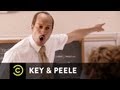 Play video
This video shows how language is often construed as wrong to many different kinds of people because there are so many different variations in the English language.
"Eumaeus", from Ulysses, p.508-509
" - A beautiful language. I mean for singing purposes. Why do you not write your poetry in that language? Bella Poetria! It is so melodious and full. Belladonna. Voglio.
Stephen, who was trying his dead best to yawn if he could, suffering from lassitude generally, replied:
- To fill the ear of a cow elephant. They were haggling over money...
- Sounds are impostures, Stephen said after a pause of some little time, like names. Cicero. Podmore. Napoleon... Shakespeares were as common as Murphies. What's in a name?"(Joyce, 508-509 Gabler Edition).
Bloom displays a typically 'folk' attitude towards language (see Preston 2002, "Language With an Attitude"), attributing qualities that inhere to the sounds and words of language itself - in this case viewing the sounds of the Italian language as "melodious and full". Stephen, who understands Italian, is able to take a more critical step back and question whether we can attribute meanings and qualities to the phonetic aspect of words and names, outside of the associations people come to build upon words such as the proper name 'Shakespeare'.
Do children with Tourette syndrome have an advantage at language?
Researchers in Newcastle recently found that children who had Tourette syndrome were faster at phonological processing than children without Tourette syndrome. The researchers wanted to examine potential strengths of the language-affected disorder, rather than studying the weaknesses, which is far more common. [Published on 09-29-2016]
Kodak Black Social Artifact Golden Boy
 Play video
He uses a dialect that is familiar with the rap community, and has an accent that is usually associated with the Haitian community. His delivery of the language he uses gives him his swagger, and gives him a style that stands out from other artists. Examples of his lyrics include saying things like "dat" instead of "that", or "witchu" instead of with "with you".
Linguistic study proves more than 6,000 languages use similar sounds for common words
A study from Cornell recently found that 6000 languages around the world used similar phonemes in words that represent the same thing. The researchers found that words used to describe “nose” are likely to have the sounds “neh” or “oo” in them, and words for “sand” are likely to begin with the “s” sound to name a couple. [Published on 09-13-2016]
Variety of Spanish Accents
 Play video
Joanna Rants uses analogies to compare different Spanish accents.
The Top 10 Most Frequently Mispronounced Foods
Language borrowing has been an interest to various fields of linguistics for some time. A good example of loanwords can be found on menus. Here is a list of “The Top 10 Most Frequently Mispronounced Foods” by Kemp Minifie
West Coast Speech Community
 Play video
This is an example of a speech community. In the video, she is referring to the different ways in which her speech community interacts compared to the area she is in now. Her examples should be relatable to many living on the West Coast.
Angel Haze - A Tribe Called Red
 Play video
One of Angel Haze's that shows some good coronal stop deletion in the repeated "around", for example.

Sassy Gay Friend in Eden
 Play video
Sassy Gay Friend was mentioned in the Campbell-Kibler, so I thought I'd contribute my favorite. Definitely a good example of the stereotypical "sounding gay".
What linguists say about Kevin Spacey's bizarre Southern accent on House of Cards
Linguists discuss the use (and non-use) of Southern English features by actor Kevin Spacey, who portrays a politician from South Carolina on the TV show House of Cards. [Published on 02-27-2015]
How Do You Pronounce "Bon Iver"?
Our discussion of the foreign /a:/ potentially sounding pretentious made me think of this issue...
A cause of confusion and debate among hipsters and indie music listeners has been the pronunciation of Justin Vernon's musical project, Bon Iver. I have always pronounced it /bɒn aɪvər/* to avoid sounding pretentious and made fun of my boyfriend when he pronounced it in the more correct way, /bəʊn i:veər/*. It turns out that the band's creator doesn't mind it either way! Could the pronunciation of this band name tell us something about the speaker? It may not be as political as "Iraq", but I think it's worth discussing.
*Please forgive any IPA errors, I'm still getting the hang of it. [Published on 02-13-2012]
How to Speak New York
A website featuring sound files of "authentic" pronunciations of proper names for streets, neighborhoods, shops, etc. relevant to New York.
Lohnson's Fury (Singapore English)
 Play video
These Singapore English speakers have made a whole bunch of "Singlish 101" videos, all of which are really fun. I chose this one because it illustrates a couple of interesting fixed expression (including "win already lor"--basically lexicalized sarcasm), as well as giving some idea of how the vowel system and intonation of Singapore English work.
The "ax" versus "ask" question
A 2014 op-ed in the LA TImes from John McWhorter on the pronunciation of "ask" as "ax" by African Americans.
Beckhams talk more posh, say researchers
A 2013 report on research from the University of Manchester that David and Victoria Beckham have decreased h-dropping and l-vocalization in their speech.
Fox News: No Maw 'New Yawk'
A 2010 article on the change away from raised THOUGHT in New York City English.
My Fair Lady: The Rain in Spain
 Play video
Actress Audrey Hepburn as Eliza Doolittle, demonstrating features of the Cockney accent, including h-dropping and the diphthongization of /e/.
African American English: The Wren
Play audioAn audio file of an African American man reading the poem The Wren.
Story of English: Appalachian English
 Play video
Segment from the 1986 documentary "The Story of English" on Appalachian English.

Bill Gates and the Pacific Northwest Accent
A blog post that includes a clip of Bill Gates, a native of Washington state, and attempts to dissect his Pacific Northwest accent.
Pittsburgh Pronunciation
The Pronunciation page from the University of Pittsburgh's "Pittsburgh Speech and Society" page, which has audio of seven native Pittsburghers reading a passage.