Language Revitalization
Spain is still multilingual
 Play video
This video talks about the linguistic diversity in Spain and how the Spanish state maintains it, contrasting with other states which suppress minority languages. The video describes how Spain's state acts against standard language ideology by mandating that regional languages also be taught in their schools, such that students are raised bilingual, and the minority languages become preserved systemically. The video also touches on the concept of standard language ideology and how it isn't as innate to state power as is sometimes thought.
Language Revitalization Documentary -- Questionable Ethics
 Play video
A 2008 documentary featuring two linguists "racing to document languages on the verge of extinction." Brings up questions about the responsibility of linguists (especially those working on language documentation) to the communities with whom they work.
The full documentary is accessible in the Reed College Library.
Teaching Khmer in Surin Province
 Play video
Uploaded October 22, 2011, which is right around when Project 2 ended and the decline in Northern Khmer usage began. Video shows a classroom of young students practicing the pronunciation of Northern Khmer words (and consonants/vowels?)
SkoBot robot for language preservation
Danielle Boyer, an inventor, shows off a robot she created to help with the preservation of indigenous languages. The specific robot she has is working with Anishinaabemowin
How To Sign In BASL (Black American Sign Language) | Strong Black Lead
 Play video
A shorter and more modern video about BASL from one of Netflix's YouTube channels. The title is pretty misleading, because it's more of an overall history and explanation than a how-to, but still very interesting. This signer seems to use less signing space than those in the documentary we watched, perhaps because she needs to fit in a smaller space on-screen (which would especially make sense given that she signs on TikTok a lot).
New Gaelic School in Edinburgh, Capital of Scotland
 Play video
In this video teachers at a new Gaelic school in Edinburgh and education workers within the Scottish government are interviewed, giving insight into Scottish Gaelic revitalization efforts.
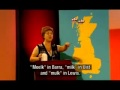
Comedy about Native vs New Speakers of Scottish Gaelic
 Play video
In this video a comedian takes on an over-the-top (but semi-realistic) persona complaining about new speakers of Scottish Gaelic, making fun of both sides of the debate over standardization and the introduction of new terms into Gaelic.
Kaurna Language Learning Video for Kids
 Play video
A language learning video for kids as part of the movement to revitalize Kaurna in Australia
"Language of the Diaspora": Speaking Hebrew or Yiddish in Israel
 Play video
Jacob Apelberg talks about his experiences with Hebrew and Yiddish, especially the complex political history of Hebrew revival in Israel, where there was bias against Yiddish.
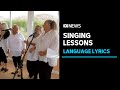
The Deadly Nannas singing group teach the Ngarrindjeri language through song
 Play video
A group of women celebrate and revitalize their language through singing
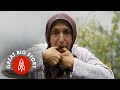
Turkish Whistle Language
 Play video
For three centuries, farmers living in the remote mountains of northern Turkey have communicated great distances by whistling. It’s a language called kuş dili that is still used to this day, though fewer people are learning it in the age of the cell phone. Muazzez Köçek lives in Kuşköy, and she is the best whistler in her village. Muazzez shows us how she uses varied pitch frequencies and melodies to translate Turkish vocabulary into whistles with meaning.
Can Filipinos Speak Their Own Language?
 Play video
This video features street interviews with several Filipino people who attempt to speak pure Tagalog (no English or other loanwords). They also share their thoughts on the increasing incorporation of loanwords into everyday speech.
What Language Am I Speaking
 Play video
This video primarily explores assumptions that people make based on simply hearing the phonology of another person's native language (without seeing the person speaking). In particular, starting at 6:54, one of the speakers is speaking Russian and many of the guessers remark on its harshness/anger. However, many people in the comments who claim to be native Russian speakers are offended by his focus on only the curse words and (stereotyped) vulgar nature of Russian that has been a hallmark of prejudice against Russian speakers. We discussed this in class on Tuesday: that languages like Russian or German are no more harsh than any other language is (but here we can see the perception in
action). Among a variety of other linguistic topics, a native speaker of Makah, a tribe indigenous to Washington briefly discusses how he is one of only seven people teaching the language (and none of them fluent speakers). This isn't something directly connected to our conversations on accent and L2 accent discrimination, but something that I find really sad/interesting.
No Béarla
 Play video
This miniseries follows an Irish filmmaker who tries to go about daily life in Ireland without speaking English. Despite Irish being one of the official languages of the Republic of Ireland, a minority of people in Ireland are competent in it. I found it interesting that most people he interacted with seemed very confused as to why he would not just converse in English, especially when he was interacting with someone who didn't speak Irish. People in Ireland clearly do not expect there to be people who speak Irish who don't also speak English. I also find it interesting how Irish people refer to the language's situation. They talk about being competent in Irish as "having Irish", as in "I don't have any Irish".
How old English would have sounded like
 Play video
A reconstruction of old English through a (fictional) interview with an anglo Saxon.
Sylbo, The Last Speakers of the Lost Whistling Language
 Play video
a video about the language Sylbo on the island of La Gomera, of the Spanish Canary Islands off the coast of north-west Africa. The Spanish government is attempting to preserve the whistling language which imitates the phonetic features of Spanish.
Languages affect how we physically perceive the world
A recent study has proposed that humans have different ways of perceiving the world around them depending on the language they speak. For example, when native English speakers were asked to describe the taste of bitter-flavored water, responses varied from "bitter, to salty, sour, not bad, plain, mint, like ear wax, medicinal, and so forth." Meanwhile, when Farsi speakers were asked to describe the same drink, it was nearly unanimously "talkh," the Farsi word for bitter.
Some languages are more equipped in describing smells, for instance, than other languages -- and that affects how we, as users of language, perceive the world around us.
[Published on 02-27-2019]
Poetry slams (Bertsolaritza) are helping reinvigorate the Basque language
The Basque Language Euskara, spoken in areas between France and Spain, has been pushed to the fringes of society over the course of the last century. The recent revival of Bertsolaritza, a Basque tradition of improvised song, has contributed to the increase in popularity of the language, both inside and outside the region. [Published on 02-14-2019]
The Revival of Ancient Babylonian Language
This article discusses how Dr Martin Worthington, a fellow of St John’s College, has created the world’s first film in the ancient Babylonian language with his Babylonian-speaking students dramatising a folk tale from a clay tablet from 701BC. Since 2000, he has been teaching himself to speak Babylonian and is currently creating a campaign to revive it as a spoken language. Babylonian has "extremely regular structures" and is semitic like the languages that replaced it; Hebrew and Arabic.
Ever wanted to watch Sailor Moon in Anishinaabemowin?
Inspired by dubbed versions of Sailor Moon in languages all around the world, Westin Sutherland, an Ojibwe 18 year-old from Canada, created a dubbed version of Sailor Moon in Anishinaabemowin and Cree, two indigenous languages of Canada. He believes that it gives young speakers confidence and pride in their language, and encourages young speakers (who are traditionally the weak link in linguistic transmission) to keep speaking indigenous languages. [Published on 08-12-2018]
Moana Reo Maori
This article discusses the immense popularity of the Maori dub of Moana, showed at 30 free theaters across New Zealand. Maori has historically been a highly stigmatized language in New Zealand, and many speakers of the boomer generation were discouraged from speaking Maori when they were younger. Much like Hungarian in the Gal (1978) paper dealing with a Hungarian/German bilingual community, Maori is in danger of extinction as younger speakers use it less and less to attain prestige through English. However, this film is part of an effort to give Maori covert and explicit prestige among younger speakers through its association with a cool, hip film.
Implementation of Hebrew as a Standard Language in pre-1948 Palestine
This article discusses the revernacularization of Hebrew into a standard language in Palestine, and then gives examples of how political and interest groups carried out this implementation at a local level through an examination of the 1930s and 1940s city documents of a small Jewish settlement, Raanana. [Published on 01-01-2008]
Can Facebook save endangered languages?
This article shows Facebook's attempts of saving endangered languages. Facebook is adding the option of many endangered languages, such as Corsican, to make the world more connected. Many endangered languages are not available digitally. With these efforts, users have the option of selecting their language as opposed to a more "mainstream" language. This allows endangered languages to cross the digital divide and allow it to be more available.
Mandana Seyfeddinipur's TED Talk on Endangered Languages
 Play video
This is a TED Talk video of Mandana Seyfeddinipur, a linguist and the director of the
Endangered Lanuages Documentation Programme at SOAS University of London, sharing her
perspective on endangered languages. Seyfeddinipur shares how globalization, climate change,
urbanization and political unrest are causing the extinction of languages at a rate equivalent to
the loss of biological diversity during the mass extinction of the dinosaurs. She also emphasizes
how such change can negatively impacts cultural diversity and decreases social resilience.
4 Reasons to Learn A New Language
There is a video which linguist and Columbia professor John McWhorter shares four reasons to learn a new language. Nowadays, increasingly people focus on learning English, the diversity of languages is slowly disappearing. The first reason is culture which language is always associated with it. Also, multilingual people less likely to have dementia than people who only use one language. Moreover, it is interesting for us to learn diverse language. The last but not least, we live such a convenient age which it is easier to learn any languages than before.
"A Mother", from Dubliners, p.117-8
"When the Irish Revival began to be appreciable Mrs. Kearney determined to take advantage of her daughter's name [Kathleen] and brought an Irish teacher to the house... Soon the name of Miss Kathleen Kearney began to be heard often on people's lips. People said she was very clever at music and a very nice girl, and, moreover, that she was a believer in the language movement" (Joyce, 117-118 Norton Critical Edition).
Here we see an interesting example of a language revival movement acting as a marker of social status, and even marriage eligibility for middle and upper-middle class Dubliners. While the Irish language doesn't hold prestige as the language of the state (Ireland is part of the U.K. at the time of "Dubliners"), it acts as a marker of in-group cultural identity and national pride for those able to study it - the lower and working class people of Dublin have no such opportunity (c.f. Ulysses, Joyce, 12-13). The daughter's name, "Kathleen", is another fashionable index for Irishness after the protagonist of a 1902 play by Yeats (footnote in text).
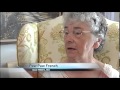
Paw Paw French
 Play video
This video is about a French dialect that is spoken in Old Mines, Missouri. It is said to be one of the oldest dialects of French that was formed in the United States called “Paw Paw French”. The dialect takes from Cajun, American Indian and the Canadian French Language that was made by early French settlers in the 1700’s. It is an endangered dialect that some of the residents of the town are trying to keep alive.
Berenstain Bears Reconnect Sioux To Native Language
Berenstain Bears cartoons help teach and revive the Lakota language. [Published on 09-26-2006]
How to understand the differences between British and American English
 Play video
The video does a great job at comparing words and the differences in meanings they can portray whether being interpreted from someone from the U.S OR U.K. It shows the power of the interpretation of language and how it can cause an interaction to be positive or negative. It shows the importance of linguistic relativity and the social context individuals are a part of.
Cherokee Look for Ways to Save Their Dying Language
This article depicts the perception of Cherokee as a "dying language", and how the remaining speakers are trying to bring it back to life. [Published on 02-29-2016]
Shakespeare: Original pronunciation
 Play video
A demonstration and explanation about what Shakespeare would have sounded like with its original pronunciation (Early Modern English). [[Something else that I would like to point out is how its "unexpected" good reception with the modern audience could have to do with their preconceived notions and therefore encouraged them to actually try to understand what was being said (taking it back to our discussion on accents).]]
Language Crisis: The American Indian Reality
Walt Wolfram's article in the Huffington Post profiling language revitalization efforts for the Cherokee language in North Carolina. [Published on 11-14-2014]
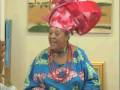
Gullah Story Teller Carolyn White
 Play video
Storytelling from Gullah speaker Carolyn White, from 2009.
Received Pronunciation and Shakespeare's "Original Pronunciation"
 Play video
Actor Ben Crystal performs Shakespeare in both Received Pronunciation and what he calls Shakespeare's "Original Pronunciation" (Early Modern English?) and discusses the differences between the two.