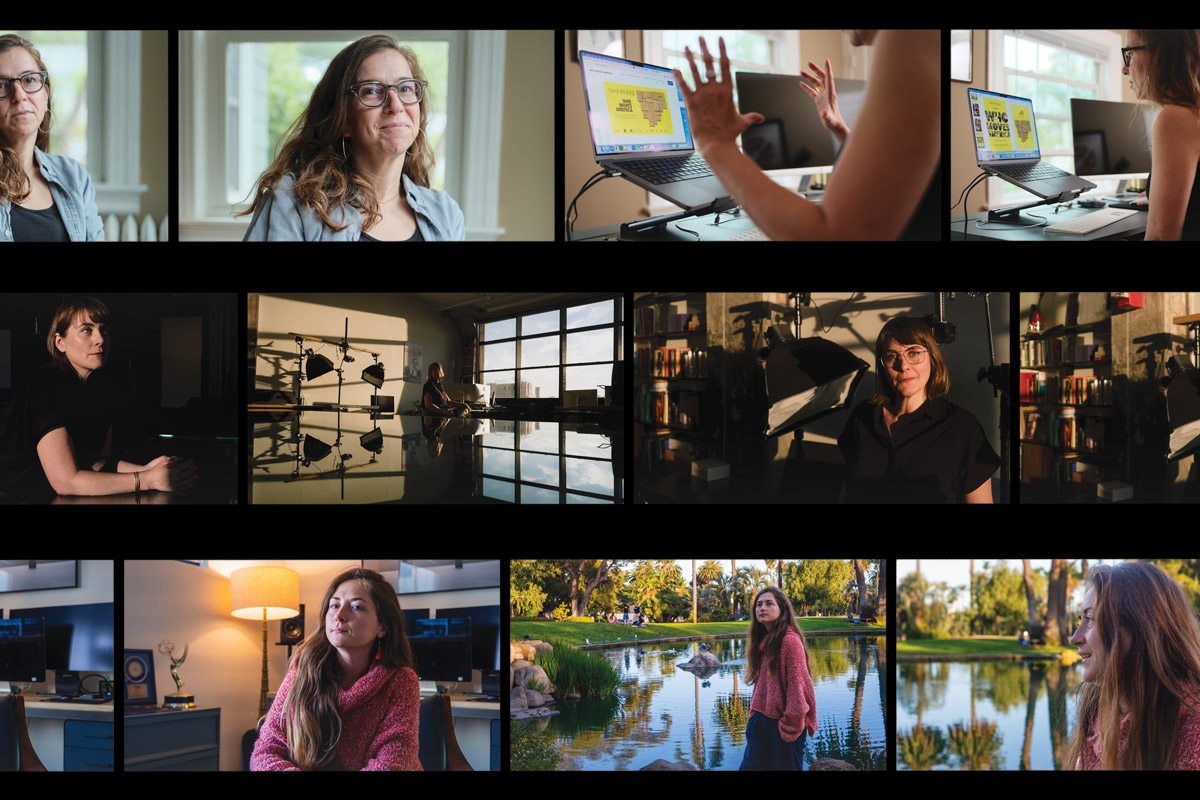
A Director, an Editor, and a Producer Reflect on Their Journeys to the Frontlines of Documentary Filmmaking
Reed has nurtured influential documentarians like Amy Foote '00, Yael Bridge ’05, and Lucy Sexton ’12.
It all came down to a pair of hands.
While editing All the Beauty and the Bloodshed (2022), a documentary about artist and activist Nan Goldin, editor Amy Foote ’00 made a decision that she might have previously avoided: to cut to a close-up shot of Goldin and one of her fellow activists holding hands. “I always chuckle to myself about that particular shot because I normally hate when editors use hands as a cutaway. It feels lazy.” Amy says. “But I made an exception to my rule in this scene because of the emotion shared by the connection of [them] holding hands. Their trembling hands showed just how much was at stake.”
To unite real-life images in an expression of story and emotion is the job of a documentary filmmaker—and it’s a job that Amy, who is a member of American Cinema Editors (ACE), says Reed prepared her to practice. “When I first had to dig through raw footage and build scenes, I thought, ‘Well, this is actually a lot like writing my thesis, where I looked through primary sources and documents and then had to create an argument out of it,’” she says.
While Reed first launched its film and media studies major in 2024, the college has always offered an intellectual framework that nurtures promising filmmakers, including Amy, Yael Bridge ’05, and Lucy Sexton ’12. Each embraces a different role in the filmmaking process—Yael is a director and Lucy is a producer—but the combined story of their respective careers helps illustrate how Reedies have influenced the evolution of documentary storytelling. Not to mention how they’ve built on the breakthroughs of other influential Reedie documentarians, such as Laura Nix ’89.
“I remember [Professor Jacqueline Dirks ’82] said to me, ‘Okay, you have enough material. Now you’ve got to say something about it,” Amy recalls. “That is the struggle when you have 300 hours of raw footage and you have to craft a narrative into a feature-length film. How will I introduce the characters? And when/how will I set up the engine of the story?”
The Director
In Yael’s three-minute, black-and-white documentary Chicken and Zoe (2012), a young girl watches her father, a farmer, kill a chicken. “If the chicken had a soul, it’s gone,” the father says. It’s a snapshot of ordinary life at once simple and profound, showing childhood innocence colliding with grown-up reality.
“I just got really, really lucky, to be honest,” Yael says of Chicken and Zoe, which she directed while studying documentary film and video at Stanford. “He was a really incredible father—and had a wonderful, matter-of-fact way of speaking that was really clear-eyed and unromantic. That was movie magic, as it were.”
For Yael, the path to capturing true movie magic was far from straightforward. At Reed, she signed up for an introductory art class, but balked at her first assignment: to draw whatever she wanted on a gigantic pad of paper. “I just exited out the back door,” she remembers. “I’m not artistic in that way, and I found it really terrifying.”
The door to visual storytelling, however, did not fully close for Yael. With advising by Professor Daniel Reisberg [psychology 1986–2019], she wrote her thesis on self-knowledge and bias, topics that proved relevant to her future filmmaking career. “Specifically, I was really interested in how memory changes over time—and how we change as a result of our memories changing,” she says.
At first, Yael was more interested in editing than directing (“I didn’t have a real sense of, ‘I’m going to be a director and I’m going to make films that are relevant to my values,’” she recalls). That changed when she made her feature directorial debut with The Big Scary “S” Word (2020), a film about the history of socialism in America that helped solidify her passion for making films about
the power—and possibilities—of systemic change.
“People were trying to weaponize that word, socialism: ‘Oh, it’s terrible, it means everyone in uniforms. You’re not going to be able to, like, read the newspaper,’” Yael says. “We thought that would be a great topic to explore: ‘What does this word mean? And what is its history in this country?’” The result of that exploration is a film that follows two financially desperate Americans (a public school teacher and an ex-Marine) who turn to socialism, inspired by Bernie Sanders’s 2016 presidential campaign.
While The Big Scary “S” Word features a parade of progressive rock stars (including Sanders and Alexandria Ocasio-Cortez), Yael cautions viewers against looking to her film for lessons about influence and charisma. “What was really important to ask in making that film—and every film that I’ve made or worked on since—is being sure to not have it just be about one person,” she says. “It’s kind of dangerous to lift up an individual. That person can falter.”
That philosophy applies not only to Yael’s films, but her filmmaking process, which is rooted in collaboration—including with fellow Reedies like Gilded Age star Morgan Spector ’02 (a Big Scary “S” Word producer), Sasha Leitmann ’16 (a Big Scary “S” Word co-producer), and Amy Foote (who served as a consultant on Who Moves America, Yael’s 2026
documentary about a potential UPS Teamsters strike).
“There is this [idea of], ‘Oh, it’s the director, it’s the director’s vision’—this auteur theory of filmmaking that I feel has always been wrong, and is also historically incredibly sexist,” Yael says. “I try to use the word ‘we’ in filmmaking, especially when I’m directing.”
The Editor
Midway through the Emmy-winning documentary Girls State (2024), there’s a scene that sums up the tension at the heart of the film. Disappointed by the Missouri chapter of Girls State (a national summer leadership and citizenship program), high school junior Emily Worthmore confronts what she sees as the organization’s restrictive treatment of young women—and voices her suspicion that a nearby Boys State chapter offers a far more politically engaged experience.
Suddenly, the scene shifts to Boys State, revealing fast-cut images of young men shaking hands and delivering speeches. Just like that, Emily’s hunch is confirmed. “Magic happens when I find juxtapositions between scenes that make them more than they are by themselves,” says Amy Foote, who won a Cinema Eye Honors Award for editing Girls State. “When scenes are in the right spot they create a dialogue with the scenes around them that engages the viewer to make their own connections. They’re speaking to each other.”
Making scenes speak to each other is one of the most difficult parts of the filmmaking process. While directors get the most credit, editors are directly responsible for the making of the final product—particularly in the case of documentaries, which can require an editor to discover and craft a coherent narrative from hundreds of hours of unscripted footage. “In the process of building a film, I start by editing an assembly of scenes I’ve cut from the raw footage that I think tell a story,” Amy says. “Once I have everything assembled, I look for the emotion in the scenes and iterate on the structure until I get it right.” That’s a little like saying that constructing the Empire State Building was like figuring out the structure of a few floors.
Today, Amy is one of the industry’s most acclaimed documentary editors, having frequently collaborated with legendary filmmaker Laura Poitras (All the Beauty and the Bloodshed, Citizenfour) and won two Emmys (one for 2020’s Father Soldier Son and one for 2025’s Cover-Up, which was also directed by Poitras). Recently, she was selected to be one of the 20 Artisans of Cinema Eye’s second decade, one of the most notable honors a nonfiction filmmaker can receive.
Like Yael, Amy didn’t initially consider a career in film. “I was just a fan of films, especially documentary films,” Amy says. Her early favorites included Crumb (1994), Plutonium Circus (1994), and Promises (2001), a documentary about Israeli and Palestinian children that she first saw at a theatre in New York’s East Village.
“At the end of the film I had tears streaming down my neck,” Amy recalls. “And looking at the credits through my tears I thought, ‘Wouldn’t it be amazing to be part of creating this experience I just had for someone else?’”
Just a few years after seeing Promises, Amy was working 20 hours a week as an unpaid intern on the documentary series Flying: Confessions of a Free Woman (2006). Over the course of three years, she ascended from intern to co-producer, ultimately deciding that she preferred editing.
“I have a stutter—and being on the phone really brings out my stutter,” Amy says. “So being a producer and cold-calling people was not at all something I would have wanted to do. And editing was where all the storytelling and creative puzzling was happening. That is where I wanted to put my energy.”
While Amy is best known for her work on Poitras’s films, our conversation gravitated toward Girls State, which was filmed shortly before the Supreme Court overturned the constitutional right to an abortion. That looming decision casts a shadow over every frame of the film, amplifying the urgency of a story of young women emerging as leaders while distant, powerful forces dictate their futures.
“I originally made the assembly without using any interviews, to see how far we could make the scenes tell the story,” Amy says. “But we needed those interviews to get inside the heads of the girls, especially because a lot of them were holding back how they really felt in public.” The result- ing film makes you feel the intensity of the girls’ ambitions, especially when they face obstacles.
Throughout Girls State, the phrase “incompatible for comparison” is used to justify denying Girls State students the same opportunities as Boys State students. I asked Amy about gender equality in the film industry, particularly among editors.
“I don’t see gender inequality in editing in documentary film,” she says. “However, I do see inequality in other areas. Men are given many more opportunities to direct. And when a male director premieres a film at Sundance for instance, offers to direct more films seem to pour in. I’m not seeing that for equally talented female-identifying directors, unfortunately.”
The Producer
If a director oversees the making of a film and an editor puts the pieces together, a producer—well, it depends on who you ask. The job of producer is notoriously nebulous, with filmmakers who earn the coveted “produced by” credit ranging from artists engaged in every aspect of a film to financiers whose work ends with the signing of a check.
“Documentary producers, we wear almost every hat,” says Lucy Sexton. “I think sometimes, ‘Is this project going to grow a skill or grow a muscle that I haven’t either used in a long time or would be a new challenge?’” Among the skills she has mastered: fundraising, research, and the organizing of Tupperware-themed dances (for a scene that was sadly scrapped from the Netflix series Dirty Money).
As the daughter of former New York Times sports and metropolitan editor Joe Sexton, Lucy spent much of her childhood in a newsroom, providing the paper’s photojournalists with a kid’s perspective on current events. “They’d be like, ‘Here, we’re choosing between these two photos for the front page tomorrow. Which one do you like better?’” Lucy recalls. “Who knows if they really ran with whatever I chose.”
After graduating with a BA in political science, Lucy embarked on a postgrad odyssey that was daring and eclectic even by Reed standards. “I definitely see a lot of raised eyebrows when [people] look at my résumé: ‘Owned a restaurant! Wrote articles for The New York Times! Have a master’s degree in intelligence studies!’” she says. “All of that goes into helping me be a good storyteller, and also a smart journalist and investigator.”
The stories and subjects of Lucy’s films vary wildly, from a feud between a Swiss art dealer and a Russian oligarch to Ariana Grande’s Sweetener World Tour to the 1979–81 Iranian hostage crisis, which she investigated in the HBO series Hostages (2022).
To understand the trauma endured by hostages and their families, Lucy travelled to Washington, D.C., to meet Babak Namazi, an Iranian-American whose father and brother had been wrongfully imprisoned in Iran (each was released after more than half a decade in captivity). “We wanted to see if there was a way to weave in a contemporary story,” Lucy says. “That’s why I was in Washington, DC, when I got the news that my father had been taken.”
Despite their shared passion for investigation, Lucy had forged a different career from her father’s. (As a third-grader, she barred him from editing her work after he added the word “divine” to a writing assignment.) Now she was in the painful position of making a film about hostages while her father was held captive by a Libyan militia, which had kidnapped him and his colleagues as they reported on the murder and mistreatment of migrants.
“In the moment, it didn’t necessarily feel like some sort of sick, cruel thing,” Lucy says. “I was focused on getting through every five minutes at a time, on top of producing. When you’re in the field, those are 16–18 hour days. I was running—and wasn’t really processing or stepping back and seeing if there was any kind of dark, tragic irony to it all.” She continued to produce the series and found time to bring Joe’s plight to Roger Carstens, President Joseph R. Biden Jr.’s special presidential envoy for hostage affairs—who she happened to be filming for the series.
After several days, Joe was released. He went on to collaborate with Lucy on a feature for The Atavist about their respective experiences of his capture and their work as journalists and storytellers. “I think it was really a story about us and our love for each other—and also, our love for the work that we do,” Lucy says. “Writing and investigating and journalism have been like a bridge between us. Even just writing that story together was like a form of conversation and almost therapy, I would say, for us.”
With Hostages and the Atavist article, Lucy accomplished some of her most adventurous and personal work—qualities that she hopes to harness as she transitions to directing. It would be easy, she says, to fall back on “safe” documentary genres like sports and true crime, and she doesn’t want her directorial debut to be safe.
“I think we need a lot more storytelling where people are courageous enough to open up their heart and soul and their family—and really put that all out there,” Lucy says. “So that’s what I look for.”
Closing Credits
Every filmmaker has a favorite part of production. For Yael, it’s postproduction, when she can condense the footage she’s captured from a series of isolated scenes into a continuous story.
“When you’re out in the world, it’s very overwhelming—you could point your camera anywhere, anything could happen,” she says. “And so I love being in the edit. We have all the puzzle pieces.”
Building a successful career in documentary filmmaking can be a lifelong puzzle, but the pieces have come together for Yael, Amy, and Lucy. Yael’s Who Moves America (on which Isabel Lyndon ’17 was a producer) was released this year; Amy recently consulted on and finished Sam Green’s film The Oldest Person in The World; and Lucy has been working on a documentary about weather forecasters and the struggles they face when they confront the climate crisis.
“I think I approach a lot of the stories with an investigative-journalist perspective,” says Lucy, who cites the critical-thinking skills she honed at Reed as a significant influence on her filmmaking. “I’m really intrigued by stories where there are a lot of questions that haven’t quite been answered. And so I just want to constantly dig deeper.”
Tags: Alumni, Books, Film, Music