History or Fiction?
In a new Chinese humanities course, students try to uncover what an influential Silk-Road traveler may have looked like.
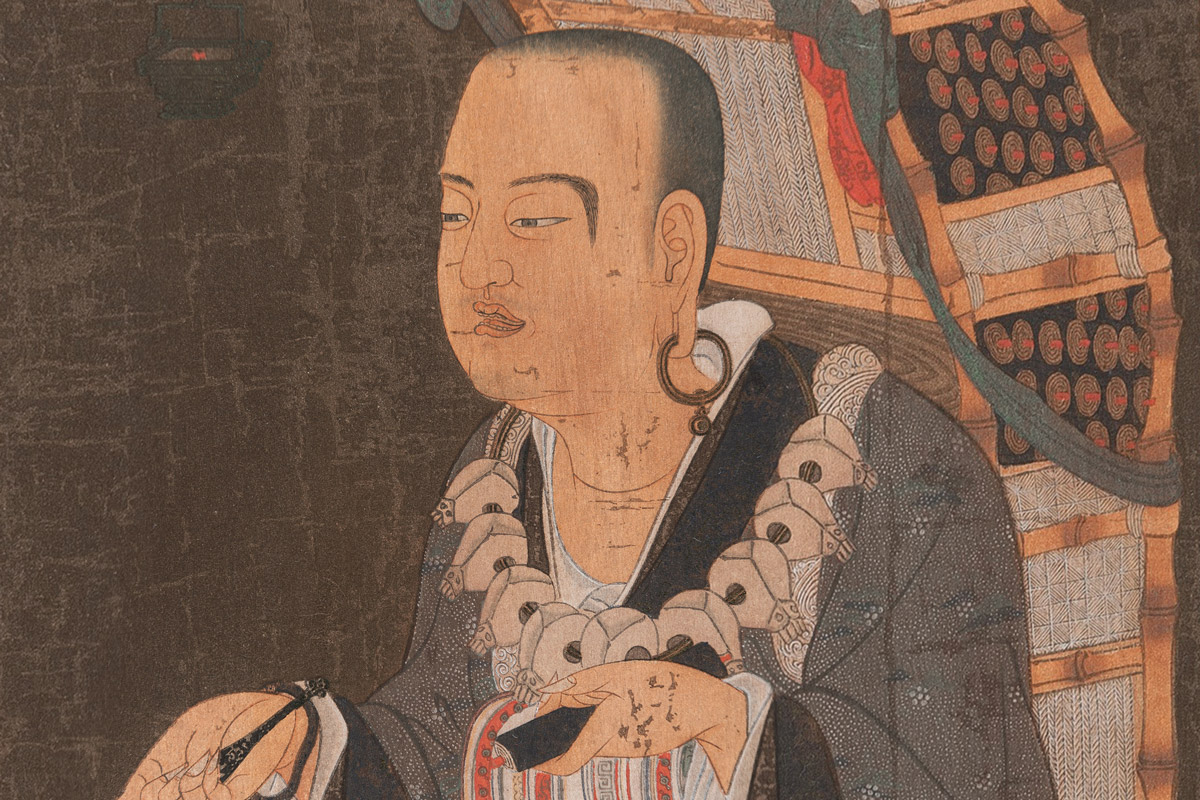
What did Xuanzang look like? As one of the most influential travelers along the Silk Roads, the tales of his pilgrimage from China to India in the seventh century spread across East Asia. But like many figures in premodern times, he did not leave any portrait during his lifetime, and we may never know what he looked like. Meanwhile, his image was produced and reproduced as a Buddhist scholar, a fictional figure, and even a deity. The new Humanities 232: Empires (Medieval China: From the Tang to the Yuan Dynasty) course explores Xuanzang as a multifaceted figure in history, storytelling, and hagiography. Designated as an Important Cultural Property by the Japanese government, the handscroll produced around the fourteenth century is widely used to illustrate Xuanzang as a historical pilgrim, in contrast to a fictional character in Journey to West. However, art student Camille Daley ’28 pushed this boundary between history and fiction in her course paper. The visual representation of Xuanzang in stride, holding a fly whisk to dispel evil and a sutra scroll for recitation, falls into the tradition of visualizing itinerant monks in East Asia. Despite the painting’s realistic touch, Buddhist devotees would immediately decode its embedded symbolism, worshipping Xuanzang as a model and, as Camille describes it, a “religious icon.”
Tags: Academics, Object of Study