Reedies Win (And Lose) in This Year’s Midterm Elections
Amid a "blue tsunami," several alumni made waves.
This year’s historic, remarkable midterm elections are now being called a “blue tsunami,” such were the historic wins of the Democratic party.
In the House of Representatives, Democrats running for House seats won the largest share of the popular vote since 1976 and the party is on track to win one of their largest majorities in that chamber since 1991 (when they had 267 seats).
One Reedie played a consequential role in those results.
Since 2023, Suzan DelBene ’83 has served as the chair of the Democratic Congressional Campaign Committee (DCCC), which works to recruit, fundraise, and campaign for Democratic House candidates.
The morning after the election, DelBene led the way as Democratic House leadership walked into the DCCC’s press briefing room. Speaking to reporters, DelBene said House Democrats approached this year’s midterms with a “very simple arithmetic” problem—regaining power by flipping just four seats.
“We hit that mark and then some,” she said.
Her remarks were peppered with phrases many Reedies would recognize. “This historic victory was resounding and impressive in its depth and in its breadth,” she said.
She spoke of the “hubris” of “every Republican scheme to rig the midterms,” including gerrymandering districts, legal challenges to vote-by-mail, and removing people from voter rolls.
Hakeem Jeffries, likely to become the next Speaker of the House, thanked DelBene in his remarks, praising her “extraordinary leadership and stewardship as our field general,” which helped lead to House Democrats’ victory.
Marie Gluesenkamp-Perez ’12 is one incumbent Democrat who benefitted. Elected to a third term representing Washington’s Third District, which includes Vancouver and Southwest Washington, Gluesenkamp-Perez won by more than 53%. It is her largest margin of victory yet, even though the race was expected to be close.
Gluesenkamp-Perez has caused rancor among progressive Democrats for occasionally breaking with her party. She has defended herself by saying that her positions, which emphasize helping working-class people, reflect her district. A political analyst who spoke to Oregon Public Broadcasting after the election said that Gluesenkamp-Perez's approach is working—and that Democrats should continue to focus on affordability and accountability.
During the DCCC press conference, DelBene attributed Democrats’ victory to the candidates, saying they are “deeply connected to their districts in their own way.”
“There were no cookie-cutter candidates,” she said.
At the state level, Marcia Morey MAT ’79 was reelected to a sixth term in North Carolina’s House of Representatives, handily winning by 93%. Representing parts of Durham County, Morey is one of the few openly LGBTQ members of North Carolina’s legislature.
She calls herself a “lifelong progressive.” That means “fierce advocacy to help people to improve their lives and have hope,” Morey said. “It’s not left or right.”
The changes to North Carolina’s state legislature are some of the more dramatic in the country. After 15 years of Republican control, Democrats now have a majority in the North Carolina House (for the first time since 2010) and made gains in the Senate.
Morey called the results “astonishing.”
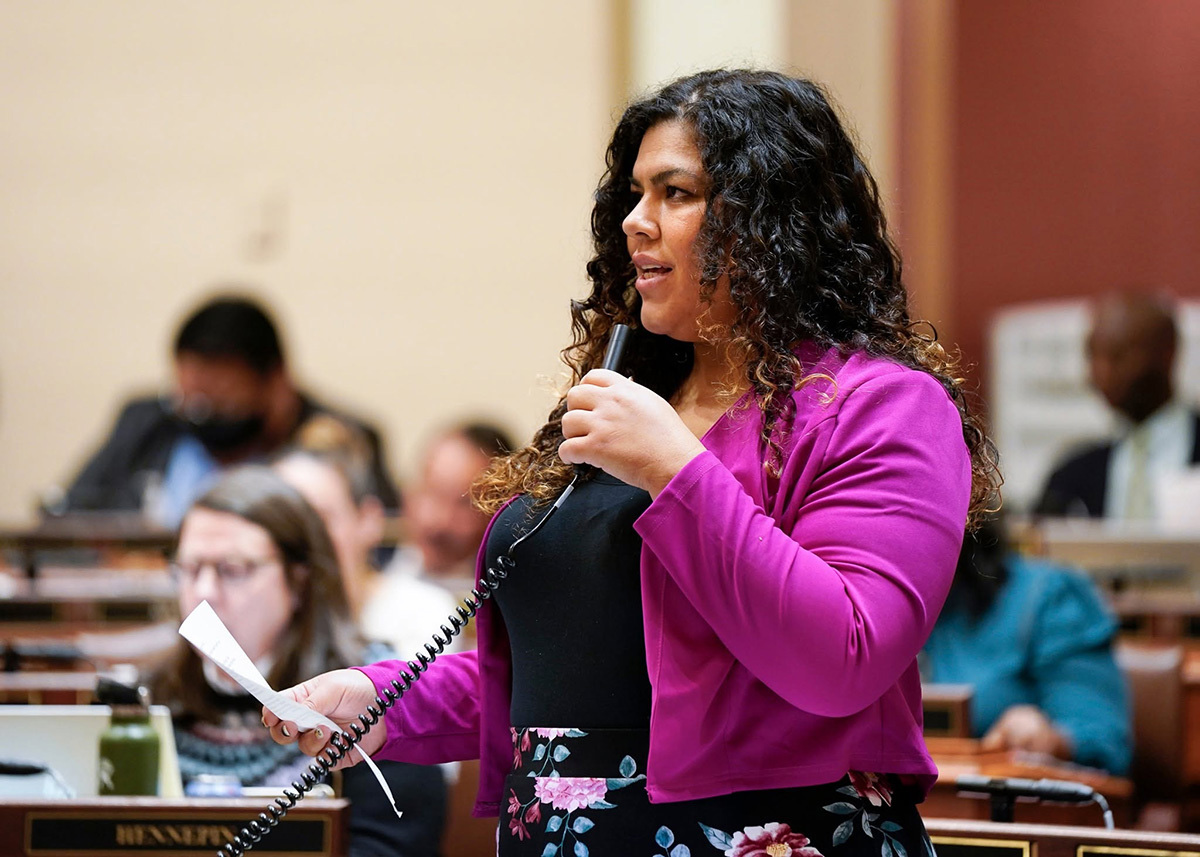
Athena Hollins ’05 was reelected to the Minnesota House of Representatives, representing parts of St. Paul. A member of Minnesota’s Democratic-Farmer-Labor Party, Hollins serves in House leadership.
Other Reedies ran for elected office, but did not fare as well. David Roth ’92 ran for a Vermont State Senate seat, losing to his Republican opponent by less than 2%, the equivalent of 172 votes.
In Oregon, Joanna Robinson ’10 sought to flip a reliably Republican seat and represent parts of Albany in Oregon’s House of Representatives. Her opponent, a four-term Republican incumbent, defeated previous Democratic challengers by double digits. Although Robinson lost, she came close, receiving 48.1% of the vote.
Yi-Kang Hu ’95 won election to serve a full term as mayor of Tigard. Hu was first elected to the Tigard City Council in 2022 and became mayor in October 2025 after the Tigard City Council appointed him to the position, vacated by the resignation of the mayor.
For two Reedies, this election was anticlimactic, since they had won their races outright in the May 2026 primary. Oregon elects its judges in nonpartisan races. Chris Garrett ’96, a judge on the Oregon Supreme Court, ran unopposed. He has held the position since 2019.
Christine Lewis ’07 has served on the Metro Council, the governing body of the Portland metropolitan region, since 2020, representing parts of Portland and its southern suburbs. She has won each of her elections. This year, she won by her widest margin yet—99%.
“It was quite humbling to see the sheer volume of people who bothered to fill in a bubble in an uncontested down ballot race,” Lewis said, noting the number was more than the capacity of a Blazer’s game.
She attributes those results to “working really hard.”
“My community knows that I’m standing up for them,” she said.
Both Lewis and Morey think that local legislation and policy will mirror the calls for the change at the federal level.
“Affordability and stability is something everyone is talking about,” Lewis said.
“It’s the people speaking to us that they want dramatic change,” Morey said. “We have heard the mandate.” She intends to pursue increasing the state’s minimum wage, strengthen labor laws and environmental protections, and introduce gun safety measures.
Morey, laughing, quipped that after years of being in the minority and not being able to amend bills or debate them on the House floor, “I will have to change my personality from being grumpy.”