Our House
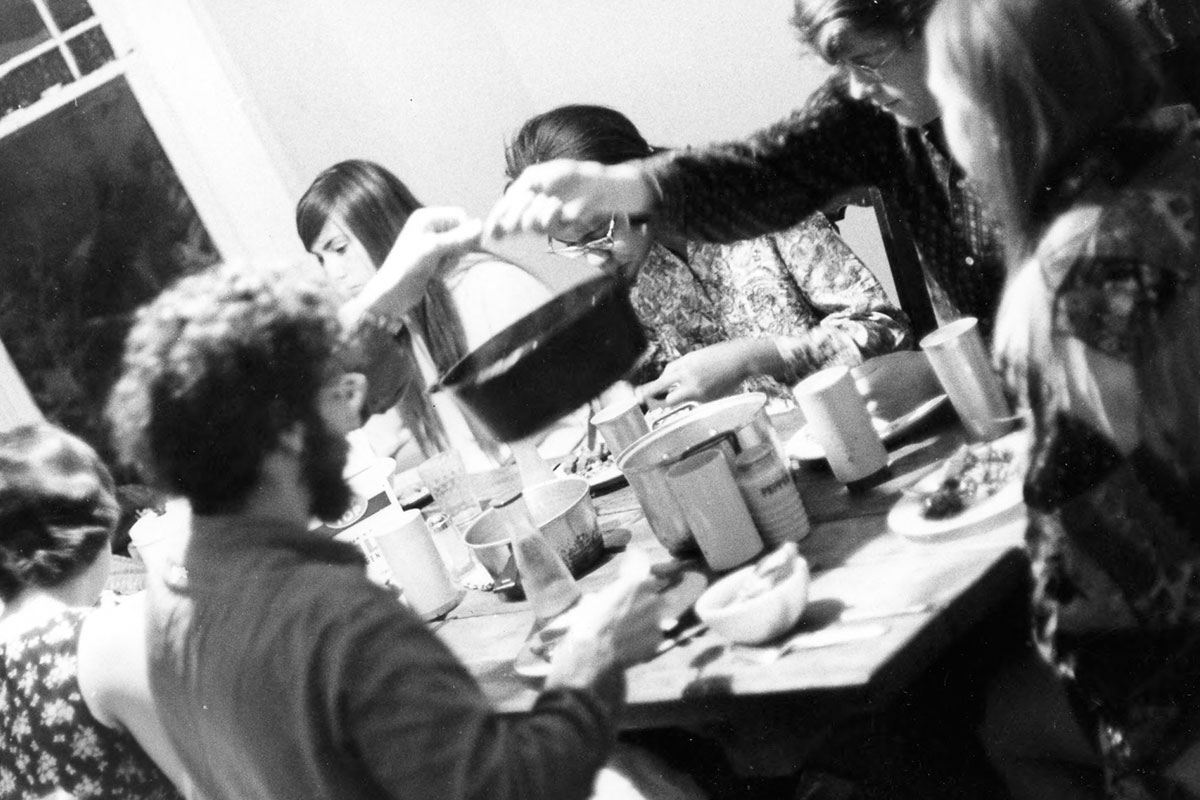
Reedies often took over big Southeast Portland houses in the mid-late 20th century, creating memories that lasted a lifetime. The tradition of communal living didn’t end with them.
The Bloodshed, the Dust Bin, the Frigidaire, the Cube, the Maison D’Etre, the House of House, the F.R.O.L, the Whirlpool, the Center of the Universe.
They aren’t band names. They’re famous off-campus Reed houses.
The sites of potluck dinners, friendships turned to family, late-night parties, and even the birth of the Beat Generation, off-campus Reed houses have long held eras of the college’s history within their walls.
It all began at the original “Reed House” at 1414 SE Lambert Street. Home to a group of iconic Reedies in the late 1940s and early 50s, poets like Gary Snyder ’51, Philip Whalen ’51, Lew Welch ’50, and a whole other cast of characters who, at one time or another, holed up in one of the house’s bedrooms or its basement.
At that time, many of the Reedies who lived off campus were nontraditional students who had come to Reed on the G.I. Bill after serving in World War II. Such was the case for many at Lambert House.
“It was economical, it was cooperative, we all shared in a lot of cooking,” recalled Snyder in an interview for the Reed’s oral history project, an alumni-led undertaking for the college’s 2011 centennial celebration. “We had good potluck meals together, and we got a lot of study and scholarship done. It was just the right balance. Most of us biked to school, a two-mile ride. There was a sense of family. We had Thanksgiving dinners together there.”
Reed houses were venues for legendary parties and the usual young adult mayhem, but they were also hotbeds for intellectual discussion and places where important ideas were born that would, for some, turn into great works or lifelong careers. This was true for Snyder, who published his first poems while at Reed, and later earned the Pulitzer Prize for his poetry.
By the ’60s, living off campus in Reed houses had become a “tradition,” according to Richard Burkhart ’69, who stayed in one for a summer.
“The Reed houses are sort of like a commune. They’re a form of commune, because people come and go,” he said in his oral history interview. “Often you might make meals, sometimes individually or communally, or have communal activities. It’s very fluid, sometimes with one or two other people, sometimes the whole group. Sometimes everyone’s got a party. Or sometimes you just do your own thing. But it is a communal kind of experience.”
They became sites of typical odd legends and stories, too. Like the Fish Market, a set of apartments over two storefronts on the corner of Powell Boulevard and 21st Avenue. Sandy Cutell ’63 recalls that household inviting Elizabeth Gurley Flynn, the head of the Communist Party, over for dinner while she was in Portland. Another Reed house, the Cosmos, just off Steele Street, was turned into a zendo by Reed students Len Brackett ’70, David Simon ’70, Bob Wollheim ’70, Frank Poliat ’70, Laura Shill Schrager ’70, and Sam Schrager ’70.
Jay Wylie ’67 called living off campus a “specifically Reed thing”—something that perhaps wasn’t as prevalent at other colleges at the time.
“You go home, and you’ve got to cook dinner, and you had real life as well as this life of the mind that people have been talking about,” he explained in a group oral history interview. “And so there was something more integrated about living off campus and going to class here than there was in places where it’s all dorm life and kegs and stuff.”
Part of this was probably because unlike many other institutions, Reed never had Greek life programs. This meant when students did live off campus, it wasn’t in fraternity or sorority houses, but in more cobbled-together, free-wheeling living situations.
Greg MacNaughton ’89, now Reed’s Calligraphy Initiative coordinator and education outreach coordinator for the Douglas F. Cooley Memorial Art Gallery, lived in a few houses while at Reed with up to six roommates: the R House (the original source of the red “R” still hanging in the Student Union), the Long House, and, briefly, the Ponderosa House.
For him, the communal living aspect offered a way to share with others, and a chance to learn how to be an adult—by cooking his own meals, keeping up on housework, and paying rent.
“What I recall really was a kind of hospitality that was really nurtured in those houses, by which I mean, ‘We're making dinner, come over for dinner. In fact, bring your whole house over. We're gonna have X house come and visit Y house. Yeah, and we're gonna feed you all,’” MacNaughton says. “There was that kind of sharing of food, sharing of space, sharing of self.”
To this day, MacNaughton still lives communally with other Reedies, including his wife, Amanda Yampolsky ’90, whom he met at a Dust Bin party.
The Reed houses were a break with earlier Reed tradition. Prior to the popularity of communal off-campus living, the college was split between those who’d traveled from far away to attend Reed and lived in the dorms, and native Portlanders who continued to live off campus, usually with their parents, and were referred to as “day-dodgers.”
Martha Powell Wilson ’25 relayed the experience in her oral history interview.
“Most students lived off campus like me and were called day-dodgers,” she said. “I would get up early and walk down to the depot in Vancouver to catch the three-car train that crossed the Columbia River to Portland, and ride that to where I met a streetcar. I had to take three streetcars to get to Reedway, and then I would walk a mile up Reedway to campus for my 8 a.m. class. Reedway wasn’t a street mind you, it was a path. It took me about an hour and a half to get to school.”
Things look a little different these days. Due to rising rent costs in Portland, Reed has made a dedicated effort to provide housing for students right on campus. Since the new Trillium dorm opened in 2019, Reed has been able to accommodate a total of 1,136 students each year. When students do live off campus, they still often live in houses together, or in apartments. In an off-campus student survey, a fifth of Reedie respondents said they lived with two roommates. Another fifth said they lived with three. Nearly another fifth said they lived with four. In that way, they keep the tradition of communal living alive. But unlike daydodgers of years’ past who walked, and many in the 20th century who biked, most respondents said they commuted to campus by car.
Despite cultural changes and changes to the city of Portland, Reed ensures students still spend a lot of time together, whether at Commons, in their dormitories, or in off-campus haunts, not only sharing spaces, but their experiences, which is what MacNaughton says communal living was always all about: “We were oriented around the table, inviting people in and making meals together—and sharing our lives.”