- 28 West
- Health & Counseling Center
- Kaul Auditorium
- Sports Center
- Greenwood
- Performing Arts Building
- Gray Campus Center
- Eliot Hall
- Vollum College Center
- Parker House
- Dorothy Johansen House
- Studio Art
- Biology/Physics
- Chemistry
- Psychology
- Library
- Educational Technology Center
- Greywood
- Birchwood Apartments
- Reed College Apartments
- Canyon House
- Garden House
- Farm House
- Sitka Residence Hall
- Sequoia Residence Hall
- Aspen Residence Hall
- Bidwell Residence Hall
- Trillium Residence Hall
- Naito Residence Hall
- Sullivan Residence Hall
- McKinley Residence Hall
- Griffin Residence Hall
- Woodbridge Residence Hall
- Chittick Residence Hall
- Bragdon Residence Hall
- MacNaughton Residence Hall
- Foster/Scholz Residence Hall
- Anna Mann Residence Hall
- Old Dorm Block: Winch
- Chinese House
- French House
- German House
- Russian House
- Spanish House
- Community safety vehicle 1 (Subaru)
- Community safety vehicle 2 (Honda)
- Community safety small medical bag (dispatch)
Narcan Emergency Kit Program
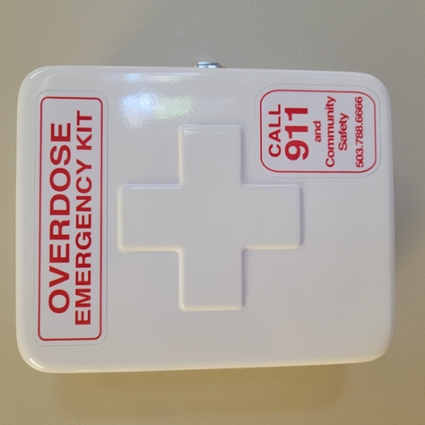 In collaboration with the health & counseling center, community safety ensures that Narcan/naloxone is available across campus. There are 46 opiate overdose prevention kits located around campus that each contain a CPR shield and two doses of Narcan brand nasal naloxone. There is one kit in every residence hall, 17 in non-residential campus buildings, and an additional three in first aid kits carried by community safety officers (CSOs). CSOs do weekly audits of all the naloxone, and replace doses as needed (when they are used, or near their expiration date). Every CSO is trained in basic first aid, including CPR, how to use an AED, and how to administer nasal naloxone.
For more information on nasal naloxone and how it is administered, please view this video created by the Multnomah County Health Department.
View a map of the Narcan/naloxone locations on campus or see the list below.
Narcan Emergency Kit Locations
Overdose Prevention
You can help keep your fellow community members safe! Learn about the emergent and urgent signs of alcohol or other drug overdose and our medical amnesty program. Please contact community safety with any questions.
If a person exhibits any of the following symptoms, they may be experiencing a medical emergency, and you should call for help immediately. Stay with the person until help arrives!
Emergent Symptoms
Urgent Symptoms
Medical Amnesty
Excerpts from Reed College's Alcohol and Other Drug (AOD) Policy:
Section VIII.A: According to this policy, when a student experiences a physical and/or psychological crisis while under the influence of alcohol or other drugs (AOD), neither the student in crisis nor the student calling for help will be subject to disciplinary action for personal possession or use of illicit substances, including consumption of alcohol by minors.
Section VIII.B: In cases of sexual abuse or physical assault involving AOD, student services staff will not pursue disciplinary action against someone who complains of a physical or sexual assault as a result of AOD use.
Medical Amnesty Application: There is no specific limit to the number of times a student may be granted medical amnesty. Any request for help may be considered "calling for help" under the policy, including phone calls, text messages, coming in to 28 West, in-person requests to CSOs, Night Owls, etc. All potential medical amnesty decisions are reviewed individually by both community safety and the dean of student's office.