A Walk with the Wildflower Woman
Barbara Robinson ’68 has dedicated her life to protecting the Columbia River Gorge. Amanda Lucier ’02 and I took a walk with her to witness that work firsthand.
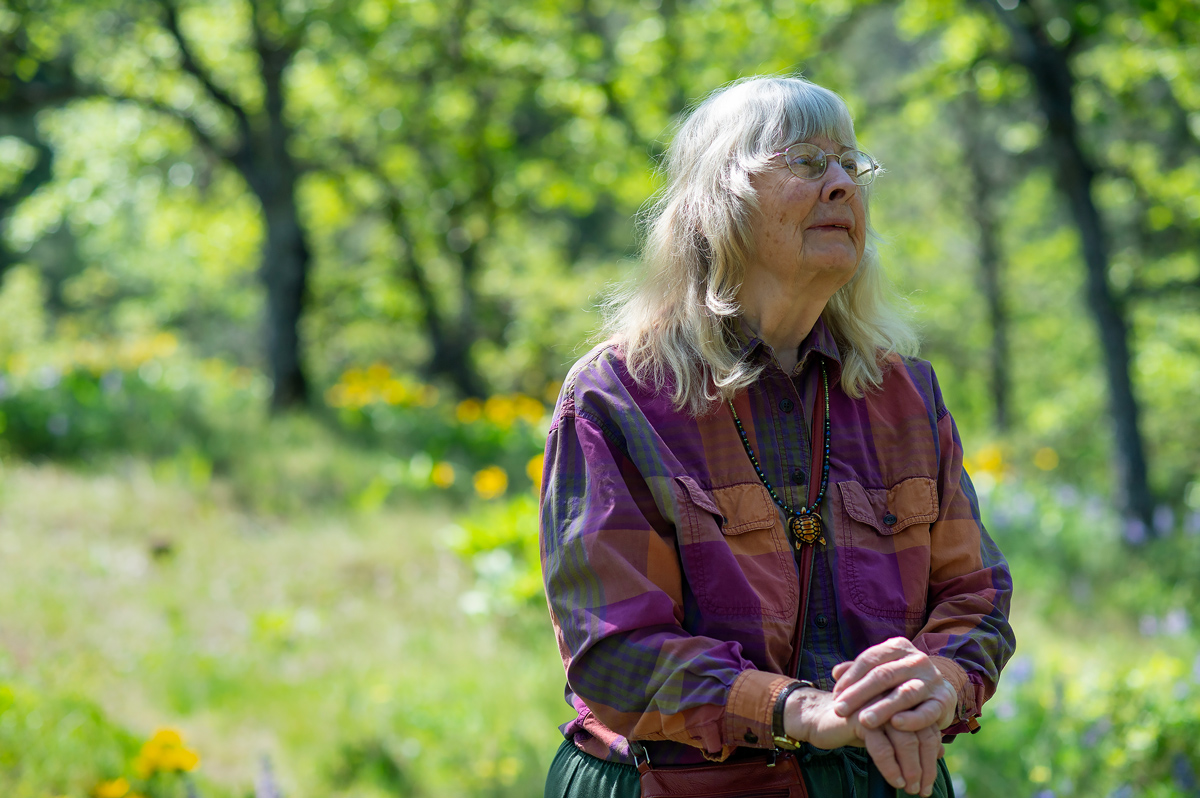
Master botanist Barbara Robinson ’68 has long helped preserve the public lands of the Columbia River Gorge. Dubbed “the wildflower woman,” Barbara received a lifetime achievement award from the Washington State Trails Coalition in 2024, a testament to her decades of commitment to protecting the beauty of the Pacific Northwest. Last spring, three generations of Reedies connected in the wilds to enjoy Barbara’s life’s work, as she, English student Faolan Cadiz ’25, and photojournalist Amanda Lucier ’02 went on a special trek through the trails of the Gorge.
■ ■ ■
When I arrive at the Rowena Crest Overlook to meet Barbara Robinson ’68, she’s sporting a floppy gray hat and carrying a ski pole. A wrong exit on the freeway left me 30 minutes late, but she doesn’t seem to mind. “I have something I want to show you,” she says.
Holding up a hand-drawn map against the view of the overlook, she explains the entirety of the geography. She points to a small mass of land in the middle of the Columbia River and identifies it as Memaloose Island; she had recently helped rescue a friend who was stranded near there with his kayak. Her hand waves over to the plateau on the left. “There’s the land I owned for all of 24 hours,” she says—in 1978 Barbara bought 34 acres of the Rowena Plateau for $5,000 and sold it to the Nature Conservancy the very next day. Mt. Adams looms over the river, the only mountain Barbara ever climbed. She motions across the river to a small town, traces her finger along the main street, stops and points out her own house.
“This is for you,” she says, handing me her map and a sign that says, “Please enjoy the beauty, and Stay on the Trail!”
Growing up in Chicago, Barbara felt the deficit of nature around her, which led her to the Pacific Northwest and to Reed. Her first train ride out west before her freshman year was filled with other East Coast and Midwest Reedies, waiting for the first glimpse of the trees and mountains.
As a young student, she intended to study physics. “Space, time, matter, energy, mind,” she says, were the most interesting things to her. But she ended up graduating as a double major in philosophy and psychology. She’d been fascinated by the powers of the brain, and philosophy and psychology, she explains, allowed her to access and address consciousness as a philosophical issue.
As we begin our trek, Barbara and I are joined by another Reed alum, esteemed photojournalist Amanda Lucier ’02. We head towards a nearby trailhead that takes us right over the bluff. Every couple of sentences, Barbara leans down to identify a plant for me. She always starts with the scientific name and then the common name. She explains her dismay with the
ever-changing scientific names, saying, “I love the knowledge, but hate the name changes.”
When she left Reed, Barbara headed south to study psychobiology at UC Irvine. In the end, though she was still fascinated by the functioning of the brain, she decided that the academic life of “publish or perish” was not for her. She also knew that she would have to accept any job she was offered, and was diametrically opposed to living in a major metropolitan city. She moved back to Portland and began working as a professor at Portland Community College, where she taught psychology and biology.
Purchasing the Rowena Plateau land marked the start of Barbara’s involvement in fighting for its preservation and for the wildflowers and native plants that inhabited it. In 1985 she raised the money to buy the 64-acre hilltop south of the plateau (McCall Point) for the Nature Conservancy. And in 1988 she started a formal experiment with the Nature Conservancy on the Tom McCall Preserve—a survey where she planted 760 balsamroot seeds in 23 test plots on the preserve. The goal was to see if the native sunflower could be reestablished from seed, and how much and how far the seeds would reproduce and spread over a certain period.
Our second destination is a trailhead located at a pullout off a winding road: the Old Scenic Hwy. After a short upward trek we arrive at a meadow of wildflowers surrounded by beautiful, small oak trees. Barbara instructs us to follow her, and we carefully step through the grass so as not to trample the balsamroots and lupines and Indian paintbrush—and to avoid poison oak.
Barbara tells a story about her friend Nancy Russell, a founder of the Friends of the Columbia Gorge and passionate environmental activist, whose work contributed to the creation of the Columbia River Gorge National Scenic Area. Barbara and Nancy, who suffered from ALS before her passing in 2008, had spent a substantial amount of time devoted to fostering the growth of the white oaks on Sevenmile Hill. Barbara brought Nancy to the trail for their last time there together, and they spent some of that time weeding and picking up cigarette butts. “What we understood was that this place is spiritual—it’s where people can fall in love with nature,” Barbara says.
Barbara pulls out an old plastic bag that she keeps in the back seat of her car. It’s filled with small bags of Doritos, Cheetos, Welch’s Fruit Snacks, and small tins of chicken salad. She offers me and Amanda the first picks; we both opt for Doritos. “Oh good,” Barbara sighs, “the Cheetos have always been my favorite.” Over our delicacies from her snack bag, we compare our experiences at Reed. Barbara lived in Westport Hall in the Old Dorm Block, while I lived in Foster.
Throughout her time at Reed, Barbara spent more time in the canyon than on the Great Lawn. Her sophomore year, she convinced Professor Bertram G. Brehm [biology 1962–93] to let her run an independent survey on the plant life in the canyon. “I wanted to get into the wild stuff,” she says. I tell her about the recent Earth Day celebration and my experience pulling weeds in the canyon without any gloves. “I never use gloves. You don’t need them,” she reassures me.
We spend an hour walking around the grounds of the Columbia Gorge Discovery Center, of which she was essential in the planning and planting. As we walk toward the building, Barbara stops and points down to one brick among many that bears her and her daughters’ names engraved on it. The path is paved with the names of all the donors and volunteers who made the construction of the Discovery Center possible. Opened in 1997, the Discovery Center has information about the Columbia River, the Gorge, and Indigenous peoples’ involvement.
As we walked around the grounds Barbara held a long screwdriver in her hand—her favorite tool for weeding—and stopped her story every five minutes to bend down and dig an invasive weed out of the ground. “There were a few days where I spent eight hours weeding,” she says. “And you learn humility because something without a brain, and even without nerve cells, can outsmart you.”
As we walk back to our cars and bid farewell I notice a pole sticking out of the ground. “Is that yours?” I ask.
“Yes,” she replies. She had left one of her ski poles stuck in the ground a few days ago when she was out weeding. We laugh and she tells me, “I’ve been absolutely absent-minded my whole life. I used to tell my students that I was so absent-minded, I had to be a professor.”
Before I walk away I apologize for my tardiness. Barbara smiles and says, “It seems that you and I belong to the same family.”
Tags: Alumni, Service, Climate, Sustainability, Environmental