A Chance for Exploration: Reed Zine Community Combines Art and Inclusivity
Recent Zine & Arts programming has centered the work of Asian American artists, blending art and belonging on and off the Reed campus.
They nicknamed the row “Reed Alley.”
Staff, students, and faculty visitors lined one of the halls of Fubonn, the largest Asian mall in the state of Oregon, and the site of Portland’s first Azn Zine Fest, co-organized by Reed’s zine librarian, Ann "A'misa" Matsushima Chiu.
“It was so nice to have both staff and faculty in attendance to witness it,” Ann says. “I am so proud of the Reed students who tabled their zines. It can be scary and intimidating to put your artwork out for the community to see, but they signed up and showed up!”
Including many Reedies in attendance, Azn Zine Fest hosted over 100 tablers and 1,600 visitors.
Chlöe Van Stralendorff, Reed’s visual resources curator, tabled at the event, and found the magic of the fest “energizing.” One of the best parts, she says, was interacting with Reedies in the affectionately-named Reed Alley.
“The Reed presence was special because the students asked if they could table next to me which meant the world to me,” Chlöe says. “I also had the opportunity to witness them be part of the zine community and really share what they’ve learned from the zine curriculum and programming Ann and I have organized and led at Reed.”
Professor Michelle Wang [art history and humanities] attended the Azn Zine Fest, too. “It was a wonderful experience to see a thriving Asian American art and zine scene in Portland and to see the ways that Reed engages with the broader community,” she says.
Growing up in Los Angeles, Ann says there was no shortage of vibrant, robust spaces for Asian artists. In Portland, the community is not as obvious, even though the talent and enthusiasm is everywhere. Ann wanted to make a community-centered space for Asian American zine artists, and worked with local organizers and artists to make that dream a reality.
Once the idea took off, several others joined in—including Natalie Soutonglang ’26, main organizer of the Asian Solidarity Network on campus, who Ann says was integral to making the event go smoothly.
“She held her own in a roomful of community organizers and professional artists,” Ann says. “She showcased the community-engaged and creative spirit that we value here at Reed.”
The Azn Zine Fest endcapped a series of recent Reed events focused on Asian American art. In February, cartoonist Yoko O.K. visited the Visual Resources Center on campus to co-host a risograph workshop.
“The goal is to give students a co-curricular experience using the machine and consider the possibilities of personal and academic projects,” Chlöe says. “[Everyone was] laughing, having fun, playing music, and connecting with each other, just like a resource center should be.”
Also in February, Ann moderated a discussion with two Asian American women artists—Yumi Sakugawa and Helen Oji. The Asian Solidarity Network organized students to attend the talk. Many of those students, Ann says, are artists and community organizers themselves, and benefited from hearing from Yumi and Helen about how to continue down paths that blend both art and activism.
Chlöe says her favorite question of the night came from Professor Shohei Kobayashi [music], framed around the theme of throughlines in each of the artists’ lives.
“The word ‘throughline’ really resonated with me,” Chlöe says. “I started thinking of Ann, and how she is a throughline on campus for zine, community, and togetherness.”
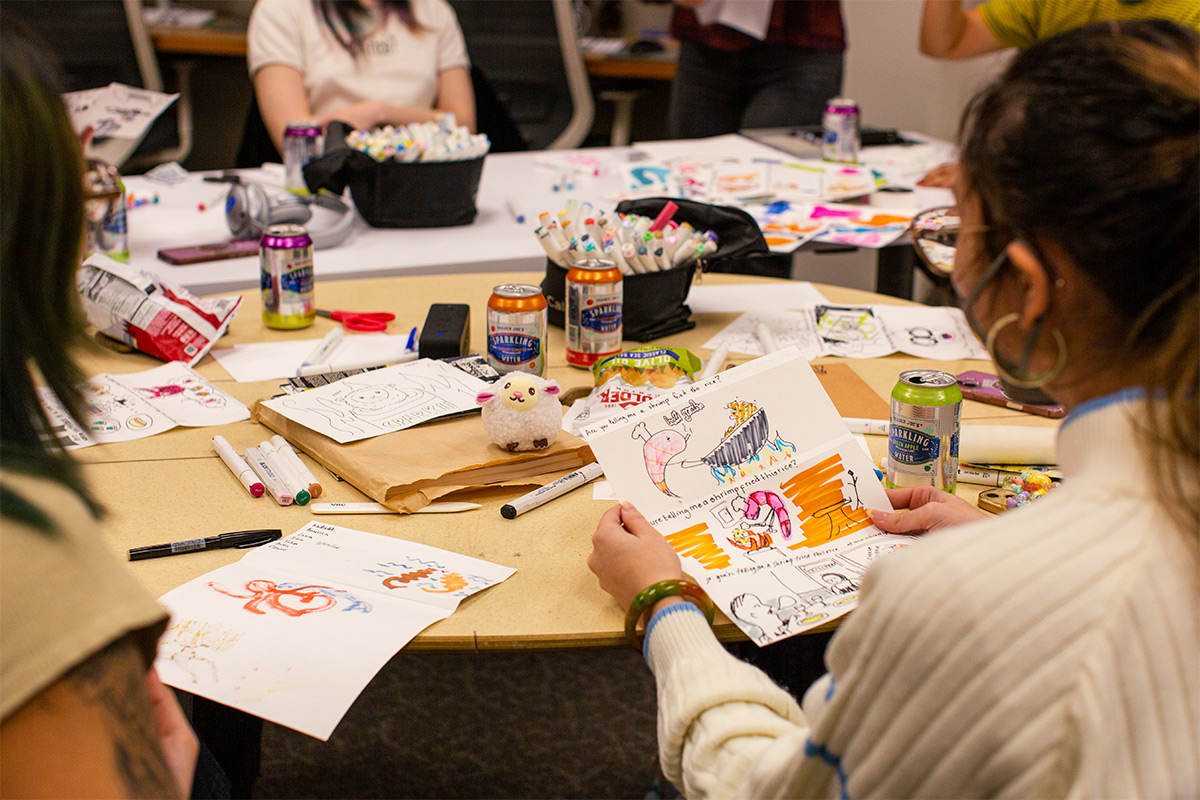
The Reed Zine & Arts Program was created by Ann and Chlöe for the purposes of teaching students transferable skills—event planning, leading a team of peers, developing creative ideas, formulating zine workshops, and having fun with new art ideas.
“Each year that passes we have more and more students who want to engage with the program and learn new zine and risograph skills, and we are happy to teach them and introduce them to more resources,” Ann says.
Ann and Chlöe keep in mind that Reed students need both structured academic applications and open creative exploration, which they offer with their zine and art programming.
“Through our collaboration, we discovered that our Zine & Arts programs extend far beyond just making art and zines,” Chlöe says. “They're about students meeting people who have interdisciplinary skillsets which inspire and empower them to explore their voice.”