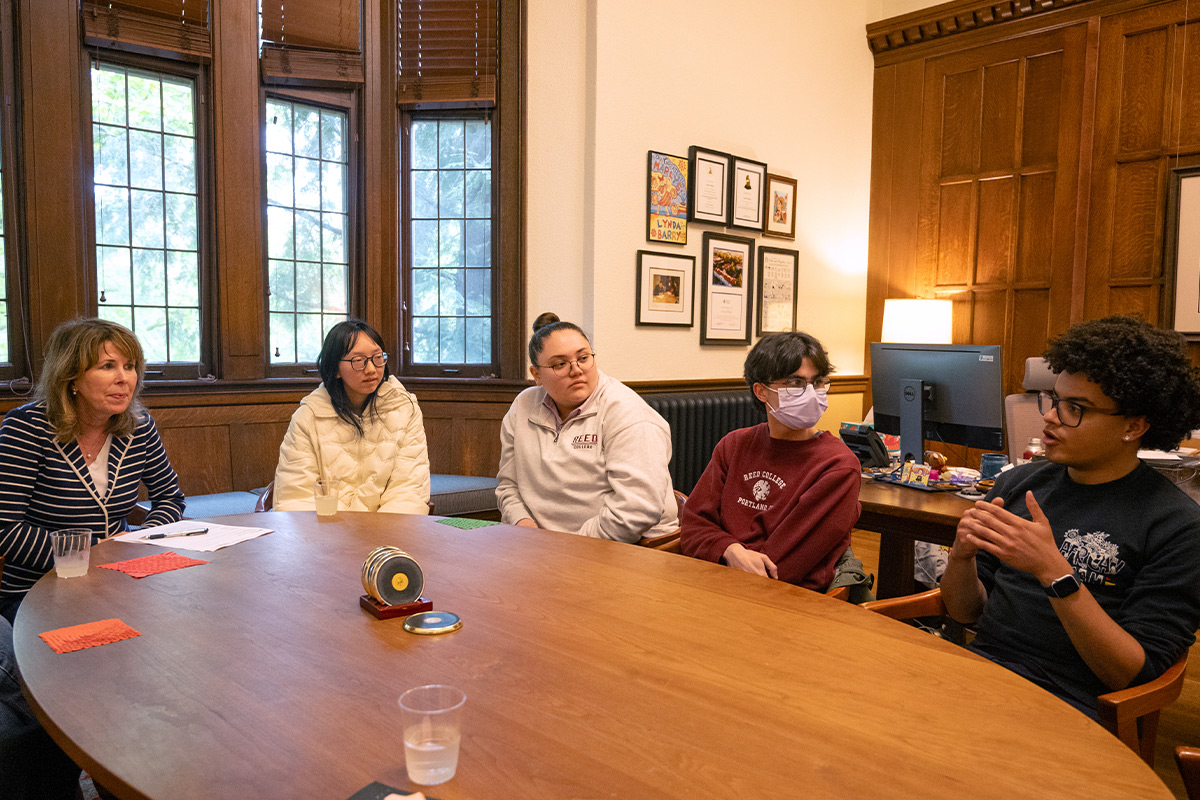
As a founding leader of the National Student Success Project, Bilger joins higher education presidents and associations in championing academic excellence, educational opportunity, and lifelong student success.
October 22, 2026
Press Release
PORTLAND, Ore. — Reed College President Audrey Bilger is among 19 college and university presidents and chancellors helping lead a new national initiative to strengthen student success, expand educational opportunity, and demonstrate the lifelong value of higher education.
The National Student Success Project, announced today in Washington, D.C., brings together a coalition of more than 50 colleges and universities committed to helping students realize their full potential during college and throughout their lives. Bilger serves on the project's founding advisory board, which has helped shape the initiative since its development began earlier this year.
As a founding leader, Bilger brings the perspective of Reed College, a nationally recognized liberal arts college known for its rigorous academics, close faculty-student engagement, and commitment to intellectual inquiry. Her participation reflects Reed's belief that an extraordinary education should challenge students intellectually while preparing them for meaningful opportunities and lives of purpose.
"As a first-generation college student myself, I want to be sure that the possibility of an extraordinary education at Reed College is made clear to students here in Oregon, the United States, and around the globe," Bilger said. "Students should be able to envision themselves at institutions like Reed and understand the transformative benefits of a rigorous liberal arts education. Reed provides students with guidance, resources, and support to thrive in their studies and long after they graduate. This national initiative gives us an opportunity to share what we are doing, learn from institutions across the country, and strengthen our collective commitment to student success."
Putting Student Success into Practice at Reed
The National Student Success Project establishes five core commitments that participating institutions will advance in ways that reflect their individual missions:
- Deliver strong value for the investment students make in their education.
- Empower students with clear and affordable pathways to a degree or other significant credential.
- Advance academic excellence through innovative programs and strong teaching.
- Ignite career ambitions through real-world experiences and robust guidance.
- Cultivate supportive communities that promote student success, civil dialogue, and respect for others.
For Reed, these commitments align with the college's longstanding emphasis on academic rigor, intellectual discovery, and the transformative power of a liberal arts education. They are also reflected in practical initiatives designed to help students navigate their educational journeys and prepare for life after graduation.
Two Reed initiatives will be featured on the National Student Success Project's website as examples of how colleges and universities are putting these commitments into action:
- The Center for Life Beyond Reed helps students connect their academic experiences with their aspirations for life after college. Through career exploration, individualized advising, internships, fellowships, graduate and professional school guidance, and opportunities to build professional connections, the center helps students clarify their goals, recognize the value of their skills, and gain experiences that prepare them for their next steps. Its approach emphasizes that career preparation and intellectual exploration are complementary parts of a liberal arts education, empowering students to pursue meaningful work and lives of purpose.
- Reed's Financial Wellness program equips students and the broader campus community with knowledge and resources to make informed financial decisions and build lifelong financial confidence. Coordinated by a committee of students, faculty, and staff, the program offers educational events, workshops, and access to financial literacy resources. By helping students develop practical skills in budgeting, money management, and financial decision-making, the initiative supports their well-being during college and prepares them to navigate financial responsibilities beyond graduation.
Beyond the initiatives featured on the National Student Success Project's website, Reed is also advancing student success through its broader commitment to affordability and access. Through the Reed Promise, the college provides tuition-free education to eligible U.S. students from families earning less than $100,000 annually with typical assets. This initiative builds on Reed's longstanding commitment to meet 100% of demonstrated financial need, helping ensure that talented and intellectually curious students can pursue a Reed education regardless of their financial circumstances.
Together, these programs illustrate Reed's commitment to an educational experience that combines rigorous academic inquiry with practical resources for personal and professional success. They also demonstrate how the college is helping students recognize and realize the value of their education in ways that extend well beyond the classroom.
"At Reed, we believe that an exceptional education prepares students not simply for their first jobs or graduate studies, but for lives of curiosity, adaptability, and purposeful contribution," Bilger said. "Programs like the Center for Life Beyond Reed and Financial Wellness help students translate their education into opportunity and give them tools to navigate an increasingly complex world. They are important examples of how we can pair the intellectual ambition of a Reed education with the practical support that helps students flourish."
A National Commitment to Student Success
The National Student Success Project responds to questions from students and families about the cost, accessibility, and long-term value of higher education. It seeks to make colleges' and universities' commitments to students more visible, measurable, and actionable.
Bilger serves on the project's advisory board alongside presidents and chancellors representing the breadth of American higher education, including public research universities, private liberal arts colleges, historically Black colleges and universities, community colleges, and regional public institutions.
Five national higher education associations are helping launch the project: the American Association of Community Colleges (AACC), the American Association of State Colleges and Universities (AASCU), the American Council on Education (ACE), the Association of American Universities (AAU), and the Association of Public and Land-grant Universities (APLU). The project is supported by Strada Education Foundation.
Together, these leaders and associations are working to identify effective practices, assess outcomes, and strengthen the ways colleges and universities support students from enrollment through graduation and beyond.
The project recognizes that student success will look different across institutions with distinct missions, student populations, and educational approaches. Rather than prescribing a single model, it encourages colleges and universities to demonstrate how they are fulfilling the five commitments through programs, policies, and practices suited to their communities.
More than 50 institutions are participating in the project's initial launch, and they are inviting other schools to join. The project's founding statement emphasizes the importance of collective action:
"Now is the time to accelerate our progress together. We will listen to students and other partners, assess outcomes, share effective practices, and strive always to improve. We aspire to build a movement to lift higher education to new heights, for the public good and for the students of today and tomorrow."
About the National Student Success Project
Colleges and universities across America are mobilizing to advance an agenda centered on the success of all students.
The National Student Success Project spells out five concrete commitments that define how institutions equip students to reach their full potential. They focus on value, affordability, academic excellence, career ambitions, and civil dialogue. All seek to address practical concerns from students and families. Participating institutions will show examples of how they are following through on the commitments, with specific policies and programs.
The project is organized by a coalition of higher education associations: The American Council on Education, the American Association of Community Colleges, the American Association of State Colleges and Universities, the Association of Public and Land-grant Universities, and the Association of American Universities. The project is supported by the Strada Education Foundation.
Learn more about the National Student Success Project at nationalstudentsuccess.org.
For more information, contact:
Sheena McFarland, Chief Communications Officer, Reed College smcfarland@reed.edu; Cell: 801-510-5567
About Reed College
Founded in 1908 in southeast Portland, Oregon, Reed College is a coeducational, independent liberal arts and sciences college. Referred to as one of the most intellectual colleges in the country, Reed is known for its high standards of scholarly practice, creative thinking, and engaged citizenship.
Reed College is devoted to the intrinsic value of intellectual pursuit and is governed by the highest standards of scholarly practice, critical thought, and creativity. Its undergraduate program of study, leading to the degree of Bachelor of Arts, is demanding and intense and balances breadth of knowledge across the curriculum with depth of knowledge in a particular field of study. The goal of a Reed education is that students learn and demonstrate rigor and independence in their habits of thought, inquiry, and expression.