Paper Topics | Fall 2006 | Paper 2
Saturday, October 7th, 5 p.m., in your conference leader's Eliot Hall mailbox.
Maximum Length 1500 words
-
Homer exerted a great influence on later Greek writers, especially Greek poets. Discuss the relationship between the Homeric epics and the poetry of one of: Sappho, Stesichorus, Ibycus, Anacreon, Archilochus, Semonides, Alcaeus, Solon, Theognis, or Xenophanes. Consider both style and content.
-
Compare and contrast the presentations of cosmology (what the universe is and how it came to be how it is) and theology (what the gods are and how they came to be how they are) found in Hesiod with those found in Xenophanes and with those found in Heraclitus. Address such issues as: (i) the source or justification the thinkers give for their discourse; (ii) what roles are played by normative concepts like beauty and justice; (iii) what roles are played by the irrational or random; or (iv) the human's place in the cosmic or divine order. You will not be able to address all relevant issues: select and focus.
-
War stands at the heart of both Homer's Iliad and Herodotus' Histories. But does Herodotus' understanding of the Persian Wars include a distinctive view of war: of its causes, motivations, and conduct? Commenting, for instance, on Greek victory, Herodotus notes that "I find myself compelled to express an opinion which I know most people object to" (VII.138):
It was the Athenians. . . who, having chosen that Greece should live and preserve her freedom, roused to the battle the other Greek states which had not yet submitted. It was the Athenians who-after the gods-drove back the Persian king (VII.139-140).
Taking this section (VII.138-153) or others from Books 7-9 of the Histories as evidence, elaborate upon Herodotus' view of war, and, in particular, his view of who the actors are, and what is at stake.
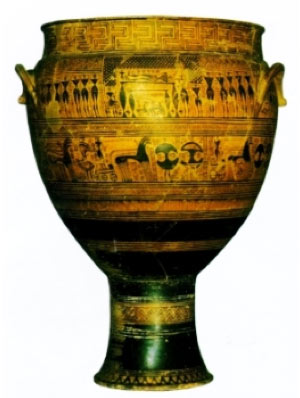
Geometric vase (krater) with prothesis and funeral procession, 8th century BCE. New York, Metropolitan museum. Reproduced as item 13, p. 33, in Osborne Archaic and Classical Greek Art.
Link to large on-line image: http://www.accd.edu/sac/vat/arthistory/arts1303/Greek17.jpg
The prothesis (laying out of the body) and funeral procession are frequent subjects of representation on large Geometric pots, some over four feet high, which were used as tomb monuments. Discuss this vase and its painted decoration. Include in your essay some account of formal elements (such as pattern, light-dark contrast, visual parallels and oppositions, color, the shape and articulation of parts of the vase) along with a discussion of the scenes represented. Given your account, does this vase support the following claim of Robin Osborne?
There is in Geometric art a rather cosy domestication of the world. The world of dedications is dominated by the horse, the domesticated beast par excellence, by sheep, by cattle, by deer, and by birds. The world of the dead is dominated by routine events of life, by processions, and by bat- tles fought by choice and decided by skill. This imagery, like the regular geometric patterns which surround it, is an imagery of control.
(Osborne, Archaic and Classical Greek Art, p. 65)