Timeline
June
- Registration open—sign up early to reserve your spot
- Begin your summer research, internship, or creative project
- Start brainstorming ideas and designs for your presentation
July
- Early bird registration deadline: July 6, 2026
- Continue developing your project and refining your presentation
- Draft and design your poster or creative presentation materials
August
- Final registration deadline: August 7, 2026
- Showcase materials submission deadline: August 10, 2026
- Finalize your research, presentation materials, and/or poster
September
- Prepare for showcase day and practice presenting your work
- President’s Student Showcase: September 3, 2026
Event Day Logistics
Where do I check in?
The check-in table will be located inside the third-floor entrance of the PAB. Please stop by when you arrive to sign in and pick up your name tag. Your name tag will include your presentation session and presentation location, and our team will be available to help you find your assigned space.
When should I arrive?
Please plan to arrive by 3:30 PM, at least 30 minutes before the event begins, unless you have a class that prevents you from doing so. If you are unable to arrive by 3:30 PM, please plan to arrive at least 30 minutes before your scheduled presentation time. This will give you plenty of time to check in, find your presentation space, connect with fellow presenters, and get settled before you begin presenting.
Where is my presentation space?
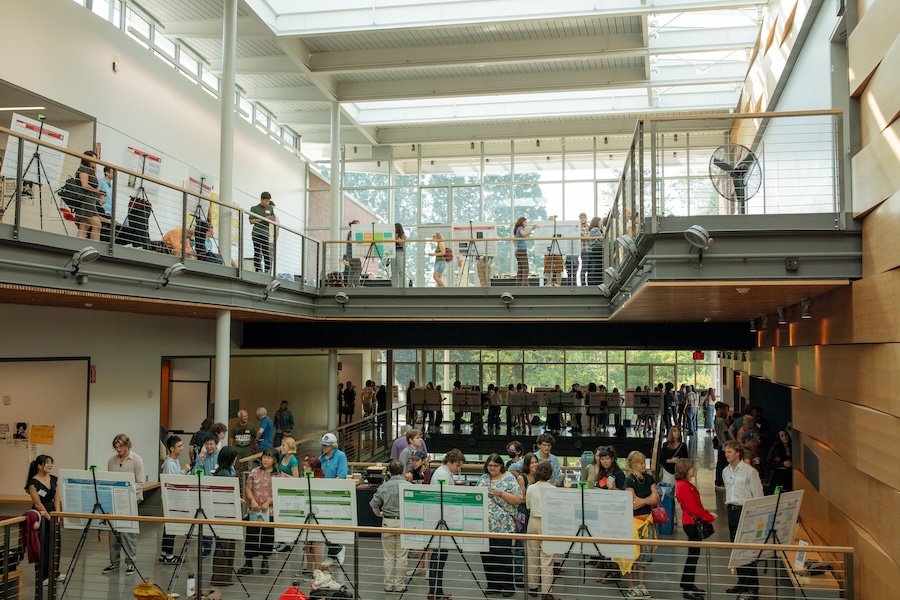
Every presenter will have an assigned presentation space that includes an easel and foam board.
If you are presenting a poster, it will already be mounted on the easel before the event. If you are giving a creative presentation, your assigned space will also include an easel, though there will not be a poster displayed.
If you have opted for the creative presentation option and it requires additional setup time, please reach out to us before the event. We will do our best to make the necessary arrangements.
When will I present?
Presentations are divided into two sessions:
- Presentation Session A: 4:00-4:50 p.m.
- Presentation Session B: 5:00-5:50 p.m.
You will receive your assigned session by email 1-2 weeks before the event, and it will also be printed on your name tag. We will do our best to accommodate any class conflicts noted during registration.
Please be ready to begin promptly at the start of your assigned session. There will be a 10-minute transition period between sessions (4:50-5:00 p.m.) to allow presenters to switch places. Please be mindful of the time and one another to help us keep the event running smoothly for everyone!
What should I do when I'm not presenting?
We encourage you to use your non-presenting session to explore other presentations, connect with fellow presenters and community members, and enjoy the refreshments available throughout the event.
Will food be provided?
Yes. Light refreshments will be available throughout the event. We encourage you to enjoy them during the session in which you are not presenting.
What should I wear?
Business casual attire is recommended. Slacks, skirts, dresses, collared shirts, blouses, and similar attire are all appropriate. Choose clothing that is both comfortable and polished. We want you to be at ease and also to make a good impression with the alumni and other professionals who will be in attendance.
Will photos be taken?
Yes. This event will be photographed in alignment with Reed College’s Recording and Photography Guidelines.
Images may be used by the college for promotional or educational purposes, including on websites, social media, and in print materials. We understand that comfort levels with photography vary. If you prefer not to have your image used, please contact the Office of Strategic Communications & Marketing at communications@reed.edu.
Event FAQs
Do I need to participate in the Showcase?
All Reed students engaging in summer research, projects, or work are invited to participate, though some students are required to participate. For Reed-funded summer opportunities, the requirement is based on the requirements of your funding source. Please refer to your award letter for more information. If you aren’t sure where to find your award letter, please contact the administrator for your grant. For example, if you received funding from your home department or major, you would contact your Faculty Administrative Coordinator.
All other students receiving external funding or otherwise, are invited, but not required to present.
Can I invite people to the event?
YES! Please do! All students are encouraged to invite friends, family, mentors and colleagues. Parking on and around campus may be hard to find, so please encourage them to plan accordingly.
Do I need to take my poster with me after the event?
YES please! We encourage you to take your poster with you as you may be invited to present your work at other events such as Parent Family Weekend.
Moreover, any materials you bring with you or have at your station are your responsibility to pick up. Please help us to keep the space clean by cleaning up after yourself!