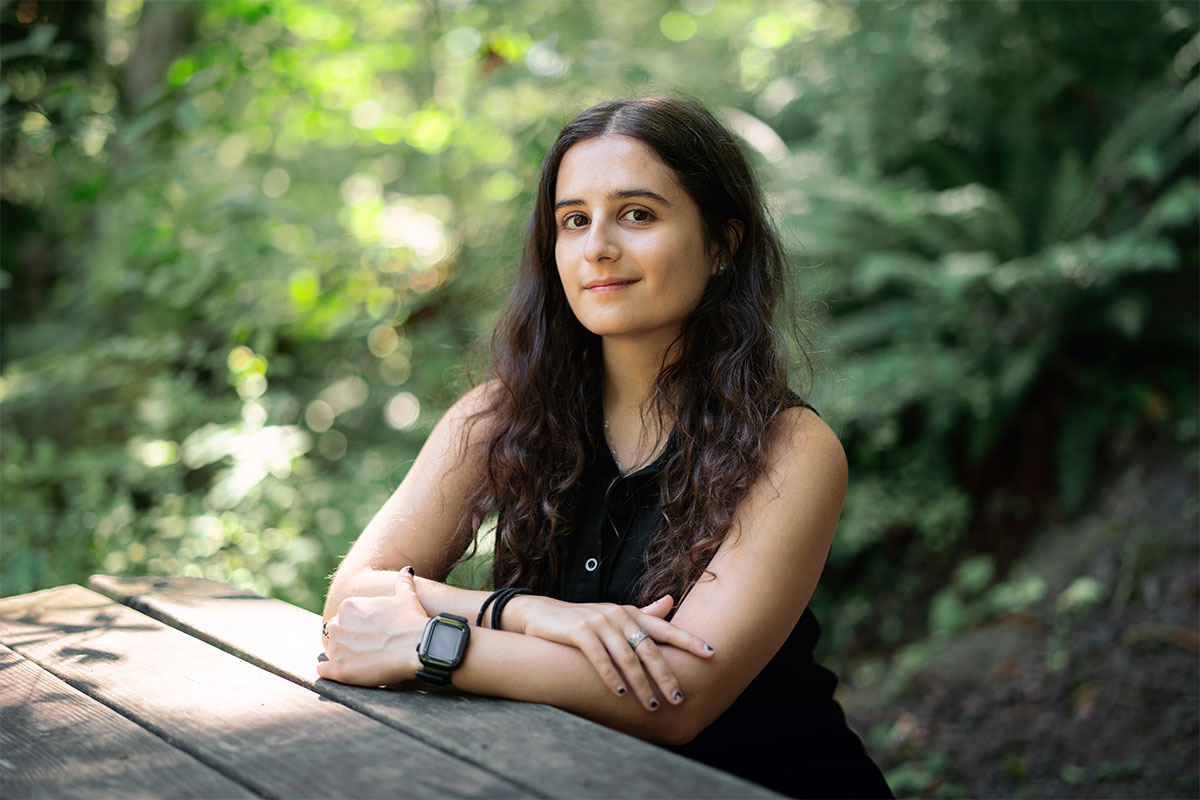
Miranda Kubek ’26 is working to find out with the help of a National Science Foundation graduate research grant.
By Cara Nixon
September 23, 2026
Did you know microbes hibernate?
They enter and exit dormancy, a reversible state of reduced metabolic activity, much like how some animals go into a state of inactivity during the winter and return to a normal state in the warmer months. Miranda Kubek ’26 will be studying how environmental conditions affect this process this fall at Indiana University Bloomington, funded by the prestigious National Science Foundation Graduate Research Fellowship Program.
The NSF GFRP recognizes and supports outstanding graduate students pursuing full-time research-based advanced degrees in STEM fields.
“I’ve always been fascinated by the way microscopic organisms shape our macroscopic world,” Miranda explains. “Investigating when and why microbes become dormant can help us understand the roles they play in ecosystems and how they may respond to continued climate change.”
An environmental studies major at Reed, Miranda says her undergraduate experience prepared her to approach scientific questions from multiple viewpoints and disciplinary perspectives. “I drew on this background while writing my GRFP proposal—synthesizing ecology, microbiology, and environmental policy questions,” she says. “I’m deeply grateful to the professors who helped me broaden my scope as a researcher here, especially Professor Sam Fey [biology] and Professor Josh Howe [history and environmental studies], who also served as recommenders for the fellowship.”
At Indiana, Miranda will be starting her PhD in the lab of biologist Jay Lennon, whose work she first encountered in Sam Fey’s Global Change Ecology class. In summer 2025, she spent time in the Lennon lab as part of Reed’s Summer Opportunity Fellowship Award program, and developed her GRFP proposal while there.
Miranda joins other Reedies who have earned the NSF GRFP in recent years, including Josie Bicknell ’24, who is pursuing a chemistry PhD at Northwestern University, and Jackson Pillifant ’24, who is pursuing a master’s of science in marine biology at the University of Alaska Fairbanks.
“I’m excited to expand on prior work on dormancy and environmental microbiology as a graduate student,” Miranda says. “This funding will support my growth as an interdisciplinary researcher and allow me to pursue complex questions in the lab and in the field.”