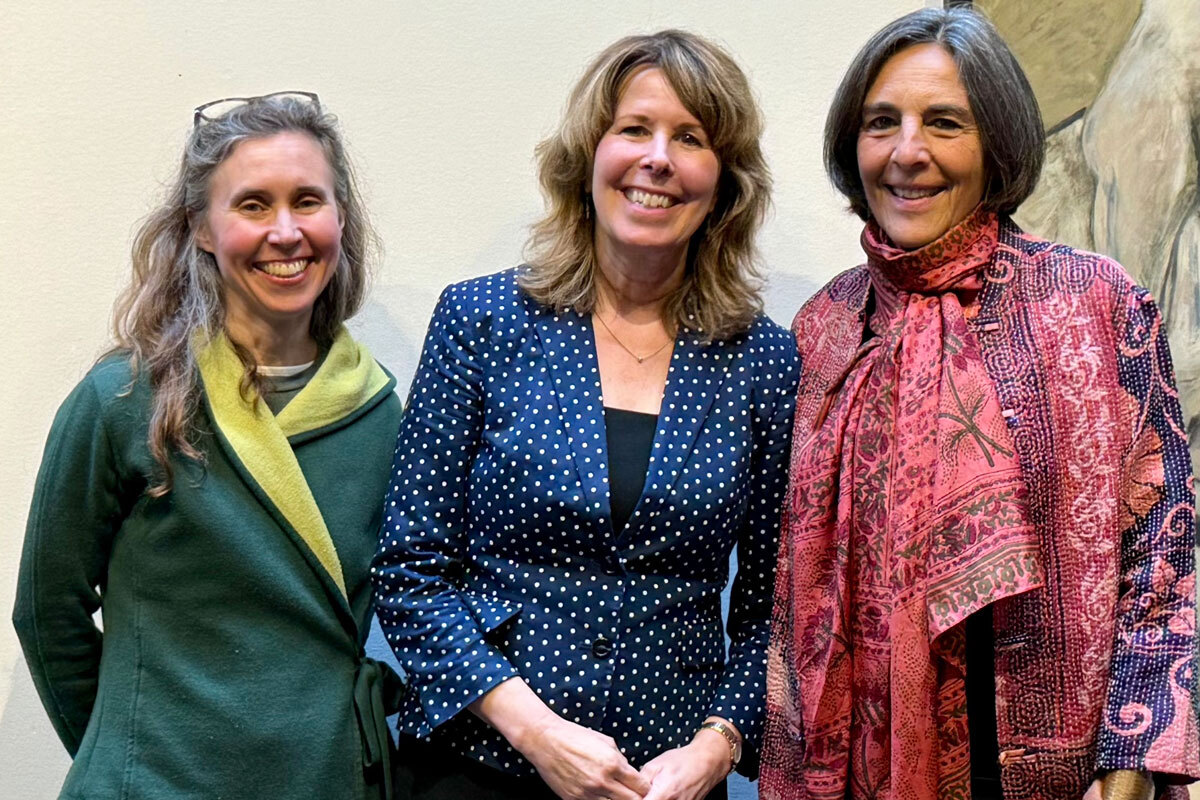
The program is building relationships abroad while opening new possibilities for research, teaching, and student learning.
By Sheena McFarland
September 8, 2026
When Kara Cerveny, Reed’s Ronald A. Laing Professor of Biology, arrived at Universitat Pompeu Fabra (UPF) in Barcelona, she found herself in an institution very different from Reed: larger, more research-intensive, and embedded in the fabric of the city. But stepping into the lab of developmental neurobiologist Cristina Pujades felt immediately familiar.
“We kind of do have that universal language,” Cerveny said of science. The ease of moving into one another’s labs—and simply sitting down to work—became a hallmark feature of Reed’s latest International Faculty Exchange.
The exchange brought Cerveny to UPF before Pujades, a prominent Spanish developmental neurobiologist who is the vice-rector for research and a full professor at Universitat Pompeu Fabra (UPF), made the reciprocal trip to Reed this September. Each spent about a week immersed in the other’s institution, meeting faculty and students, visiting labs, discussing teaching, and getting a close look at how another academic culture operates.
Those extended, in-person encounters are precisely what makes the exchange valuable, the two scientists said. Conferences and Zoom meetings create opportunities to exchange information, but they rarely leave room for the spontaneous conversations that happen over coffee or while working alongside someone. Those informal moments, Pujades noted, are where a professional relationship becomes a lasting one.
They are also where new ideas emerge. At Reed, Pujades found herself talking with Cerveny about how she might change the way she evaluates students in her own courses. At UPF, Cerveny met with researchers working on image analysis and came away reconsidering how she might approach similar problems with Reed students—not by searching for a single perfect solution, but by treating the process as a series of small experiments.
Seeing another institution up close also brought Reed’s distinctive qualities into sharper focus. Cerveny returned with a renewed appreciation for how Reed’s small size enables faculty to cross disciplinary boundaries and combine research with deep attention to pedagogy.
Pujades was struck by Reed’s liberal arts model and by the care faculty bring to teaching and students.
“You have this sense of belonging here at Reed, and this is something that in Spain does not exist,” Pujades said. “This is something you really need to cherish.”
The International Faculty Exchange program was created by Alberto del Río Malo, associate dean of global education and director of the International Programs Office.
“Over the last few years, the International Programs Office has worked to facilitate lasting institutional relationships between Reed and leading international universities, moving beyond the traditional one-way study abroad model toward mutual collaborations with our new partners that benefit our entire community,” del Río Malo said. “The participation of Dr. Cerveny and Dr. Pujades in the Reed-UPF International Faculty Exchange program exemplifies our efforts to build a truly global Reed.”
In spring 2024, the International Faculty Exchange Program kicked off with Kris Anderson, Reed professor of psychology, visiting Noemí Pereda, a victimology professor at the Universitat de Barcelona. Pereda in turn visited Portland in September 2024. A year later, In September 2025, Pereda and Anderson published a paper on alcohol use among Spanish high school students who have experienced peer victimization in the journal International Journal of Bullying Prevention.
In October 2024, Reed psychology professor Michael Pitts visited cognitive neuroscience lecturer Angela Mastropasqua at the Danish Institute for Study Abroad (DIS) in Copenhagen. Mastropasqua visited Reed for a week in February 2025.
In May 2025, Tamara Metz, Reed professor of political science and humanities, visited UPF in Spain. She was hosted by Abel Escribà-Folch, associate professor and dean of the UPF Department of Political and Social Sciences, who visited Portland in September 2025.
The office is currently working to expand the program to Argentina (Universidad Torcuato di Tella, Buenos Aires), France (Sciences Po Lille), Germany (Freie Universität Berlin), the Netherlands (Amsterdam University College), and Sweden (DIS Stockholm).
The exchange may ultimately open doors for students, too. After seeing UPF’s courses and science facilities firsthand, Cerveny said she feels better equipped to encourage Reed science students—who can be hesitant to study abroad because of structured major requirements—to consider Barcelona.
“Every time you move out of a comfort space or where you are going into some other experience, you're going to grow and learn,” Cerveny said. “I think as scientists, we like to learn, and this is another way that students can learn.”
For both scientists, the exchange has already succeeded. Cerveny now has a colleague she expects to seek out at conferences, stay in touch with, and follow as new research emerges.
“At the end of the day,” Cerveny said, “it’s about those human connections.”