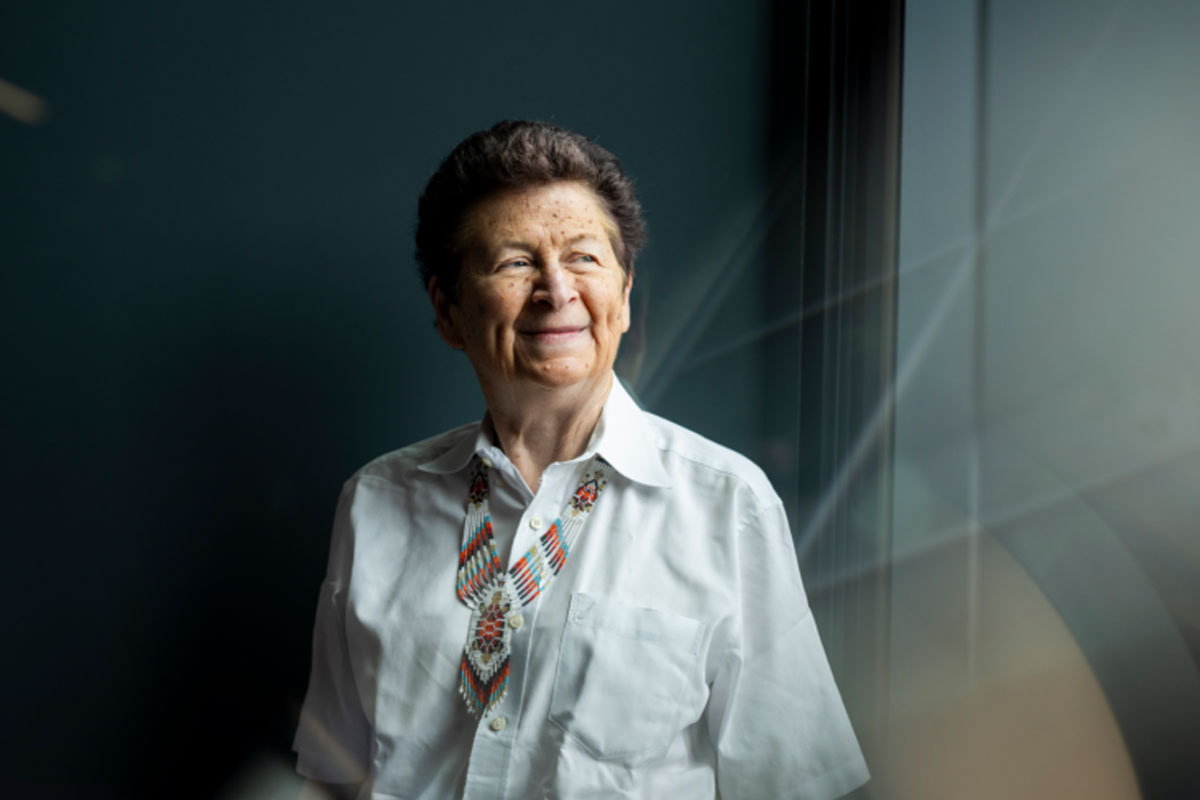
Mary Jo Ondrechen ’74 has received a prestigious award for her dedication and leadership in STEM from the Advancing Indigenous Science and Engineering Society.
By Cara Nixon
October 8, 2026
Enzymes are nature’s catalysts. As essential proteins, they make chemical reactions occur at a higher speed than they otherwise would, and because of this ability, sustain life. Mary Jo Ondrechen ’74 studies novel enzyme design in hopes of converting the chemical industry to enzyme-catalyzed processes—instead of thermally catalyzed processes or conventionally catalyzed processes—which use less energy, produce fewer unwanted byproducts, and cause less pollution. But she’s also a beloved professor—and it's both her research and mentorship that’s earned her the Advancing Indigenous Science and Engineering Society’s (AISES) highest honor: the Ely S. Parker Award.
The award “celebrates visionary leaders who exemplify the AISES mission through groundbreaking achievements in science, technology, engineering, and math.”
“Dr. Mary Jo Ondrechen embodies the very essence of dedication and leadership that the Ely S. Parker Award seeks to honor,” said Mike Laverdure, chair of the AISES Board of Directors.
Mary Jo, a citizen of the Mohawk Nation, has taught and researched at Northeastern University for nearly four decades. She and her team develop theory and methodology to interpret genomic data; perform computational work for drug discovery projects; and investigate RNA synthesis to learn more about enzymes’ role in mRNA vaccines. During the COVID-19 pandemic, her lab also worked on SARS-Cov-2, looking for molecules characterizing the SARS-Cov-2 target proteins, and trying to design molecules that bonded to those targets.
Originally led to chemistry by an inspirational science teacher in high school, Mary Jo studied the subject at Reed, and says the Reed experience helped her learn to think critically, citing Humanities 110 in particular for those lessons. After graduating, she went on to earn her PhD at Northwestern University, and after postdoctoral research at the University of Chicago and Tel-Aviv University, started her role at Northeastern. Besides running her lab, Mary Jo has dedicated a lot of time to environmental advocacy—in particular, acting as a resource and voice for Indigenous communities affected by environmental problems. “We as scientists have an obligation to use our expertise to speak out about these kinds of problems,” she says.
On top of her scientific work, Mary Jo has left a legacy at AISES through an endowed scholarship fund that supports Indigenous students pursuing a STEM degree.
“It is indeed moving to receive recognition from AISES, an organization that has touched the lives of so many people, including me, in a good way,” Mary Jo said of winning the award. “The best paths to solve the world’s problems are those that combine the techniques of modern science with the knowledge, tradition, creativity, resilience, and values of our Indigenous People; AISES is the place where those two powerful forces come together.”
Mary Jo’s other honors include an Alfred P. Sloan Foundation Fellowship, Northeastern University’s Excellence in Teaching Award, the 2024 AISES Technical Excellence Award, the 2026 AAAS Lifetime Mentor Award, and election as a Fellow of The Protein Society.
On October 17, she will be honored at the closing banquet of the 2026 AISES National Conference in Portland—right back where her academic journey began.