Extended funding and faculty mentorship are giving undergraduate researchers time to pursue complex projects—and potentially publish their findings.
By Megan Burbank
October 2, 2026
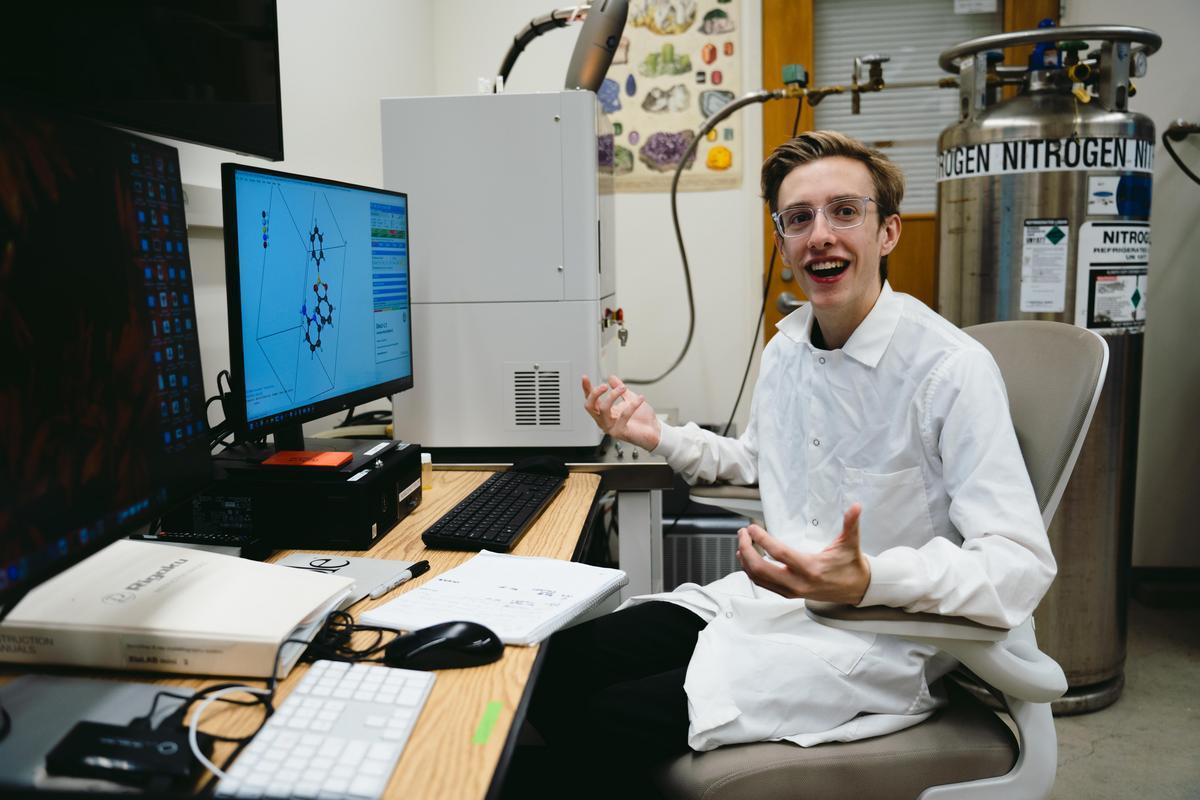
Peter Gilbert ’27 almost didn’t apply for Reed’s Beckman Scholars program, a research initiative launched in 2025 that pairs students studying biomolecular sciences with mentors to collaborate on ongoing research over an unusually generous timeline for undergraduates. But Peter, a chemistry major, was drawn to the work of Professor Gonzalo Campillo-Alvarado’s lab, and when the chemistry professor encouraged Peter to apply, he did. He secured funding in the program’s first cohort, alongside Harnoor Nagra ’27. Now, their emerging research is showing how meaningful long-term research projects can be for undergraduates in STEM.
Peter’s experience as a Beckman scholar ended up as an unexpected crash course in crystallography, the study of molecular structures of crystals. Crystallography and crystal engineering are major bases for Campillo-Alvarado’s lab’s research, which focuses on developing therapies in response to health hazards like COVID-19 and the challenges that can occur when illness-causing microbes become resistant to previously effective therapies. “I basically had to learn all of my knowledge of crystallography from the start,” said Peter, who’d had a different project in mind until he began digging into lab work with Campillo-Alvarado, gaining real-life experience studying the intricate crystalline underpinnings of molecular therapies.
Now, that pivot is paying off. With steps underway to publish their findings soon, Peter is now anticipating a first-author credit.
That’s a big deal for anyone in the sciences, and a big step for Peter, who sees research publishing opportunities as a critical step for undergrads—and one sometimes neglected by undergraduate institutions. “It’s a unique experience that I’m really happy to have had, and it will hopefully help me with grad school applications, so I’m really thankful,” he said.
It’s also a reflection of a program intentionally designed to build up research opportunities in the sciences for undergraduate students who might not otherwise have a chance for such focused, long-duration work. Biology Professor Kara Cerveny says, “I think that the extended opportunity is really something important, because it allows students not only to gain prolonged experience with particular projects and have more in-depth mentoring, but it also allows them to participate in the project long enough to probably be part of a manuscript or some sort of publication, essentially experiencing all aspects of a scientific study from conceptualization to publication while earning a stipend.”
It was Cerveny, with help from chemistry professor Gonzalo Campillo-Alvarado, who wrote the proposal to secure funds for the program. Launched in 2025, the Reed Beckman Scholars program provides financial support for two students and their faculty mentors each year to pursue scientific research together, with an emphasis on including students underrepresented in STEM. The program’s funding is unique in that it supports ongoing research that follows students for nearly two years, from the summer after participants’ sophomore year through their junior year and the following summer. Envisioned in the grant proposal as “a virtuous circle of research and mentoring,” the program pairs students with faculty mentors who oversee students’ coursework and research in the biomolecular sciences, with the ultimate goal of developing “the next generation of scientific innovators and leaders.”
Backed financially by the Arnold and Mabel Beckman Foundation, Reed’s Beckman grant covers an $18,200 stipend for scholars and an additional $2,800 earmarked for travel and materials related to their projects. This kind of support is key for students in the sciences, said Cerveny, because “it's more likely that the student scholars will be able to continue in science—getting into graduate school or pursuing other biomedical postgraduate programs.”
When the program was first launched in 2025, Cerveny said she hoped it would provide participating students with a structured research experience that would extend beyond the expectations and scope of a typical Reed thesis, but perhaps also inform those capstone projects. The proof of this is in the current scholars’ trajectories, as they carry out complex research projects like Peter’s.
The program has also strengthened research collaborations for participating professors. For Reed professors Shivani Ahuja [chemistry] and Derek Applewhite [biology], working with Beckman scholar Harnoor Nagra allowed for deeper engagement in their respective research areas. Harnoor, a biochemistry and molecular biology major, is investigating an extremely large, complex protein critical to how cells change their shape and move. Previous attempts to purify and study this protein were foiled by shorter timelines; now there is more time and space for discovery.
The Reed Beckman Scholars Program provides an unparalleled opportunity for highly motivated undergraduates in the biomolecular sciences. Cerveny said that the application process and experiences of the Scholars shows that Reed students are hungry for these deeper research experiences. The current grant runs through 2028 and she hopes that “we’ll be able to continue to offer, either through another grant or generous donations, these extended research opportunities for many years to come.”