Reed continues its long-standing tradition of engaging the local school community in programs on and off campus.
By Cara Nixon
October 1, 2025
“Everything I have tried to do in my time at Reed has been rooted in a desire to be a good neighbor,” says Greg MacNaughton ’89, education outreach coordinator for the Douglas F. Cooley Memorial Art Gallery.
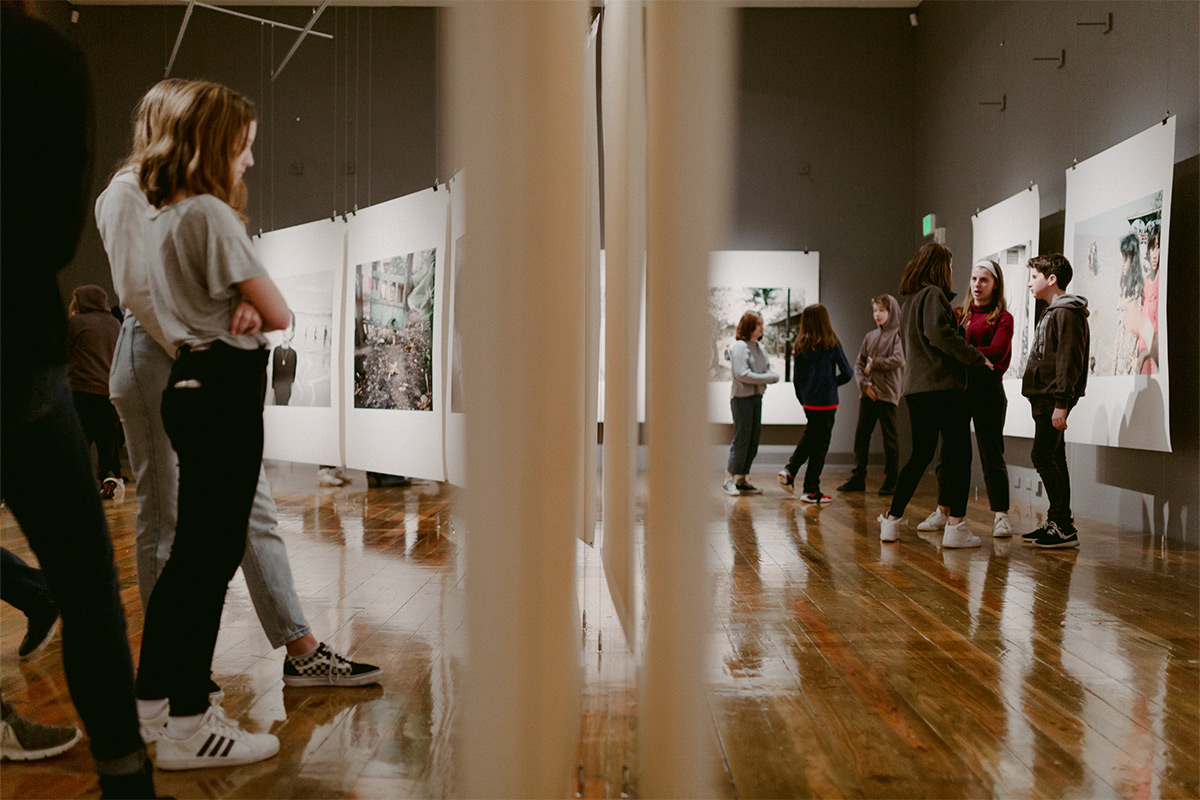
Reed is located in a Portland neighborhood with four public elementary schools within a half mile of campus. It’s only logical, then, that something like the Open Gallery Program, founded in 2004 by Cooley Gallery Director Stephanie Snyder ’91, would exist.
“I see my role as an ambassador from our classrooms to theirs,” Greg says, “helping the teachers, children, and families of this neighborhood by sharing resources, bringing the public onto campus, and taking our scholarship out into public life.”
Serving Portland Public Schools as well as at-risk youth programs, the Open Gallery Program provides first-hand experiences with contemporary and historical works of art free of charge. When students visit the Cooley, they participate in an inquiry-based discussion about the exhibition, and are encouraged to ask questions and make interpretations of the art. In recent years, students have explored the works of American painters Faith Ringgold and Kara Walker, and German artist Hans Haacke, and engaged with topics like African American art history, Iraqi art history, and contemporary conceptual art.
The Open Gallery Program is just one example of how Reed brings the public onto campus, and in turn takes scholarship and knowledge out into the community.
Reedies have returned to classes, settled into their dorms or off-campus housing, reunited with old friends, and look forward to a new semester of learning. Nearby, students in Portland’s K–12 schools have arrived in their own classrooms, facing the fresh start of a new year. And so continues a long-standing partnership between Reed and the local community’s schools—one that centers scholarship, research, and creative activity to prepare educated and engaged citizens and contribute to the overall public good.
Whether introducing young students to art galleries, sending faculty and staff to speak at local high schools, or opening campus to future generations of scientists, here are the ways Reed continues to foster relationships with the local K–12 community.
Reed College Science Outreach
Since 1996, the Reed College Science Outreach program has provided public school students with hands-on, inquiry-based science experiences every week. In recent years, the curriculum has expanded to include math, computer science, and physics.
Science Outreach at Reed is mutually beneficial—providing interactive, high-quality science education to young students while also giving Reed students a positive service-learning opportunity in the local community.
Teams of two to four Reed students visit the same classroom once a week for lessons throughout the school year, teaching students scientific concepts through hands-on, inquiry-based activities. Topics vary from biology to neuroscience to math and physics. In the fall, students learn the salmon life cycle by raising salmon eggs; in the spring, they go out into nature to learn how to be responsible citizens in regards to their environment.
The impact has been substantial: During the program’s nearly 30 year history, the Science Outreach program has reached over 11,000 elementary and middle school students and supported more than 600 Reed student-teachers.
Speakers Bureau
For Portland-area high schools and clubs, Reed facilitates a Speakers Bureau of faculty and staff to address topics of interest and expertise. Professor Betsey Brada [anthropology] can discuss what anthropology is. Professor Derek Applewhite [biology] can speak to his experiences as someone from a group historically excluded from science. Milyon Trulove, vice president and dean of admission and financial aid, is available to demystify the process of applying to colleges.
F.L. Griffin MathFest
For almost 40 years, high school students and teachers enthusiastic about math have gathered at Reed on a spring Saturday to participate in a workshop hosted by the Reed College mathematics and statistics department.
Recent MathFest topics have included “Calculus Curiosities,” “Infinity: Checking in at Hilbert’s Infinite Hotel,” and “Probability: Chances Are.” Reed math majors are also available to speak to students about their experiences with studying math in college.
Latin Forum
On a special Saturday each year, high school students and teachers of Latin from around the Northwest gather to explore a topic related to the culture and literature of early Romans in a forum sponsored by the Reed College Greek, Latin, and Ancient Mediterranean Studies department.
The day-long affair includes breakfast, a morning keynote, a buffet lunch, and sessions led by faculty on a related topic. Last year, Professor Tom Landvatter [GLAM] led a session on portraits of Roman emperors and Roman propaganda. Greg MacNaughton, who is also Reed's Calligraphy Initiative coordinator, used his calligraphy expertise to speak on the lettering of the Trajan inscription. Past keynotes and session topics have covered many bases—from Latin’s influence on the science fiction and fantasy genres to the history of Roman bakeries and bread.
“Outreach programming including Speakers Bureau, F.L. Griffin MathFest, and Latin Forum takes fundamental elements of Reed’s pedagogy such as curiosity and intellectual exploration beyond the classroom and beyond the campus,” says Laura Zientek, associate dean of graduate and special programs. “Faculty, staff, and students at Reed and K–12 teachers and learners in the Portland community collaborate by sharing new and different perspectives and challenge each other to think critically and creatively around dynamic topics of shared interest.”
Open Days
Reed is home to many science spaces, from classrooms and laboratories to the more unique Research Reactor and Physics Machine Shop. One day each year, these spots become available to the local community through the Open Days event, jointly organized by Special Programs and Science Outreach.
Through Open Days, the greater Portland community, including local K–12 students, have the opportunity to view science up close—whether touring the reactor or viewing zebrafish through microscopes in a Reed lab.
Theatre Symposia
A clown tragedy. One woman’s desperate search for meaning and love in a capitalist, patriarchal machine. A devised, digital, participatory performance centered around housing insecurity. Each fall, a faculty-directed production is shown in the Reed Studio Theatre in the Performing Arts Building. High school students and teachers can see these shows for free, with complimentary tickets on designated dates provided by the Special Programs office. Directly following, the department offers a “talk back” of the play, allowing students and teachers to ask faculty, cast, and crew questions about the performance.
Young Scholars
Perhaps Reed’s longest-standing partnership with local high school students—almost half a century old—the Young Scholars program allows seniors to take one college class at Reed for the full academic year while concurrently enrolled in high school.
The highly selective program is open to students in the Portland area who show outstanding academic achievement and a commitment to serious study in a particular interest area. Students can choose from courses in mathematics, the sciences, foreign languages, the arts, and the social sciences.