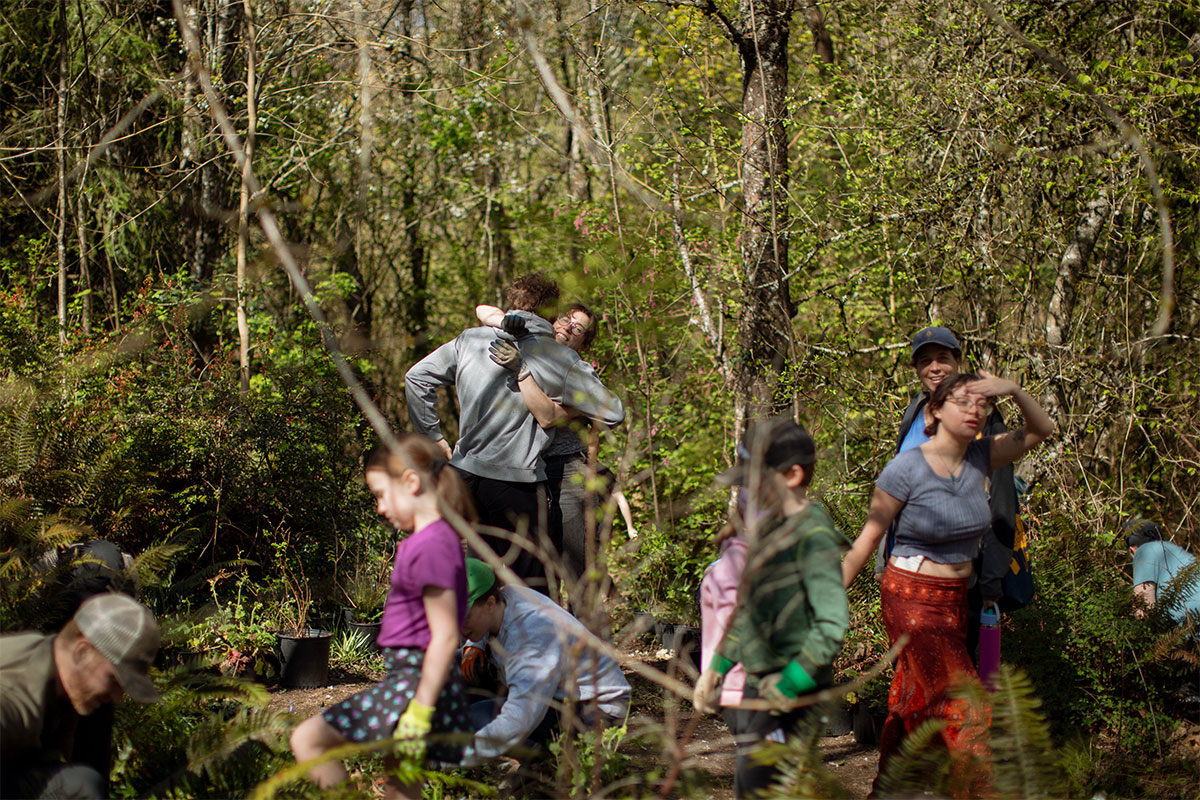
It’s not just about pulling ivy—it’s about honoring the canyon’s history, experiencing its beauty, and imagining all that the 28-acre watershed could be.
By Cara Nixon
April 10, 2026
In a 1990 essay collection, Pulitzer-Prize winning poet Gary Snyder ’51 wrote, “A place on earth is a mosaic within larger mosaics—the land is all small places, all precise tiny realms replicating larger and smaller patterns.”
When Asher Behmer ’26 wrote a palimpsest on the Reed canyon last summer with funding from the Mason Opportunity Grant, he saw how the 28-acre watershed at the heart of campus was “a mosaic all its own.” “An autonomous entity produced by various environmental, regional, and historical factors and legacies that is then interwoven with, and translated and imagined into, institutional and artistic narratives,” he wrote.
In his research, Asher found that the canyon has long offered a "traditionless space” in juxtaposition to the traditional, conservative architecture of the college; while students engage in intellectual discussion and academic rigor inside the Tudor Gothic buildings of campus, it is to the canyon they often go for respite and tranquility.
But in the case of Canyon Day, the canyon is not so “traditionless”—in fact, it's the setting of Reed’s oldest tradition, harkening back to 1915, when the community gathering was originally known as Campus Day. Reed’s Facilities Operations Manager Zac Perry says Campus Day was an opportunity to get help from the community for spring cleaning, at a time when there was likely only one maintenance worker caring for the college.
Before Zac arrived in the late ’90s, Canyon Day was focused on making the watershed like a park with big fir trees and mowed grass, more for human use than anything else. Under Zac, the day has transformed to focus on preserving the canyon and the life inside it, making it an ecosystem both humans and wildlife can enjoy.
Over the years, Canyon Day has only been cancelled a handful of times—always for good reasons, like a world war or a pandemic. It’s a tradition consistent across time, though the meaning of it has changed.
This year, the community gathered in Reed’s Centennial Orchard to clear ivy and plant sword ferns, blue elderberries, Indian plums, snowberries, and wild strawberries.
Prior to Zac’s work in the orchard, the spot had become a dumping ground for a local construction company. Zac and the grounds crew cleaned up the space, cut down old trees, and planted new ones that bear fruit when students can enjoy it—in late spring rather than over the summer. In 2011, the community came together to plant a walnut tree in honor of the Centennial Campaign, giving the orchard its new name. That Canyon Day, they made cider with the fruit from the trees and played bluegrass music.
This year, as students, staff, faculty, alumni, and neighbors enjoyed the satisfying pull and pop of ivy coming up from the earth, the sounds of students playing guitars and singing floated down across the orchard, reminiscent of that Canyon Day over a decade ago.
“The way that their voices are carried through the trees, and the way they come to the people that are volunteering,” Zac says, “that's really powerful. It's pretty magical. And that stuff, for me, it's less about the ivy and less about the plants. That’s the backdrop to bring people together, which is, I think, the magic of Canyon Day.”
Students tied together crowns of ivy to wear. People pushed wheelbarrows along the trails carrying mountains of detritus. A volunteer cooked up black bean burgers and handed out chocolate-covered strawberries for the community to enjoy in the sun.
“Having a chance for folks from different departments and majors here and contributing to this really long tradition and this connection to place, is really important and just so gratifying,” said Reed’s Sustainability Coordinator Rachel Willis. “It takes a lot to know a place, and I think it’s these deeply-rooted traditions that can be a spark for a lot of people. Yes, it’s about pulling ivy, but there’s families and kids and people playing music. It’s just joy, too.”
That seemed to be the takeaway for students at Canyon Day as well.
“I like taking care of the canyon together—it’s fun,” said Moon Chow ’27.
That’s Zac’s goal: to keep Canyon Day fun. It’s a chance to love on the canyon, but also a time to enjoy a day out in nature together.
“It’s a celebration of a community space,” Zac says. “I want to keep it feeling like a work party. There’s a job for everybody down there, regardless of what limitations people feel within themselves—the canyon needs all of us to help support it.”
In his summer research, Asher set out to understand the canyon beyond its surface—reading every piece of literature and watching every piece of media related to the watershed to identify what he refers to as the Historical Canyon, the Lived Canyon, and the Imagined Canyon.
On one day each year, all three may converge: Canyon Day, a time when the community comes together to honor the history of the canyon, experience and live its majesty, and imagine all it could be.
Historically, Asher discovered, the canyon acted as a guide for the college’s development, and then, ultimately, when it was crossed in 1958, it became the heart of campus. In the imagined version of the canyon—the books, poetry, and movies written about or featuring the watershed—it serves as a place where "educational formality transitions into personal informality.” The lived canyon, however, combines the two, as a sort of living classroom, offering a “well-rounded experience of place-based activity”—certainly, a space worth gathering together to protect each year.