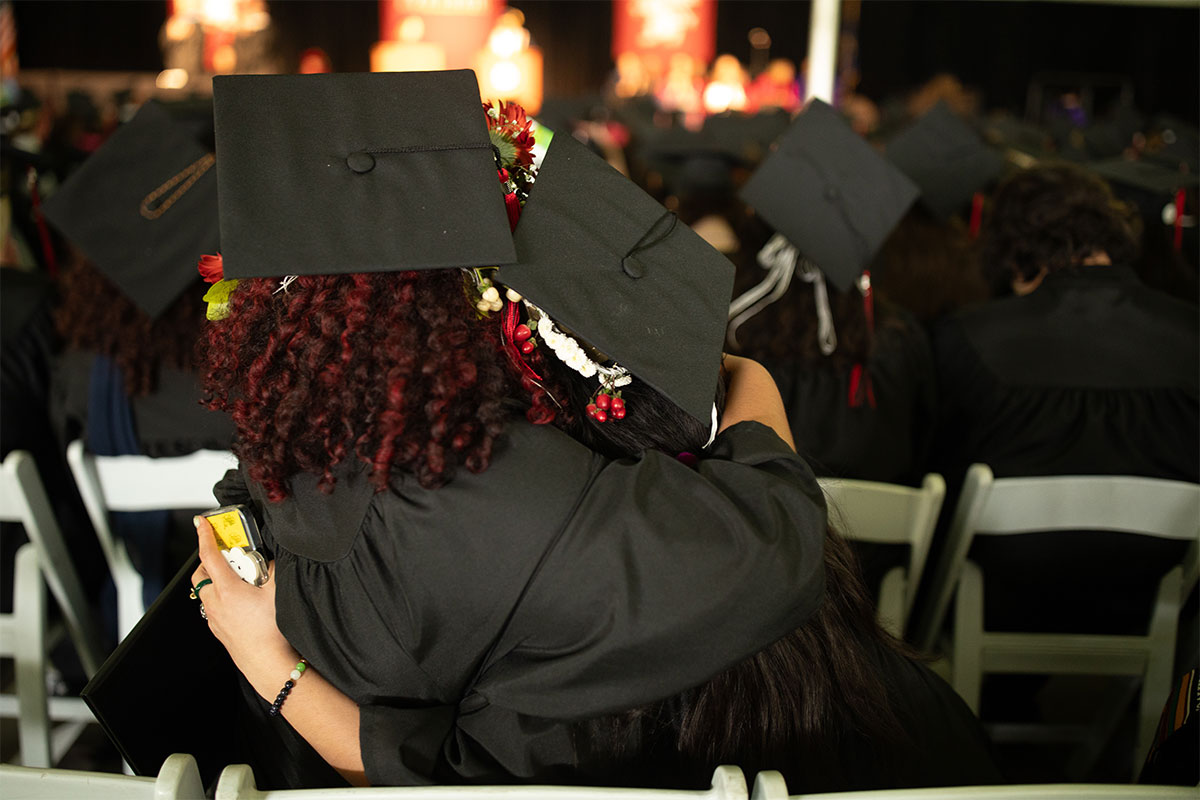
These Reedies were recognized for outstanding work with these end-of-the-year awards.
By Cara Nixon
June 24, 2026
With the end of the year comes plenty of reasons to celebrate Reedies and all their accomplishments—including annual awards given by the college. Here are some of the awards given out for 2026.
John Gregory Unrue ’84 Memorial Award
Tigerlily Warner ’26 blended critical analysis with creative reflection to consider themes of identity, performance, and selfhood in her creative writing thesis, Endnotes. The project earned her the John Gregory Unrue ’84 Memorial Award.
The Unrue award, created by John and Darlene Unrue in memory of their son, Greg Unrue ’84, recognizes outstanding work in the Division of Literature and Languages and comes with a prize of $2,500. Advised by Professor Pete Rock [creative writing], Tigerlily wrote a unique series of fragmented essays and poems for her thesis, focused on place-based writing from Portland and Los Angeles to her hometown of Silver City, New Mexico.
“It is a unique honor to win an award for creative pursuits in a category in which more customary critical theses are also eligible,” Tigerlily says. “I am a passionate believer that artistic projects can—and should—communicate complex intellectual thinking in a different way than traditional academic work. This award felt like a meaningful institutional acknowledgment of that conviction.”
William T. Lankford III Humanities Award
The William T. Lankford award is for outstanding scholarship in the humanities in line with the values and practices of William T. Lankford, a former professor at Reed. Students in Chinese, Russian, classics, and other areas of study have received this distinguished honor in years’ past.
This year, the award went to Zoe Fleysher ’26, a history-literature major who had their junior preparatory paper published in the Tufts Historical Review this last year. Their research interests lie in presenting history through a queer, women-centered, and literary lens.
“I feel incredibly grateful to receive this award, and I could not have asked for a more wonderful end to my time at Reed,” Zoe says. “Getting institutionally recognized for my work is unimaginably encouraging, and I cannot wait to continue my scholarship throughout my life. I’ll miss Reed terribly, but I will carry this gift with me through all my future academic pursuits.”
Class of ’21 Award
The Class of ’21 Award was endowed by the class of 1921, and the $1,500 award is given annually to one or two Reed students who produce creative work of notable character, involving an unusual degree of initiative and spontaneity. This year’s winners were two neuroscience majors, Christina Davis ’26 and Lauren Brown ’26.
Christina's thesis sought to uncover how astrocytes, a type of glial cell in the brain, contribute to cognitive flexibility—our ability to adjust our thoughts and actions when circumstances change. By manipulating astrocyte activity in rodents, she found that these cells influence learning strategies, including how mistakes shape future decisions and sensitivity to feedback.
"These findings suggest astrocytes play an important role in flexible behavior and may represent a potential target for intervention to help treat cognitive symptoms in conditions such as Alzheimer’s disease, chemotherapy-induced cognitive impairment, and other neurological disorders," she explains.
Although the project was challenging in many ways, Christina says it was eqyally rewarding, and having it recognized in this way is encouraging.
"I am incredibly grateful to receive this award," she says. "This project has been such a formative part of my journey as a scientist."
Lauren won for her thesis which asked: What can art and science tell us about the human experience? In her project, she sought to unravel the neuroanatomical relationship between experiences of the aesthetic and spiritual sublime. The project was a narrative review synthesizing the findings of multiple studies that demonstrated neural activity associated with varying “quasi-sublime” experiences like beauty, awe, terror, and religious ecstasy.
"I am just so incredibly surprised and grateful that people believed in my project to this degree," Lauren says. "It feels like a validation of my lifelong love for these subjects and has definitely inspired me to continue writing about art and the brain!"
Gerald M. Meier Award for Distinction in Economics
Originally established in 1998 by development economist and alumni Gerald Meier ’47, the Gerald M. Meier Award is presented by the Reed College Department of Economics to economics students in recognition of outstanding achievement. Outstanding achievement can include a creative senior thesis, excellent performance in economics coursework, or significant extracurricular work.
Four students were awarded the Meier this year: Imogen Hinchcliff ’26, David Han ’26, Julia Mascola ’26, and Emma Benson ’26. The award includes a $250 grant to be used for the purchase of books relating to economics.