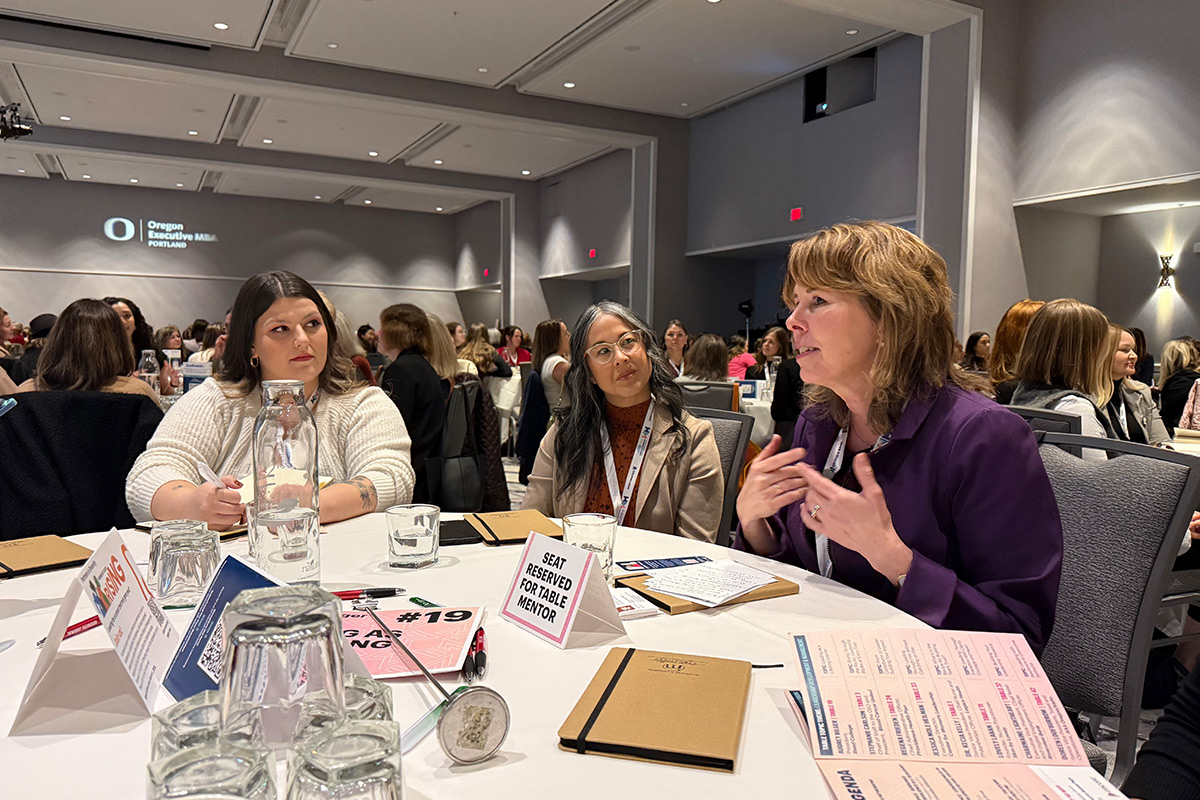
Reed College’s president brings her philosophy of curiosity-driven leadership to the Portland Business Journal Women’s Summit, connecting with women across industries.
By Sheena McFarland
February 26, 2026
Curiosity has long guided Audrey Bilger—not only in her academic career, but in the way she moves through the world and connects with the broader Portland community.
During her time as an English professor at Claremont McKenna College, she trained to be certified as a yoga instructor and added a PE class to her teaching repertoire. When her interest in music was piqued, she learned to play the drums, and as a result of that decision, she met her future wife, Cheryl Pawelski, when their paths crossed because they both played in bands in Los Angeles.
“If I hadn’t started learning something new, I wouldn’t have been in the space that led to such happiness,” Audrey reflected. “Stay curious. It will enhance creativity, and you will see more opportunities open before you.”
That spirit of lifelong learning was at the heart of Audrey’s remarks at the Portland Business Journal Women’s Summit, held February 23 at the Hilton Portland Downtown. The annual event brought together 460 women from across the region for three rounds of 20-minute mentoring sessions with 43 local leaders.
Audrey’s sessions focused on “Leading as a Lifelong Learner,” while Cheryl, who is the co-owner and founder of Omnivore Recordings, served as a mentor as well, guiding participants through “Navigating a Non-Traditional Creative Career.” Together, they embodied a model of leadership rooted in intellectual openness, creativity, and community engagement—values deeply aligned with Reed’s mission.
The women in attendance represented a wide range of ages, industries, and career stages. They gathered not only to seek guidance, but also to build relationships and strengthen their professional networks across Portland.
Drawing on her experience at Reed, Audrey described leading a college as akin to “being part of a small village.” She emphasized the importance of inclusive practices as essential to good leadership and stressed the importance of representing the most vulnerable members of the community.
She credits the strength of Reed’s leadership to the wide range of experiences and viewpoints represented among faculty and staff, noting that students benefit directly from that diversity.
“If someone says that it’s lonely at the top, they’re not doing it right,” she said. “Find the people who can support you. You should never be alone.”
By sharing her insights beyond campus—whether mentoring Portland professionals or modeling lifelong curiosity in her own life—Audrey continues to extend Reed’s values into the wider community. Her message is both simple and expansive: stay curious, lead with equity, and build the networks that help everyone thrive.