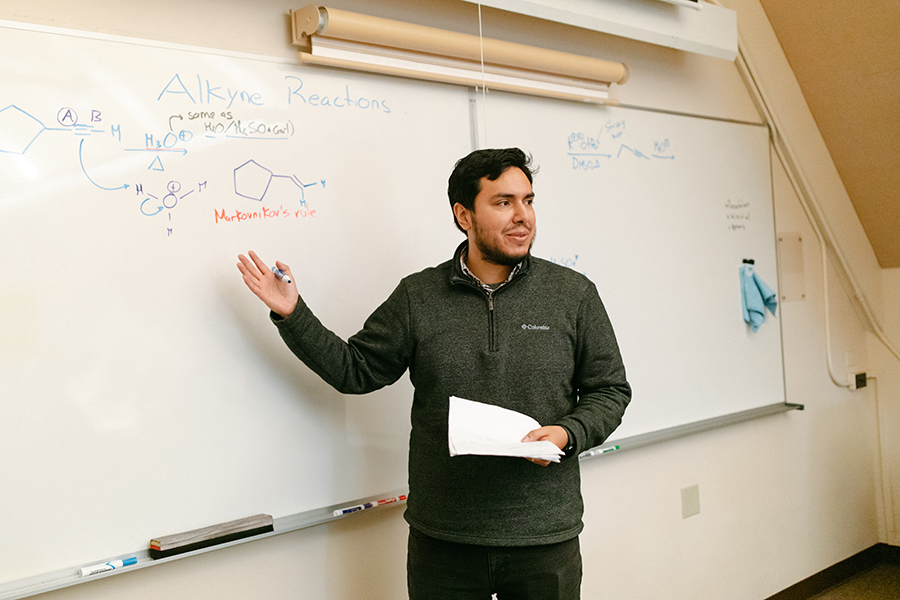
Professor Gonzalo Campillo-Alvarado hopes the work of his team will lead to more efficient technologies.
By Bennett Campbell Ferguson
April 13, 2026
Is propelling the world toward energy efficiency as simple as assembling a Lego set? Professor Gonzalo Campillo-Alvarado [chemistry] hopes so. “Molecules are our building blocks, like Legos,” he says. “We find the right types of molecules to put together.”
With a team of undergraduate researchers, Campillo-Alvarado is studying chemical separations, which account for almost 20 percent of the world’s energy. The group’s work has earned two grants from the American Chemical Society Petroleum Research Fund (ACS PRF), which has provided funding for both research and equipment.
“My dream would be that Reed students can design a process that can replace some of the current technologies in the industry,” Campillo-Alvarado says. “If we can prove that our processes are more selective, less energy intensive…I think we can start rethinking these energy-intensive processes.”
The first grant is from the ACS’ Undergraduate New Investigator Grants Program, which funds the work of new scientists and engineers at undergraduate research institutions; the second is a pilot award for the purchase of scientific instrumentation to enhance research activities.
In total, the grants have supported Campillo-Alvarado and his team—Vanshika Bhaniramka ’27, Ivan Bondarenko ’27, Peter Gilbert ’27, Valeria Gonzalez Padilla ’28, Megan Regier ’27, and Alaric Shaw ’26—with $25,000. Among other things, that support enabled the purchase of a thermogravimetric analyzer, a mini oven-like apparatus that helps analyze the crystalline “molecular sponges” that are central to Campillo-Alvarado’s research.
“Basically, we create these molecular sponges that can have petrochemicals or any other molecules inside,” he says. “With this instrumentation, we can actually see the level of encapsulation of the other molecules.”
By using the structural building blocks of diamonds (adamantanes) to separate molecules in mixtures using crystallization, Campillo-Alvarado and the students have shown that it is possible to reduce the energy that chemical separations require—by up to 80%. And in addition to revealing environmentally friendly possibilities to the energy industry, the project has allowed Campillo-Alvarado’s undergraduate researchers to accrue invaluable experience with the thermogravimetric analyzer—a device used by both Intel and Nike.
“They use thermogravimetric analyzers to see the properties of their materials,” Campillo-Alvarado says. “We were excited to get this instrumentation, because students that graduate from Reed can let Nike or other companies know that they have experience with this instrument. It’s actually very rare.”
While it may be a long time before Campillo-Alvarado knows if his team’s work will truly transform humanity’s relationship to energy, the grants and the research have already had an impact. They are an investment not only in the future, but in the generations that will help build it.