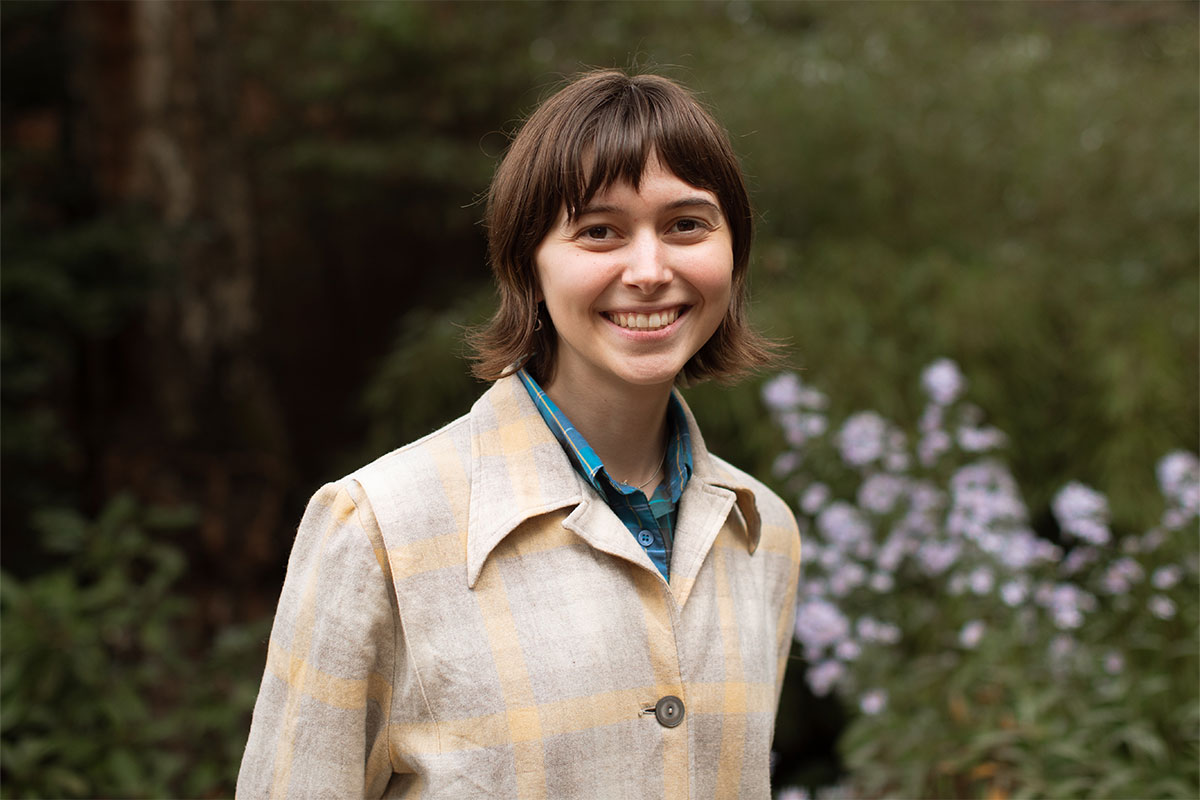
Harper Lethin ’24 has received the Fulbright U.S. Student Program award, which will allow them to study phage therapy at the historic Eliava Institute.
By Cara Nixon
May 15, 2026
Four years ago, Professor Jay Mellies [biology] showed a documentary in his microbiology class about the historic George Eliava Institute of Bacteriophages, Microbiology and Virology in Tbilisi, Georgia, an organization dedicated to the study of phage therapy—the treatment of bacterial infections in humans with viruses that kill bacteria. Harper Lethin ’24 was hooked.
Now, Harper has received the prestigious Fulbright U.S. Student Program award, which will allow them to make what they’d once considered a pipe dream a reality: studying phage therapy at the very institute that sparked the dream in the first place.
Close to 2,000 Fulbright U.S. Students are chosen each year to pursue graduate study, conduct research, or teach English in schools abroad. They are recognized alongside established researchers and professionals who teach or conduct research through the Fulbright U.S. Scholar Program.
At the Eliava Institute this fall, Harper will contribute to a project developing a phage cocktail to treat Klebsiella infections. After that project concludes, they’ll have time to further pursue the characterization of phage-bacteria relationships, work that expands upon their Reed thesis, "Enfolding Liveliness: Invoking Bacteriophage Therapy for More-Than-Human Kinships," which used "art and microbiology to investigate how bacteriophage (phage) therapy can inspire radical kinships between humans and microorganisms."
“In addition to biological research, I hope to expand on my interdisciplinary and theoretical analysis of phage therapy in the context of Georgia's nearly century-long commitment to a field abandoned, until recently, by American scientists in favor of antibiotics,” Harper says.
Harper says they’re thankful to their Fulbright recommenders: Jay Mellies, Professor Juniper Harrower [art], and Greg MacNaughton ’89, Reed’s calligraphy initiative coordinator and education outreach coordinator for the Douglas F. Cooley Memorial Art Gallery.
While not in the lab, Harper plans to trek local rural landscapes and continue a beloved Reed hobby: calligraphy—this time, in the Georgian style.