An alumna and art professor teamed up to create a cozy summer resting spot.
Katie Pelletier ’03
June 22, 2026
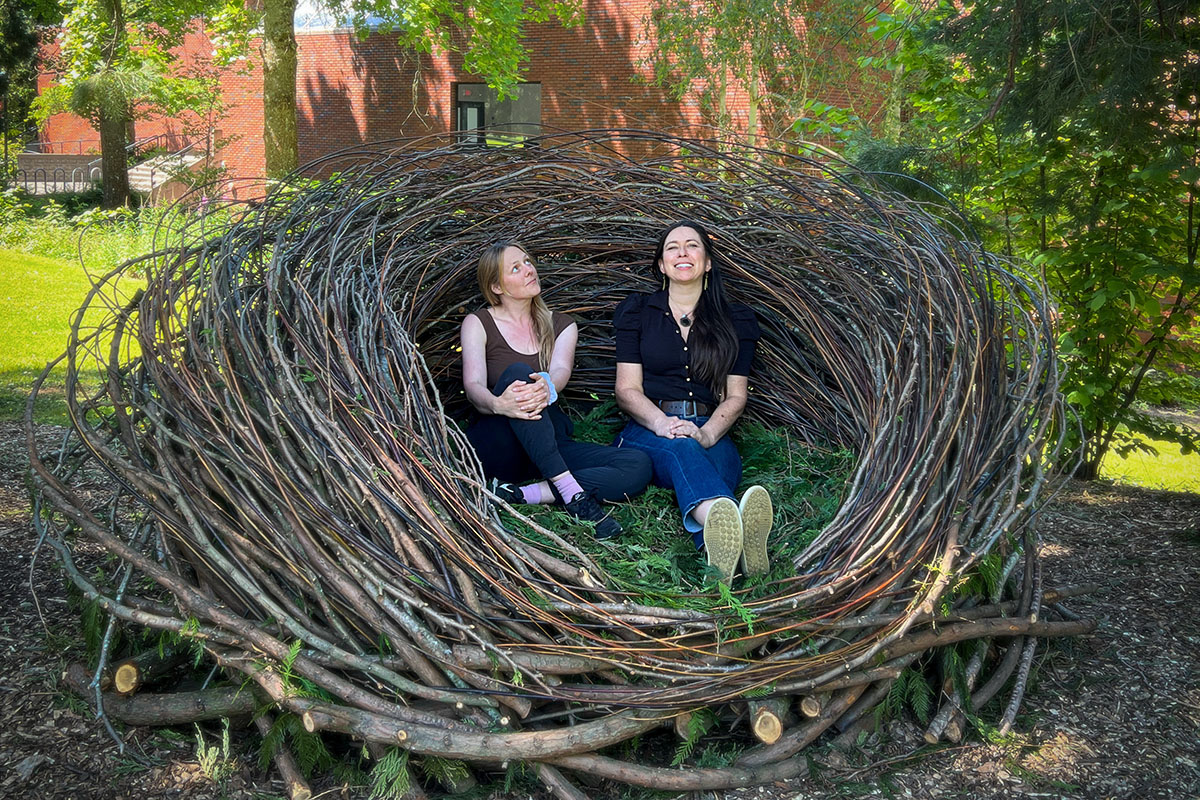
In the heart of campus, between Vollum and the library, there now sits a large nest—not for birds, though they’d be welcome—but for humans to enjoy.
Created by Amanda Bishop ’00 with support from Professor Juniper Harrower [art], the nest measures about nine feet at its widest and five-and-a-half feet at its highest point. “It seats two and it feels so special and it’s incredibly grounding,” Harrower says.
It was the demise of a local cedar tree that both inspired and provided the material for the nest. Amanda, an artist and real estate broker in Portland, had a client who was taking down the tree, which Amanda described as “majestic.” She was dismayed. “Even here in the verdant PNW our water table is slowly depleting, and some of our most beautiful old trees are starting to die off,” says Amanda, “I just couldn’t bear to see this one hit the chipper.”
When it came time to take it down, she couldn't let it go quietly. Looking up into the branches and considering their curve, she saw the potential for a human-sized nest and asked if she might have some of the wood.
This wasn't Amanda's first nest—she had previously collaborated with Portland artist Debbie Baxter, and last year built one in her own backyard in SE Portland—but it was her most ambitious. "I knew when I saw the size and curvature of these branches that they needed to be repurposed into an even more gigantic nest," she said, "and I immediately thought of Reed as the perfect place to build it." She reached out to Harrower, and the project took shape from there.
“Amanda contacted me about wanting to make a nest on campus, which was wild, but she had pictures of the one she made at home, so I knew what she was talking about,” Harrower says. Once Harrower saw them, she agreed: Reed should have a nest.
“It also connected nicely with a number of nest projects that I had done with Reed students,” she says, noting that one of these projects is now on view at the World Forestry Center and Discovery Museum. She was able to use some of her research funding and handled getting permission and support on campus.
When she consulted Facilities, they were less surprised by the request than she had been. “They told me it wasn’t the first time they’d had a meeting with the art department about nests.”
When I visited, Harrower and Amanda were busy building up the back of the nest with the help of students to make it cozy. “So people will feel held,” Harrower said. They invited passersby—students, staff, and even President Audrey Bilger—to weave in branches and try it out. They made plans to create a sign with nest-care instructions and a book of poetry that visitors can add to and reflect on.
"I want to make sure people know they can get in there, and that that's what we made it for," Amanda said.
The installation is expected to remain at least through the 2026–27 academic year, and possibly beyond.