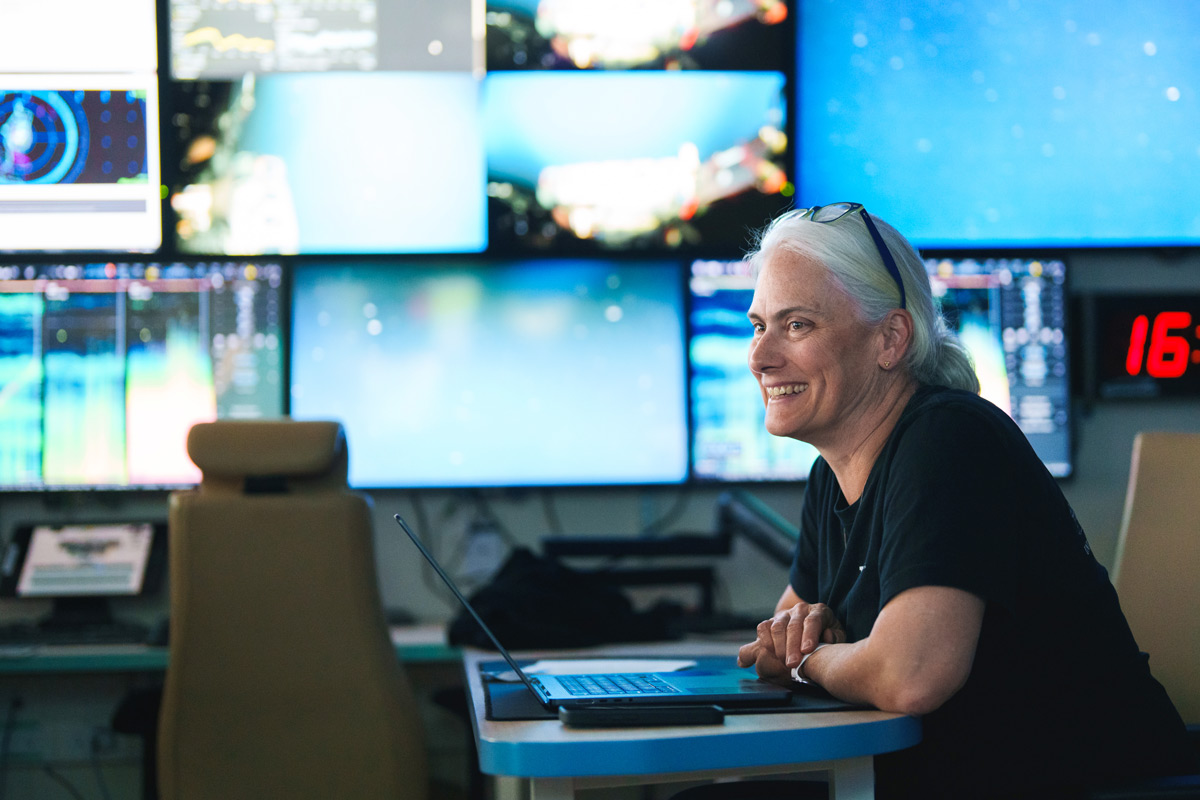
Oceanographer Anitra Ingalls ’92 had a lightbulb moment at Reed that formed her career.
By Cara Nixon
October 2, 2026
Anitra Ingalls ’92 has a couple of incredibly clear memories from her time at Reed, both of which changed the course of her life. For one, serving a drink to her future husband, David Hyde ’88, dressed as a beer fraulein at Renn Fayre. For another, having her mind blown in a biology lecture given by Professor Bert Brehm [biology 1962–93] during her freshman year.
An art student at the time, Anitra had taken the biology course to fulfill a science requirement. But what had seemed like a chore turned to a passion. “I remember vividly sitting in lecture, seeing images of insects pollinating plants and birds drinking nectar from plants,” she says. “That relationship between the different species that co-evolved over these long time periods so the beak of the birds was perfectly shaped to work with this specific flower—it really blew my mind. I was sort of swept away.”
Once she switched her major to biology, another requirement—organic chemistry—again changed her path. She discovered she loved chemistry even more than biology, for its concreteness and easily verifiable results. “I enjoyed solving the puzzles of organic synthesis, of putting these pieces together,” Anitra says.
Anitra’s thesis adviser Arthur Glasfeld [chemistry 1989–2022] taught Anitra how enzymes accomplish chemical reactions that would otherwise not be possible. Arthur became another career-altering mentor, and learning moments with him were pivotal to where Anitra’s path took her next.
Her college journey meant Anitra had started at Reed as an art student, and left as a chemist—and not only that, as a chemist in search of an environmental problem to solve.
Now, as a professor of oceanography at the University of Washington and the director of the Microbial Metabolomics Research Center, Anitra studies microorganisms in our oceans. She compares her research to what doctors do when they take blood samples from patients. They measure things like cholesterol and glucose, and use these markers to diagnose how the organs are functioning, and whether the patient is on the road to a problem with their health. Anitra and her research team do the same thing with communities of phytoplankton and bacteria—extracting all their metabolites to analyze what they’re experiencing, how active they are, and what kind of stress they may be experiencing.
Anitra says her work is directly correlated with that lightbulb moment she had in Brehm’s class all those years ago. The co-evolution of species has influenced the way she thinks now, and that initial lecture has inspired her to discover how microorganisms interact, co-evolve, and how they might fare in the future, in a different ocean on a changed planet.
When we spoke, Anitra was preparing for a 35-day cruise in the South Atlantic to continue her research. It’s a moment she says Reed built the foundation for.
“That sense that I had in that classroom looking at those birds interacting with the flowers, that sense of awe that I had—I have that often in my work,” Anitra says. “That really keeps me going to remember that. The world is this amazing place, and I have the privilege of being able to study it for a living. It gives me hope that other people will have the same experience, that places like Reed will inspire more people to do what I'm doing, or similar things.”
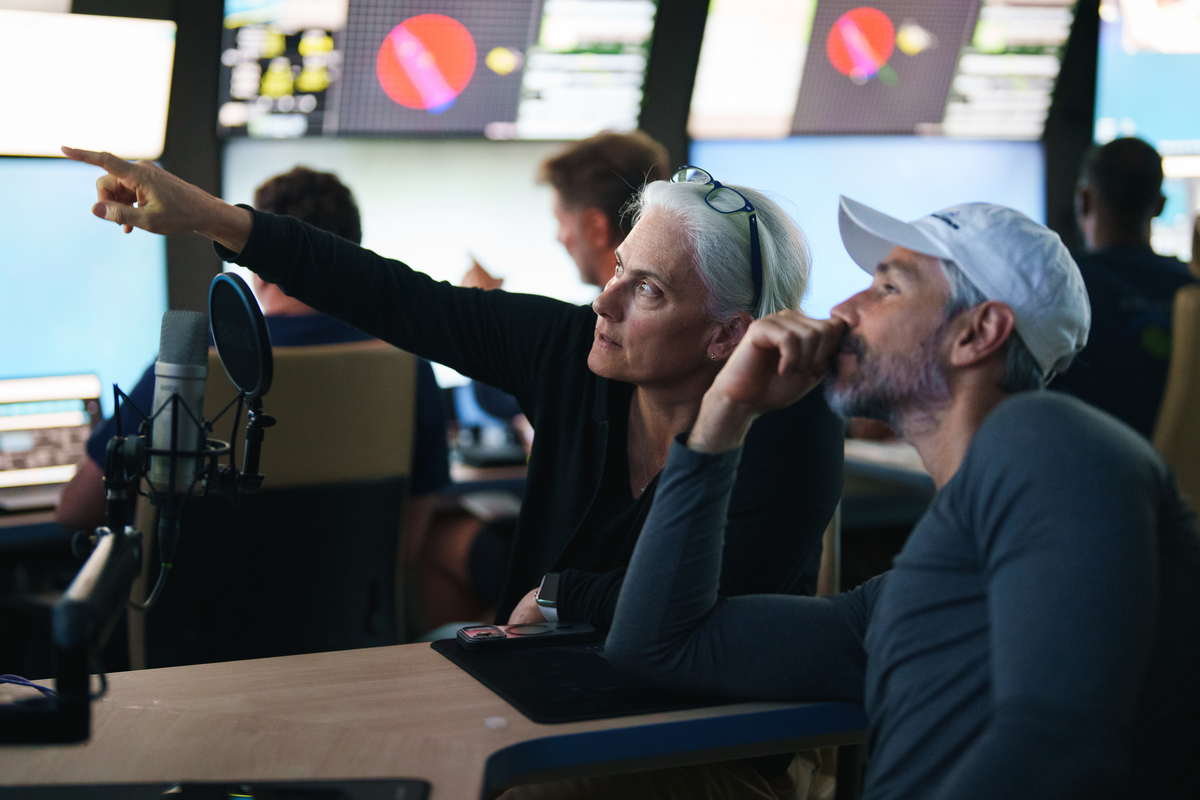
Alumni like Anitra Ingalls ’92 trace their path back to a single moment at Reed. Your gift helps create those moments for the next generation.