
Jack Snell-Ryan: Ohm Loop
April 28 - July 31, 2026
Jack Snell-Ryan
Ohm Loop
April 28-August 15, 2026
Caseworks, Reed College Library
Where to begin with a loop. The objects in Jack Ryan’s exhibition Ohm Loop derive from the formal vernacular of audio culture in an expanded sense of the term to include a range of phenomena from experimental digital music to audiophilic fetishization of equipment to sound trucks, mix tapes, and sonic assault.
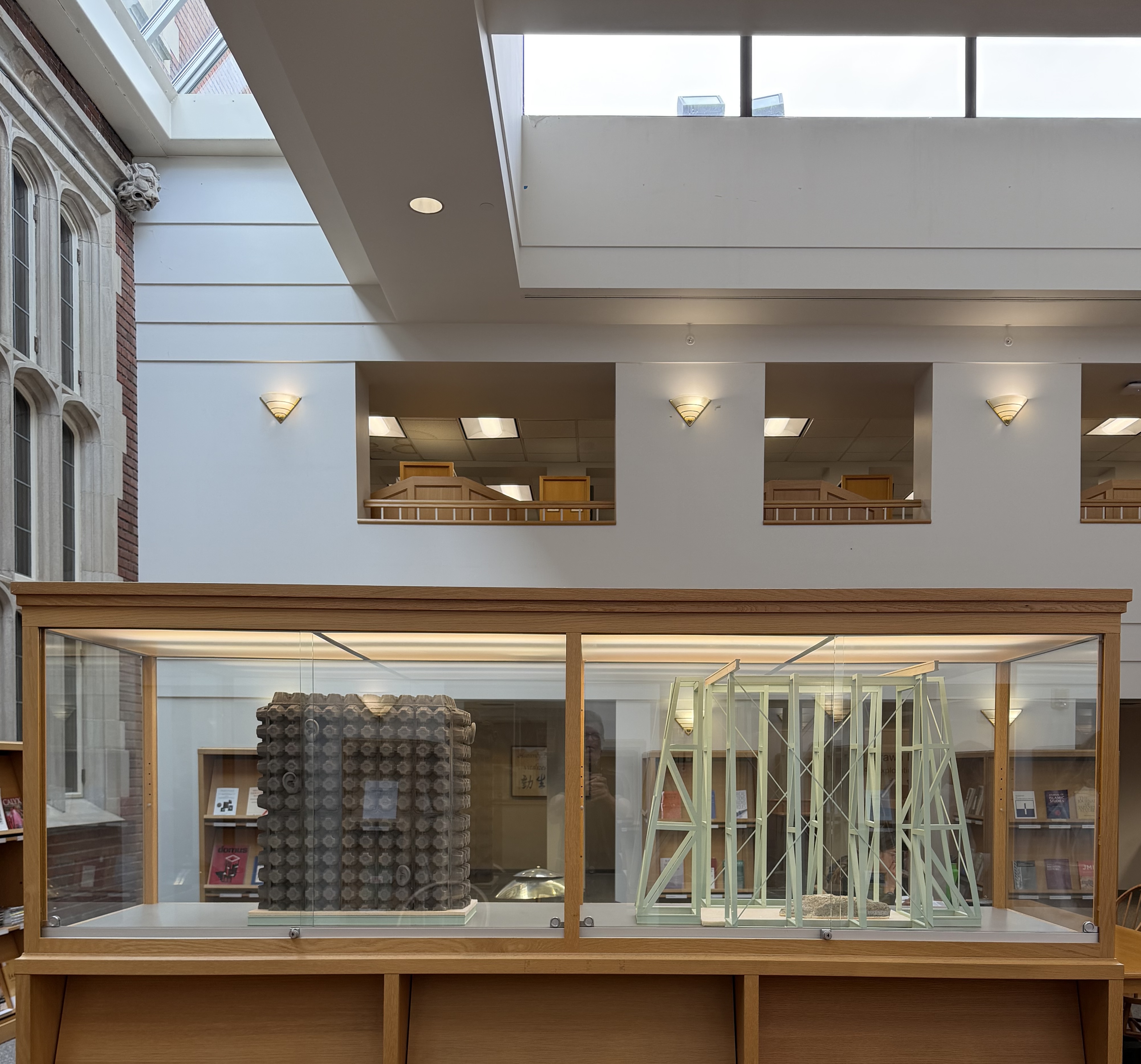
Ryan’s mute objects serve as representations of sound in specific historical and geographic instances such punk riffs in a jerry-rigged basement practice studio insulated with the poor-man’s sound-dampening technology of egg cartons and the sounds that produced the mysterious 2017 Havana Syndrome attacks around the US Embassy in Cuba. This tactic of a poetic formal conflation of historical objects with a relation to sound produce a work such as Embassy Tower (2023-2026).
Ryan’s cast concrete objects such as Shelf Speaker/Pencils (2023) that take the form of scaled down pieces of audio equipment are crafted with the specific recipe for the Roman concrete that had been lost for centuries. The loss of the recipe for this superior material is the story generally of technological innovations lost to history, putting the lie to the fantasy of linear historical progress in technology. (One might say that the persistence or return of vinyl/turntable culture And this loss echoes the loss of innovative social formations written out of history by dominant narratives.
The cast concrete, particularly as board-formed as in Door Stop (2024), invokes the Brutalist strain of Modernist architecture and landscape architecture. In Portland, this references important civic works like Lawrence Halprin’s 1970 Keller Forecourt Fountain. Look at the photo of opening day at Keller Fountain to see the validation of Modernism’s belief in the potential of public civic space—that is, the potential for social enjoyment and collectivity rather than the disciplinary space of much private “public” space today. Forecourt Fountain today is a shadow of Halprin’s vision, as Modernism generally is today the melancholic cultural register of modernity itself or the arrested and incomplete modernization that could provide for all, and generously.
There is also something in the capacity of casting as a technique for the production of multiples as in Mixtape (2024) that calls to mind both the rarity of the mixtape cassette I make as a gift just for you and ubiquity or the mass-produced object as two poles. Or the repetition of me playing that mixtape over and over again until the magnetic tape breaks. Or repetition generally, as tragedy, as farce, as history as made but not under self-selected circumstances, as the definition of madness: doing it over and over again the same way and expecting each time a different result. Or also and of course producing difference: the bubble in the cast object, the glitch in the smooth tape, the Brechtian Verfremdungseffekt.
Ryan embeds pencils in a number of his sculptures, possibly alluding to his studio habit of making a drawing, making a 3D object, then drawing the object in his own loop-the-loops. Let's read that pencil as not recording device but battery storing the potential of drawing, drafting, writing, or the potential for concretization of thought and imagination. This is a show then, about history, where the artist’s personal history or biography is overdetermined by History, which is, let’s be honest, everydayeverywhereallthetime. At the same time it is about about the possibility of writing, through action, a history whose outcome is not predetermined. This is the material grounding of the concrete utopian project.
Which requires building, but of what exactly is always the difficult question. The truss-like scaffolding or buttresses supporting nothing of Framed Void (with flagpoles) (2026) bracket off this what to focus on the how of the support structure itself.
Together we could say these works register possibility, the “what would be different” turned to stone by the forces of history. Thus the ohm in the title of the show as a measure of resistance metaphorically cuts both ways, as resistance to silence or inaction or capitulation on the one hand and as the knotty problem of resistance to transformation of social forms by the system such as it is.
Ohm Loop is organized by Ido Radon.
Jack Tuttle Snell-Ryan’s practice explores sound, trance, and contemporary culture through the conduits of sonic theory, sculpture, drawing, painting and other diverse medias. Currently a Professor of Art at the University of Oregon he has held positions at a number of universities including The School of Visual Arts in New York and UGA International Program (Cortona, Italy) among others. He studied at Hunter College (NY) and received his MFA from the University of Georgia (Athens). Ryan's work has been exhibited at The American University Museum (Washington, DC), Marylhurst Art Gym (Portland), The Hirshhorn Museum (Washington, DC), Brooks Museum (Memphis), Hunter Museum (Chattanooga), The Frist Center (Nashville), Consolidated Works (Seattle), MICA (Baltimore), The Palace of Fine Arts-Ministry of Culture (Cairo, Egypt), Dublin Electronics Arts Festival (Ireland), Ausstellungsraum Klingental (Basel, Switzerland), The Phillips Collection (Washington, DC), University of California (San Diego), Newark Museum (New Jersey), Maison Laurentine (France), Syracuse University, and The Banff Center (Canada). His research has been supported by the Oregon Arts Commission, the Ford Family Foundation, Djerassi Resident Artist Program, Marylhurst University Art Production and Publication Fund, The Precipice Grant in partnership with Andy Warhol Foundation for the Visual Arts and The Calligram Foundation, and The Banff Centre. He has been the recipient of academic research funding from Watkins College of Art, Bowling Green State University, Sewanee University, as well as from the University of Oregon for creative and faculty research. In 2015 he was awarded the Hallie Ford Fellowship.