Research
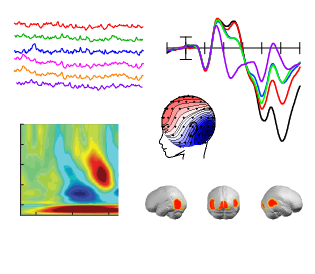 Our lab explores a wide range of topics from a cognitive neuroscience perspective, including sensory and perceptual processing, multi-sensory interactions, speech perception, language production and comprehension, selective attention, and consciousness. Our primary technique is electro-encephalography (EEG), from which we derive event-related potentials (ERPs) and oscillatory dynamics in time-frequency space, and perform multivariate pattern analyses (EEG "decoding") using machine learning. We also employ behavioral psychophysics, eye-tracking, and neuropsychological assessments, and maintain collaborations with labs at other institutions to run our experiments with functional magnetic resonance imaging (fMRI), magetoencephalography (MEG), and intracranial EEG (iEEG).
The EEG technique allows us to measure electrical signals from populations of neurons in real-time, non-invasively, in the animal species that is of most interest to psychologists and neuroscientists… us! ERPs, event-related spectra, and multivariate decoding can be used as tools to address general questions in psychology and neuroscience and when combined with other techniques, such as fMRI, MEG, iEEG, TMS, and single-cell recordings, can provide converging evidence to further our understanding of how the brain enables perception, thought, and action.
Faculty

Michael Pitts, Professor of Psychology [mpitts@reed.edu]
The general question that motivates my research is, “what is the neural basis of consciousness?” To address this question, I have adopted an approach taken by others in the field in which we simplify the problem as much as possible by looking first for neural correlates of conscious perception. The question then becomes, “what neural processes are necessary and sufficient for a specific conscious percept?”, e.g. seeing the color red or hearing a particular piano note. The primary strategy I use is to compare brain activity elicited by the same physical stimulus when it is perceived versus not-perceived, or perceived as X versus Y. A current challenge is to develop experimental paradigms in which these contrasts can distinguish neural correlates of conscious perception from pre-conscious and post-perceptual activity. Thus, my research also involves the study of low-level sensory processing, as well as higher-level functions such as attention, expectation, memory, and response selection. Outside of the lab, I enjoy running, hiking, surfing and especially snowboarding, and making sourdough pizzas and breads.
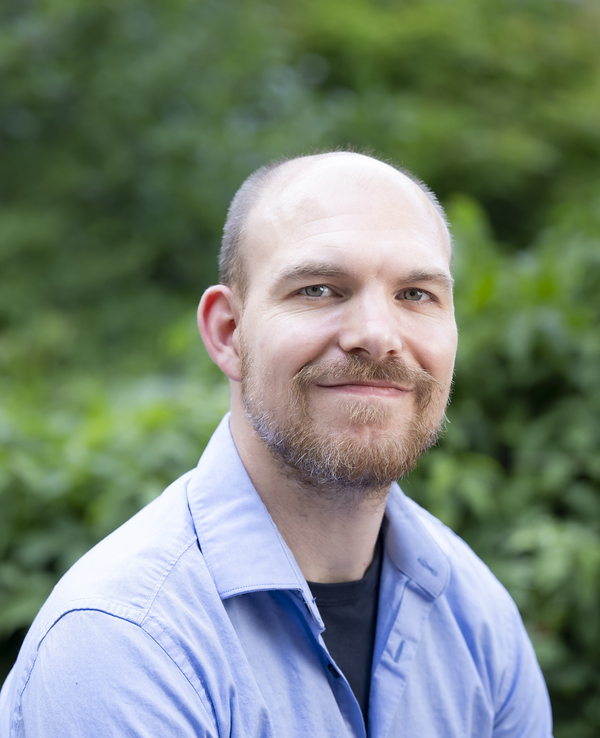 Alexander Schielke, Visiting Assistant Professor of Psychology [aschielke@reed.edu]
My work focuses on techniques of noninvasive neuromodulation, specifically repetitive visual stimulation. Changing brain function with repetitive visual stimulation (RVS) has great appeal, in particular due to the low-cost profile and the ability to use it in at-home settings. However, there are multiple challenges to realizing the potential of this method. The first challenge is to determine its effectiveness across domains, since sensory stimulation is unlikely to benefit every aspect of brain function. To identify use cases, I use various perceptual and cognitive tasks to measure, for example, thresholds in luminance and contrast perception, processing speed and attention. The second challenge is determining the time course of changes in task performance and brain function (i.e., how long does the effect last). The third challenge is identifying the best (individual) stimulation parameters (e.g., frequency and stimulation duration). To address this last question, one way is to use multiple fixed conditions. A more efficient way is using a closed-loop design where an individual’s brain response to the stimulation is used to change stimulation parameters iteratively. To accomplish these goals, my primary research tool, in addition to behavioral assessments, is electroencephalography. Together, this approach allows me to better understand how RVS works and can be improved with the goal of improving brain function in healthy as well as clinical populations.
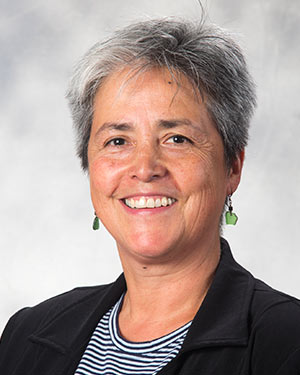
Enriqueta Canseco-Gonzalez, Emeritus Professor of Psychology [ecanseco@reed.edu]
My research focuses on language processing and its interaction with cognition in both monolingual and bilingual speakers. Within this general area, I have focused on four specific lines of research; First, I have investigated whether language-specific features influence non-linguistic categories (i.e. the Whorfian hypothesis). Second, in a study of mental chronometry of word reading in bilinguals, I have been investigating the timeline of access to various levels of linguistic information (e.g. phonology, semantic, etc.). Third, I am examining when and where our brain distinguishes between speech and non-speech sounds. Finally, I have recently begun exploring the neural basis of cross-modal plasticity using a sensory substitution paradigm. In all of these projects I take advantage of the high temporal resolution of the ERP technique and in some cases combine these measures with eye-tracking, neuropsychological assessments, and/or behavioral data. I retired in 2023 after teaching at Reed for 31 years, but I am continuing my collaborations with Professor Holmes in the Thought Lab and with Professor Pitts in the SCALP Lab. Outside of the lab, I enjoy playing tennis, kayaking, and hiking, and I'm considering starting a second career as an interpreter.