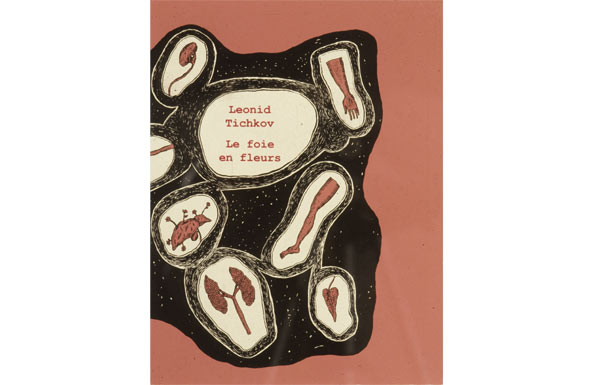
Le foie en fleurs (Liver in Bloom)
Library Information & Colophon
|
Title |
Le foie en fleurs |
|---|---|
| Library Call # |
N7433.4.T613 .F65 1994 View Reed library catalog record |
| Description |
[16] p. : col. ill. ; 32 cm. |
|
Notes/Colophon |
Imprimé en sérigraphie par Alain Buyse en mars 1994 à Lille"--P. [4] of cover. Edition limited to 300 copies. |
| colophon |
Le foie en fleurs (trans. Liver in Bloom) Leonid Tishkov, Moscow: Dabloid Press, engraving and printed text. |
Biography
Leonid Tishkov
(1953-)
Russian
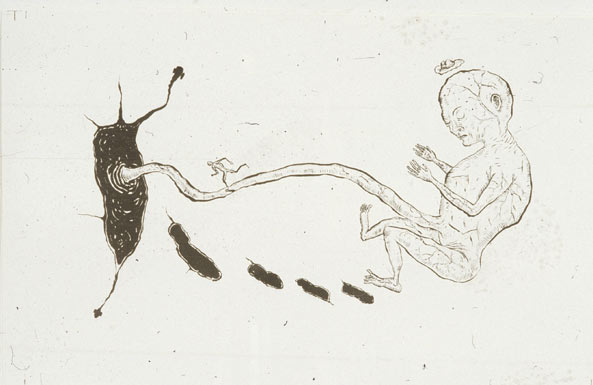
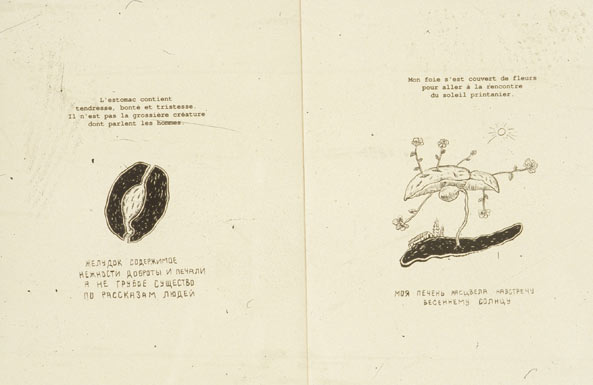
Leonid Tishkov emerged as an artist in Moscow in the 1980s after a career as a medical doctor. He developed his exotic surrealist drawings as a medical student while studying human anatomy. These humorous and strange caricatures of the body's organs make up the book Liver in Bloom included in the exhibition. This book begins with an image and poem about the head:
My senseless head
Repository of brain tongue and eyes
Hanger of ears and nose
Poor head that's all you're good for
You aren't worthy of lips.1
This poem renders the head as a vessel that carries the senses, yet as a whole it is completely sense-less. The inability of the head to use language to speak references the tradition of the wise fool figure found in Eastern European literature. In this work parts of human anatomy exist independently from the body and are viewed as signs of human existence. They lend themselves to literary or psychoanalytic analysis. Indeed, Tishkov admits that his art, in all its dimensions and forms, is an exercise in psychoanalysis.2
Tishkov's art is ultimately a story of his own introverted childhood, when he found the microscopic world of insects much more fascinating than that of human beings. He was born and raised in the Ural mountains in Russia, and the strong local tradition of myth and folk tales permeated his existence. The images and poems that tell the story of the strange characters in his books are directly related to traditional Russian wandering minstrel songs and folk tales.
Since childhood, drawing has been a matter of survival and communication for Tishkov. Living in the atmosphere of stagnation that penetrated all aspects of life in the Soviet Union, he found self-realization in art. While practicing medicine in Moscow, Tishkov began to develop his imagery of paradoxical characters full of black humor, which enabled him to survive his intensely stressful life. His drawings evolved into a personal mythology in which the body's organs became caricatures. The recurring themes of his myths are based on the perpetual biological motion of sex, birth, and digestion. Perhaps the most important character that is featured in all of Tishkov's creations is the Dablus, or the breast/phallus form which symbolizes the androgynous being. It is a hypothetical character that achieved perfection by unifying the female and the male principle. The Dablus gives birth to the Dabloid, a foot character that wanders through all of his works. This bizarre character-a foot with splayed toes crowned with a tiny head-is an image constructed on the opposition of the upper and lower extremities of the body. Analogies for these oppositions are found in Russian folklore: "Because of a stupid head, the feet get no peace."3 The Dablus and Dabloids are mystical creatures, they are pets and gods, both wise and foolish.4 They are surreal manifestations of the artistic consciousness as well as symbols of our isolation.
Tishkov's roots in surrealism are charged with humorous social commentary often reminiscent of the works of Hogarth and later art by Red Grooms and Robert Crumb.5 However, more important influences are the Russian Futurists, particularly Aleksei Kruchenykh's Zaum poetry of invented words and illogical combinations of sound used as raw verbal material.6 Tishkov’s writing is also indebted to the mythopoetic experiments of the Oberiu group of writers that includes Kharrns, Oleinikov, and Vvedensky.7 In reading texts by these writers, we are engaged in a flow of nonsense, a dissection of logic and structure. Similarly, Tishkov's narratives give birth to absurd visual and verbal symbols.
Characteristic of Tishkov's work is his ability to combine the fantastic and the banal into a thick and inseparable mixture. Ultimately his work is a form of palimpsest. One level constantly shines through another, through abstract patterns figurative printing is seen, through the arabesques of the handwriting the sense of the text appears; the sharpness fluctuates, the image at one moment is unclear, then is brought sharply into focus. These works are hard to understand, but they constantly provoke increased attention. Tishkov’s works lend themselves to dual interpretations. "His illustrations may appear as both foolish and wise, his writings as vulgar and lyrical, his world view as childish and serious."8
– This text excerpted from the Samizdat exhibition at the Douglas F. Cooley Memorial Art Gallery in Portland, Oregon, from February 6-March 16, 1997.
Footnotes
1 Leonid Tishkov, Liver in Bloom (Moscow: Dabloid Press, 1994), 3. Translated by Lena Lencek.
2 Ljiljana Grubišič, "Tradition and Innovation in the Works of Leonid Tishkov" in Leonid Tishkov Creatures (Durham: Duke University Press, 1993), 21. See also Leonid Tishkov, Ne tol'ko dabloidy. Izbrannye besedy, illiustrirovannye avtorom (Moscow: IMA-Press, 1992).
3Ludmila Lunina, "The Mythology of Leonid Tishkov: Sources, Heroes, Actions, Traditions," in Tishkov (1993), 15.
4See Leonid Tishkov, Father Mother, Dabloid Press, Moscow, 1994.
5 Michael P. Mezzatesta, "Foreword," in Tishkov (1993), 6.
6"Zaum literally means 'beyond mind'," Lunina, 27 n. 15.
7See Kharrns poetry as used by Oleg Dergatchov in Daniil Ivanovich Kharms-Poems, Do Press. Lvov, 1993. See translation in Appendix.
8Lunina, 27.
Exhibitions
Selected solo exhibitions |
|
|
1993 |
Leonid Tishkov Creatures, Duke University Museum of Art, Durham, North Carolina |
|
1992 |
Not Only Dabloids, Aryans Gallery, Moscow, Russia Soft and Hard, Velta Gallery, Moscow, Russia |
Selected group exhibitions |
|
| 1997 |
Samizdat Artist Book Exhibition, Douglas F. Cooley Memorial Art Gallery, Portland, Oregon |
|
1993 |
A Time of Transition, City Museum and Art Gallery, Bristol, England; Ferens Art Gallery, Hull, England |
|
1992 |
International Exhibition of Visual Poetry, Pankow Gallery, Berlin, Germany Communication, Ex Libris Museum, Moscow, Russia Paper Theatre, Anna Akhmatova Museum, St. Petersburg, Russia Exhibition in Lyric-Cabinette, Munich, Germany |
|
1991 |
International Moscow Art Fair ART-MIF-2, Manege, Moscow, Russia Dablus Publishers, XI International Book Salon, Paris, France Agasphere, Moscow Youth Palace, Moscow, Russia Furmanny Artists, Martigni, Switzerland |
|
1990 |
Graphomania, Exhibition in the cycle Graphic Seasons, 25 Tverskaya St., Moscow, Russia Trio, Central House of Artists, Moscow, Russia Transfuture, International Exhibition of VIsual Poetry, Kassel, Hauptman-schule, Germany Concrete, International Exhibition of Visual Poetry, City Museum of Gotha, Germany Six Contemporary Soviet Artists, Mona Bismarck Fund, Paris, France Contemporary Soviet Art, the Moscow Palette Association, Melbourne, Australia |
|
1989 |
Furmanny Lane, Warsaw, Poland International Book Design Exhibition, Leipzig, Germany |
|
1988 |
Biennale Book Illustration, Brno, Czechoslovakia |
|
1986 |
XVII Exhibition of Young Moscow Artists, Kuznetsky Bridge, Moscow, Russia |
|
1985 |
XVI Exhibition of Young Moscow Artists, Kuznetsky Bridge, Moscow, Russia |