Self Portrait in a Convex Mirror
Library Information and Colophon
|
Title |
Self-Portrait in a Convex Mirror View record in Reed Digital Collections |
|---|---|
|
Publication |
San Francisco: Arion Press, 1984 |
|
Library Call # |
PS3501 .S475 S44 1984 View Reed library catalog record |
|
Description |
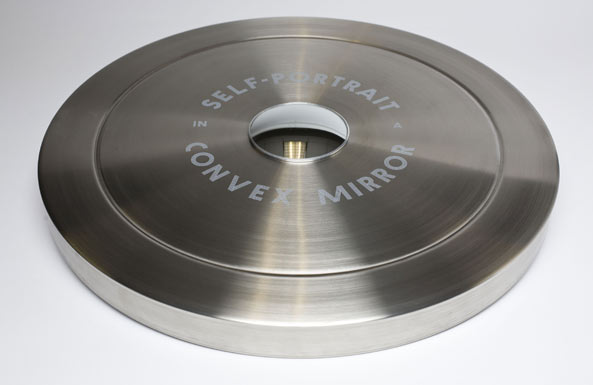
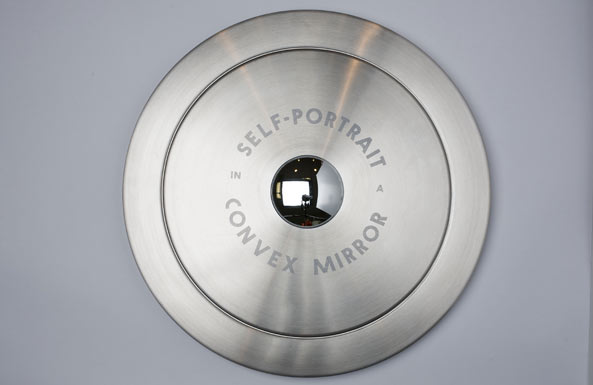
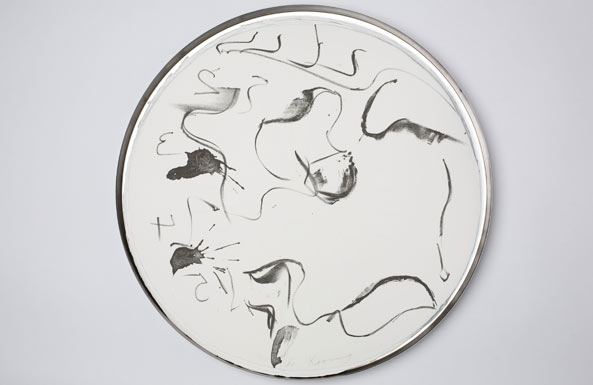
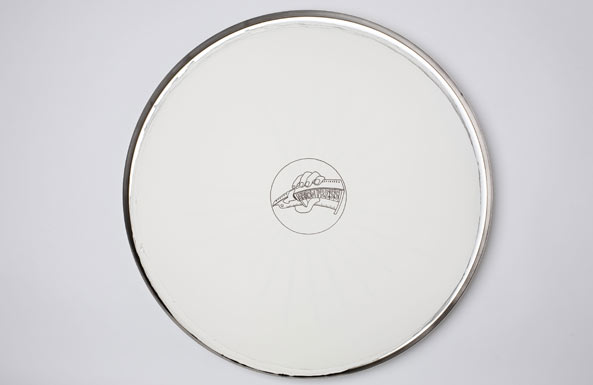
1 canister ([3], 27 sheets, [8] sheets of plates, 1 sound disc): ill. (1 col.), ports.; 49 cm. in diameter x 4 cm. high. |
|
Colophon/Notes |
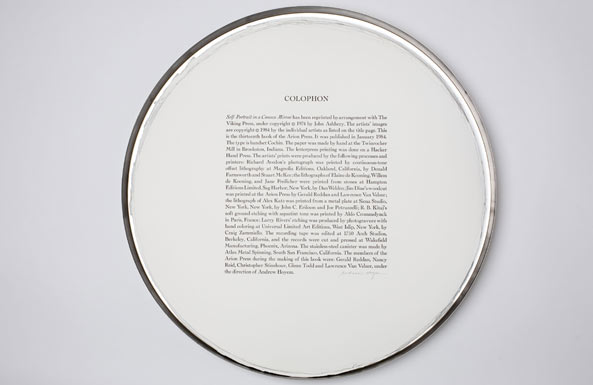
"An edition limited to 150 copies for sale, plus 25 copies hors de commerce"--Prelim. sheet [1]. |
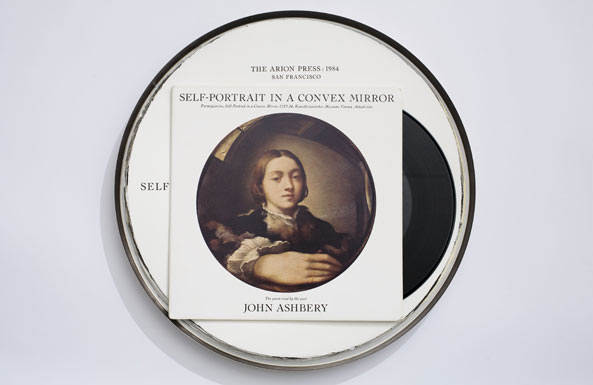
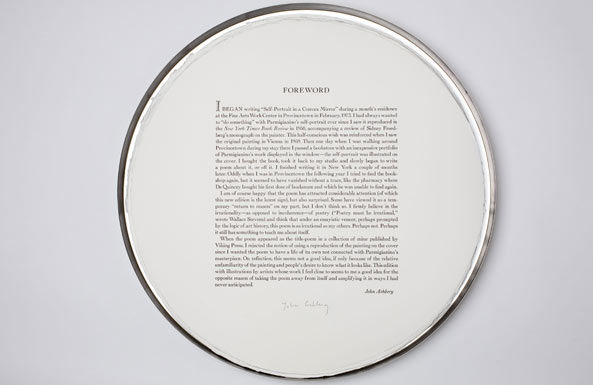
Includes a new foreword to the poem by the poet, an essay on the poem by Helen Vendler printed as liner notes on the jacket of a record album of the poet reading the poem, whose cover has a full-scale color reproduction of the sixteenth-century painting by Parmigianino, "Self-Portrait in a Convex Mirror."
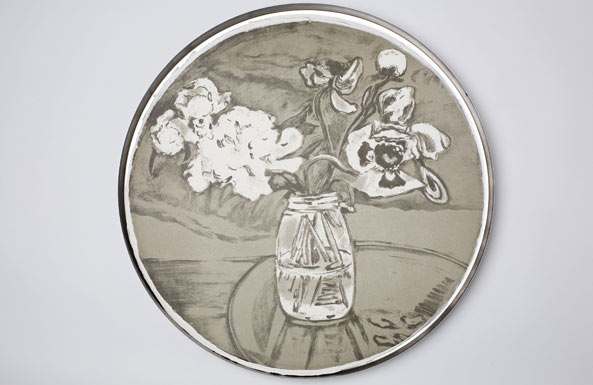
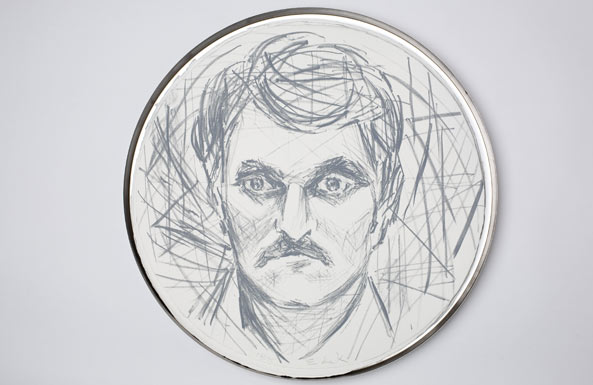
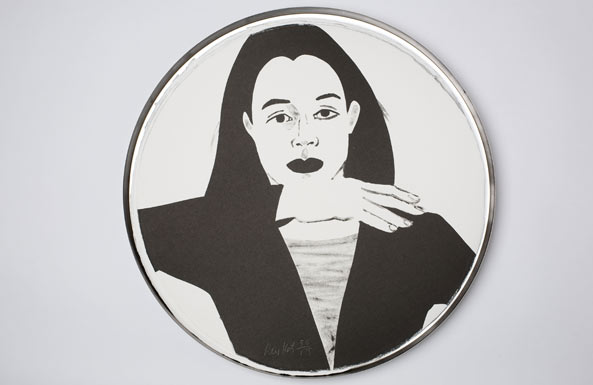
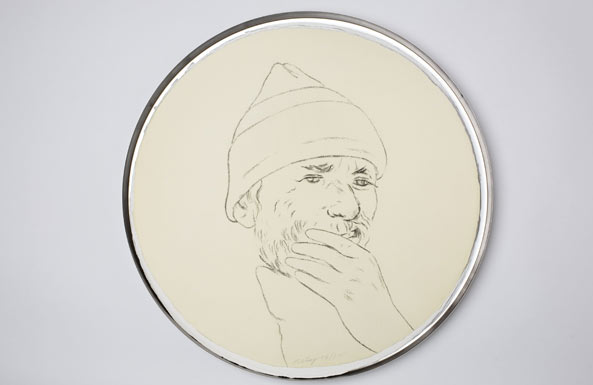
Original prints by:
Willem de Kooning, stone lithography
Jane Freilicher, stone lithography
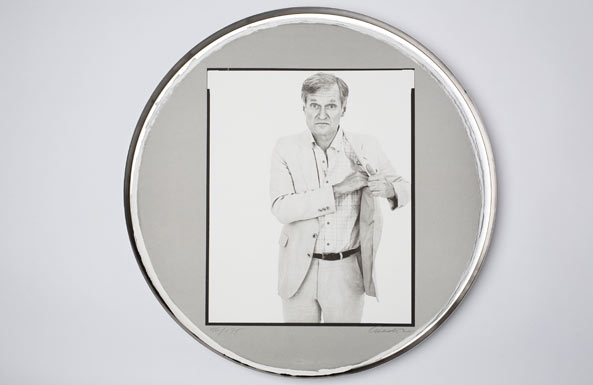
Richard Avedon, continuous tone offset lithography
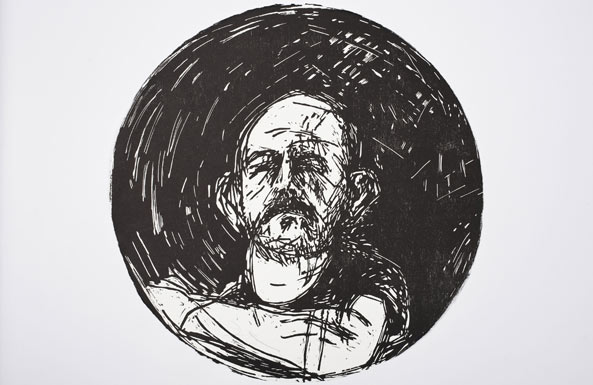
Jim Dine, woodcut
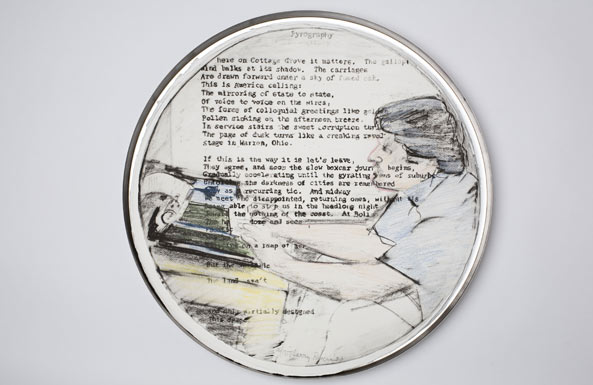
Larry Rivers, photogravure etching with hand coloring
Alex Katz, metal plate lithography
Elaine de Kooning, stone lithography
R. B. Kitaj, soft ground etching with aquatint tone
Stainless steel canister by:
Atlas Metal Spinning, San Francisco, California
Handmade paper by:
Twinrocker Mill, Brookston, Indiana.
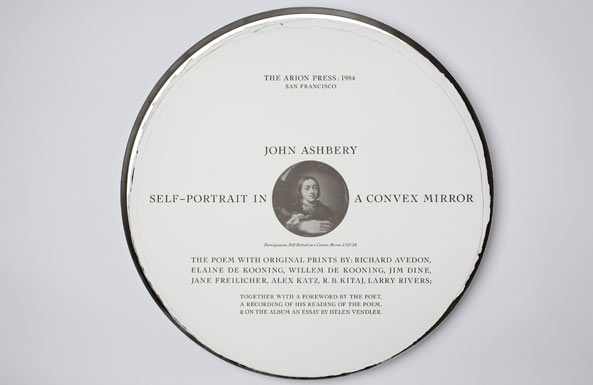
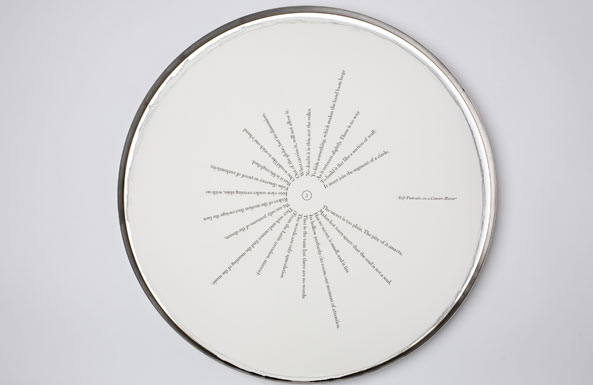
This most famous poem of one of America's most revered contemporary poets was set in this unusual manner by the typographer as a tribute to Ashbery that could be joined in by his artist-friends whose prints would be united by a circular format. The invited eight created images that respond to the poem and the self-portrait by Parmigianino that inspired Ashbery.
Format:
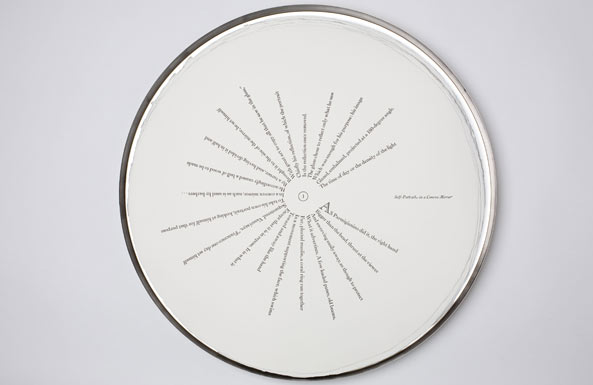
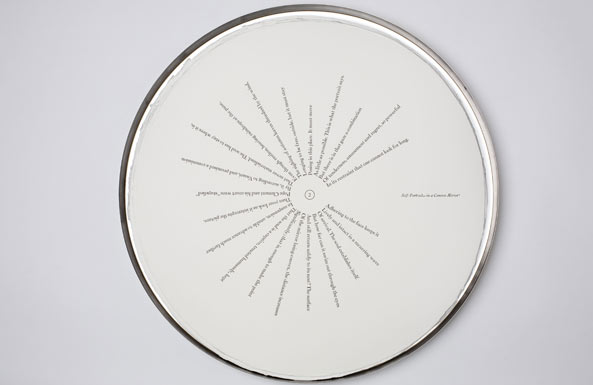
18-inch diameter, 40 leaves. The text is handset in Cochin in lines that radiate as spokes from a hub holding the page number, so that the pages literally must be turned to be read. The prints are in various mediums, including lithography, etching, and woodcut. The paper was specially made in rounds at the Twinrocker Mill in Indiana. Contained in a stainless steel canister with a convex mirror on the lid.
Self-Portrait in a Convex Mirror View website
By John Ashbery
As Parmagianino did it, the right hand
Bigger than the head, thrust at the viewer
And swerving easily away, as though to protect
What it advertises. A few leaded panes, old beams,
Fur, pleated muslin, a coral ring run together
In a movement supporting the face, which swims
Toward and away like the hand
Except that it is in repose. It is what is
Sequestered. Vasari says, "Francesco one day set himself
To take his own portrait, looking at himself for that purpose
In a convex mirror, such as is used by barbers . . .
He accordingly caused a ball of wood to be made
By a turner, and having divided it in half and
Brought it to the size of the mirror, he set himself
With great art to copy all that he saw in the glass,"
Chiefly his reflection, of which the portrait
Is the reflection once removed.
The glass chose to reflect only what he saw
Which was enough for his purpose: his image
Glazed, embalmed, projected at a 180-degree angle.
The time of day or the density of the light
Adhering to the face keep it
Lively and intact in a recurring wave
Of arrival. The soul establishes itself.
But how far can it swim out through the eyes
And still return safely to its nest? The surface
Of the mirror being convex, the distance increases
Significantly; that is, enough to make the point
That the soul is a captive, treated humanely, kept
In suspension, unable to advance much farther
Than your look as it intercepts the picture.
Pope Clement and his court were "stupefied"
By it, according to Vasari, and promised a commission
That never materialized. The soul has to stay where it is,
Even though restless, hearing raindrops on the pane,
The sighing of autumn leaves thrashed by the wind,
Longing to be free, outside, but it must stay
Posing in this place. It must move
As little as possible. This is what the portrait says.
But there is in that gaze a combination
Of tenderness, amusement and regret, so powerful
In its restraint that one cannot look for long.
The secret is too plain. The pity of it smarts,
Makes hot tears spurt: that the soul is not a soul,
Has no secret, is small, and it fits
Its hollow perfectly: its room, our moment of attention.
That is the tune but there are no words.
The words are only speculation
(From the Latin speculum, mirror):
They seek and cannot find the meaning of the music.
We see only postures of the dream,
Riders of the motion that swings the face
Into view under evening skies, with no
False disarray as proof of authenticity.
But it is life englobed.
One would like to stick one's hand
Out of the globe, but its dimension,
What carries it, will not allow it.
No doubt it is this, not the reflex
To hide something, which makes the hand loom large
As it retreats slightly. There is no way
To build it flat like a section of a wall:
It must join the segment of a circle,
Roving back to the body of which it seems
So unlikely a part, to fence in and shore up the face
On which the effort of this condition reads
Like a pinpoint of a smile, a spark
Or star one is not sure of having seen
As darkness resumes. A perverse light whose
Imperative of subtlety dooms in advance its
Conceit to light up: unimportant but meant.
Francesco, your hand is big enough
To wreck the sphere, and too big,
One would think, to weave delicate meshes
That only argue its further detention.
(Big, but not coarse, merely on another scale,
Like a dozing whale upon the sea bottom
In relation to the tiny, self-important ship
On the surface.) But your eyes proclaim
That everything is surface. The surface is what's there
And nothing can exist except what's there.
There are no recesses in the room, only alcoves,
And the window doesn't matter much, or that
Sliver of window or mirror on the right, even
As a gauge of the weather, which in French is
Le temps, the word for time, and which
Follows a course wherein changes are merely
Features of the whole. The whole is stable within
Instability, a globe like ours, resting
On a pedestal of vacuum, a ping-pong ball
Secure on its jet of water.
And just as there are no words for the surface, that is,
No words to say what it really is, that it is not
Superficial but a visible core, then there is
No way out of the problem of pathos vs. experience.
You will stay on, restive, serene in
Your gesture which is neither embrace nor warning
But which holds something of both in pure
Affirmation that doesn't affirm anything.
Biography
John Ashbery
(1927- )
American
John Ashbery has been considered a poet of the New York avant-garde since the release of his collection of poems Self-Portrait in a Convex Mirror in 1975. The book in our collection is a deluxe special edition print done by Arion Press of the title poem from that book, and is accompanied by prints from eight artists in tribute to Ashbery.
John Ashbery was born in Rochester, New York in 1927. He received a BA from Harvard in 1949, writing his undergraduate thesis on W.H. Auden, and a MA from Columbia University in 1951, writing his graduate thesis on Henry Green 1. Ashbery went to France as a Fulbright Scholar in 1955 and lived there until 1965 serving as the art editor for the European edition of the New York Herald Tribune. Returning to the United States in 1968, he continued his career as an art critic for New York and Newsweek magazines, while also serving on the editorial board of ARTNews until 1972 2.
It was not until the release of the collections of poems Self-Portrait in a Convex Mirror in 1975, which included a poem of the same title, that Ashbery received any substantial critical consideration 3. In that year the poet received all three major American poetry prizes, the Pulitzer Prize, the National Book Award, and the National Book Critics Circle Award for the collection Self-Portrait in a Convex Mirror 4. With this sudden new fame Ashbery was thrust “abruptly from the half-light of cult status into the limelight of official recognition 5,” to be accepted as a seminal American avant-garde poet.
The origin of the title poem is the 16th century painting by Francesco Parmigianino: "Self-Portrait in a Convex Mirror." In the painting, which is reproduced on the front of the record album jacket within the book, the artist paints himself from a reflection in a convex mirror, which enlarges everything near to it while diminishing what is distant 6. Ashbery describes this use of perspective in opening lines of the poem:
As Parmigianino did it, the right hand
Bigger than the head, thrust at the viewer
And swerving easily away, as though to protect
What it advertises.
“From Ashbery’s point of view, then, Paramigianino’s ‘Self-Portrait in a Convex Mirror’ is both an immaculate instance of art telling the history of its own coming into being and a radical manifestation of the self-absorbed artist 7.”
It comes as no surprise that Ashbery is drawn to such subject matter given the poet’s ongoing involvement with the arts. Ashbery himself claims, "I have perhaps been more influenced by modern painting and music than by poetry 8." The special edition of Self-Portrait in a Convex Mirror is tribute to this, as the artists contributing to the project are all well known in their own field, and all personal friends of Ashbery’s. He himself takes on the qualities of his abstract expressionist friends as he seemingly attempts to write the poetry equivalent of nonobjective painting.
“How, then, does a poet emulate the abstraction that characterizes modern painting? Critic Leslie Wolf suggests of Ashbery, “To reach this state of freedom in a verbal art, the poet must use the signifying quality of his medium against itself…the poet must arrange ‘brushstrokes’ of his tableau in such a way that they yield contradictory clues 9.” As a poet Ashbery is well known for the confusing and fragmented form of his poetry, which is often difficult to interpret with traditional poetry analysis. However, though the sentences of the poem are nonsensical, they are not gibberish. “Ashbery is greatly aided by a dexterity with syntax that allows him to craft serpentine sentences which evoke emotion and attitude even when they shun meaning 10.” He thus achieves the abstract expressionist quality of emotional intensity lacking conscious signification.
The book Self-Portrait in a Convex Mirror in Reed’s Special Collections is a special edition in which the poem is accompanied by eight art prints by friends of the poet and a record of Ashbery reading the poem, all enclosed in a round steel canister. The book was designed by a team at Arion Press, a publisher that specializes in limited edition books with original artwork aimed at wealthy collectors. The book, like many of their publications, is printed with handset type on handmade paper, and, combined with the original art work, it is an example of a contemporary livres d'artistes. Ashbery also contributed poetry to another deluxe book printed by Arion called The Temple of Flora, which is a folio of botanical prints by Jim Dine accompanied by work from 25 major poets.
Footnotes
1 John Shoptaw. On the Outside Looking Out: John Ashbery’s Poetry. Cambridge, Mass.: Harvard University Press, 1994; 3.
2 “Ashbery, Parmigianino, and the Convex Mirror.” The Academy of American Poets. Web. 6 October 2008. View website
3 David Herd. John Ashbery and American Poetry. New York: Palgrave, 2000; 4
4 “A Narrative Biography of John Ashbery.” Ashbery Resource Center. Web. 8 August 2008. View website
5 Herd. 4.
6 Poets.org. The Academy of American Poets. Web. 6 October 2008. View website
7 Herd. 163.
8 “Ashbery, Parmigianino, and the Convex Mirror.” Poets.org. The Academy of American Poets. Web. 6 October 2008.View website
9 Ibid.
10 Ibid.
References and Links
“A Narrative Biography of John Ashbery.” Ashbery Resource Center. Web. 8 August 2008. View website
Arion Press: Limited Edition Books with Original Art. Web. 16 October 2008. View website
Ashbery, John. Self-Portrait in a Convex Mirror: Poems. New York: Viking Press, 1975.
“Ashbery, Parmigianino, and the Convex Mirror.” Poets.org. The Academy of American Poets. Web. 6 October 2008. View website
Herd, David. John Ashbery and American Poetry. New York: Palgrave, 2000.
Lehman, David, Ed. Beyond Amazement: New Essays on John Ashbery. Ithica, New York: Cornell University Press, 1980.
Shapiro, David. John Ashbery, An Introduction to the Poetry. New York: Columbia University Press, 1979.
Shetley, Vernon Lionel. After The Death of Poetry: Poet and Audience in Contemporary America. Durham: Duke University Press, 1993.
Shoptaw, John. On The Outside Looking Out: John Ashbery’s Poetry. Cambridge, Massachusetts: Harvard University Press, 1994.